18-year study reveals underappreciated pediatric kickball injury burden
Kickball still gets treated like recess with a scoreboard, but the injury record says otherwise. An 18-year pediatric study in the Orthopaedic Journal of Sports Medicine found that the game sent an average of 10,644 children to U.S. emergency departments each year, with fractures, lacerations, and sprains showing up far too often for anyone to call it harmless.
What the 18-year study actually measured
The paper, titled “Kickball and Its Underappreciated Pediatric Injury Burden: An 18-Year Retrospective Epidemiological Study,” was built by Kevin Pirruccio, Daniel Weltsch, and Keith D. Baldwin. Retrospective means the researchers looked back through existing records instead of running a new experiment, and epidemiological means they were tracking injury patterns across a population, not collecting a handful of dramatic stories.
That matters because an 18-year window is long enough to smooth out one weird season or one especially rough gym class. It captures the steady, repeatable injury footprint of a sport that many adults still file under “low risk” by default.
The injury mix is more serious than the playground reputation
The clearest number in the study is the annual burden: 10,644 pediatric kickball-associated injuries, with a 95% confidence interval of 8,671 to 12,618. That is not a microscopic blip, and the range still lands in five figures, which tells you the game is producing a real stream of emergency-department visits year after year.
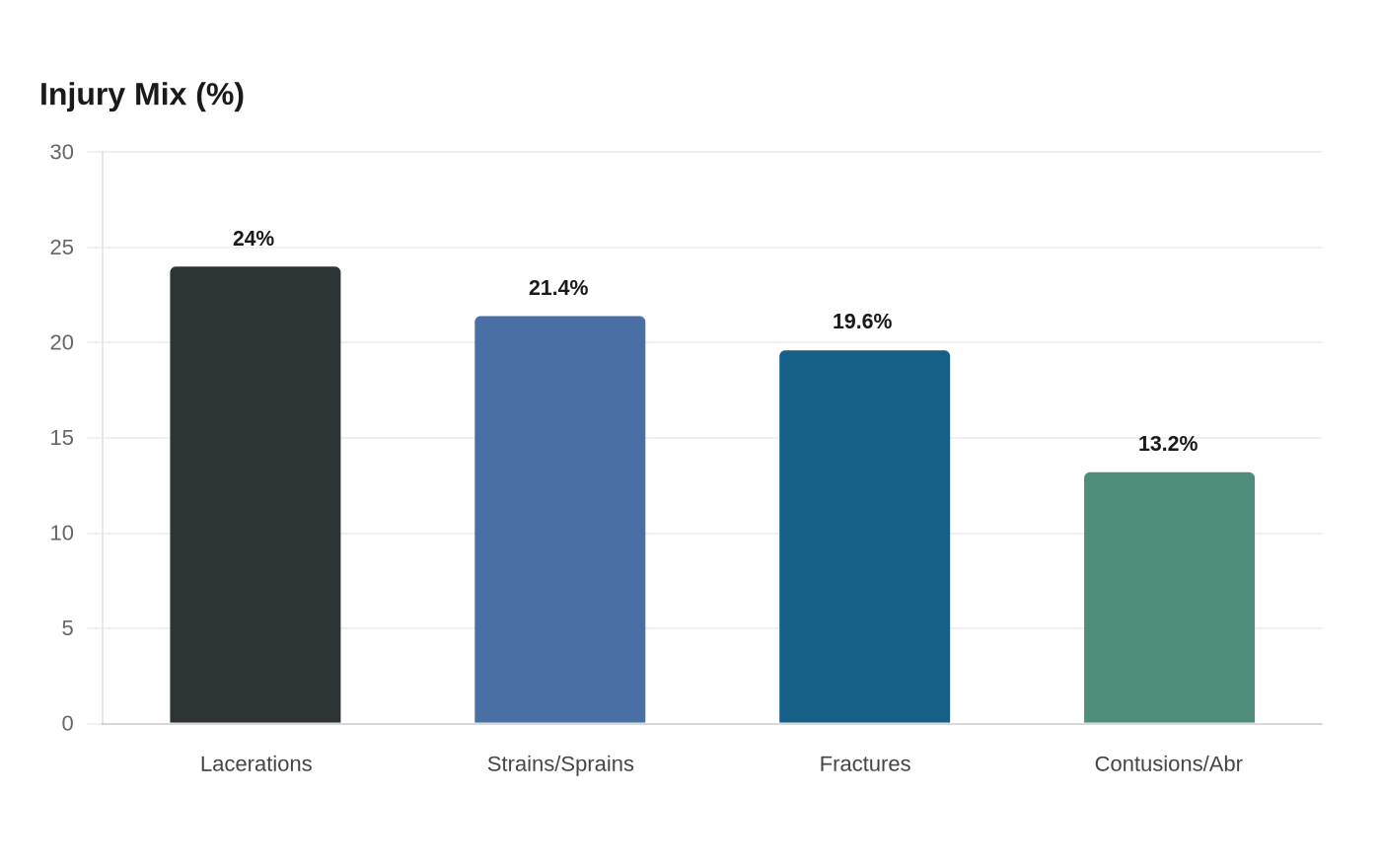
The indexed summary of the study lists lacerations at 24.0%, strains or sprains at 21.4%, fractures at 19.6%, and contusions or abrasions at 13.2%. Another related indexed summary places fractures at 24.8%, which only reinforces the same point: broken bones are not some fringe outcome here. The injury profile looks much more like a legitimate running-and-cutting sport than a harmless schoolyard diversion.
Why the game hurts the way it does
Later orthopedic coverage helps explain the mechanics. A 2025 foot-and-ankle article on kickball injuries ties the game’s fast stops and sudden turns to ankle-sprain risk, and it notes that awkward landings can lead to toe fractures. That fits the study’s mix of sprains, fractures, and abrasions: kickball injuries are not just about contact, they come from the movement pattern itself.
The game also has enough force behind it to cause worse damage than the average parent expects. A 2023 case report described an intramuscular degloving injury of the rectus femoris from kickball, a reminder that the injury list does not stop at cuts and bruises. Once the quadriceps are involved, the conversation shifts from “kids will be kids” to real orthopedic trauma.
Why public-health surveillance treats this as a real issue
Kickball belongs in the same injury-prevention conversation as other youth sports because the public-health system already tracks sports and recreation injuries as a category. The Centers for Disease Control and Prevention’s HEADS UP data page reflects that broader framework, where games are evaluated by injury patterns, not by reputation. University of Alabama at Birmingham coverage of youth sports injury rates points in the same direction: the question is not whether kids get hurt, but how often, how badly, and in what situations.
That is why the kickball paper lands so well. It takes a game that sounds casual and places it inside a familiar safety problem, one that schools, leagues, and families already manage in soccer, basketball, and baseball.
What PE teachers, league organizers, and parents should change
The injury mix points to three practical moves, and none of them require turning kickball into a joyless drill.
• PE teachers: Treat kickball like a running-and-cutting sport, because the numbers say it behaves like one. With lacerations at 24.0%, strains or sprains at 21.4%, and fractures around one-fifth to one-quarter of cases depending on the indexed summary, supervision should focus on hard stops, base approach, and safe movement, not just whether the class is having fun.
• Youth league organizers: Build the game around field conditions and control. The study’s long retrospective span suggests these injuries are not random one-offs, so organized play should use clear rules, visible boundaries, and enough adult oversight to keep sprinting, turning, and landing from becoming a free-for-all.
• Parents: Don’t let the word “kickball” lower your guard. A deep cut, a twist that swells, or a landing that leaves a child limping fits squarely inside the injury profile that the study captured, and the presence of fracture data means a painful play is not automatically a minor play.
The bottom line is simple: kickball is accessible, social, and still more injury-prone than its reputation allows. The 18-year record says the game deserves the same safety attention adults already give other youth sports, because the emergency-department numbers are not playing around.