AI wearables bring shot tracking and coaching feedback to racquetball

AI wearables are turning wrist, chest, and arm sensors into shot charts, fatigue flags, and mechanics feedback that club players can use between drills, not just pros in testing labs. Camera-free systems now capture movement fast enough to help players decide what to fix before the next rally.
From lab curiosity to on-court tool
Athlete monitoring is shifting from intermittent check-ins to continuous, data-driven tracking. Wearables are already being used for training adaptation and injury prevention, even as real-world implementation frameworks still lag behind the technology. For racquetball, that matters because the sport demands repeated acceleration, rotation, and sudden deceleration in tight court space, where feel alone can miss patterns that show up only over a full session.
Devices built around inertial measurement units, heart-rate sensors, and machine-learning software can measure shot speed, spin rate, swing path, and fatigue markers while a player is still on court. The value is not the raw stream of numbers; it is the translation of motion into a coaching cue that can change the next rep.
What the wearables actually measure
The most useful systems are the ones that track more than one layer of performance at once. SwingFlux's platform uses four IMUs to capture more than 50 biomechanical parameters in real time without cameras, which makes it a strong example of where the market is headed. WurQ uses wrist and chest sensors to monitor range of motion, physical work output, and power output, showing how wearable feedback can move beyond simple step counting or generic exertion data.
That kind of specificity is what club players need. A racquetball session can expose whether a player is slowing down late in a match, over-rotating on the forehand, or losing efficiency on recovery steps after a deep corner shot.
Shot recognition has moved past guesswork
A racquet-sport shot-detection method that combines audio and IMU data reached 95.6 percent accuracy, which is high enough to make repeated training use believable rather than gimmicky. In tennis research, wearable and deep-learning methods reached an F1 score of 96 percent for main-shot classification and 94 percent for expanded shot classes, reinforcing the idea that the underlying detection layer is already robust.
A 2024 ACM study also found that passive-arm IMU tracking can classify tennis shots while reducing burden on users.
Fatigue tracking may be the biggest racquetball advantage
For racquetball specifically, fatigue tracking may be the most valuable use case of all. The sport’s repeated bursts and rapid transitions make it hard to judge when mechanics are starting to fail, and cardiovascular measures such as heart-rate variability and pulse arrival time are increasingly being used to support continuous, real-time fatigue assessment. In practice, that means a player can see not only that the session was intense, but when the body started to drift off its best pattern.
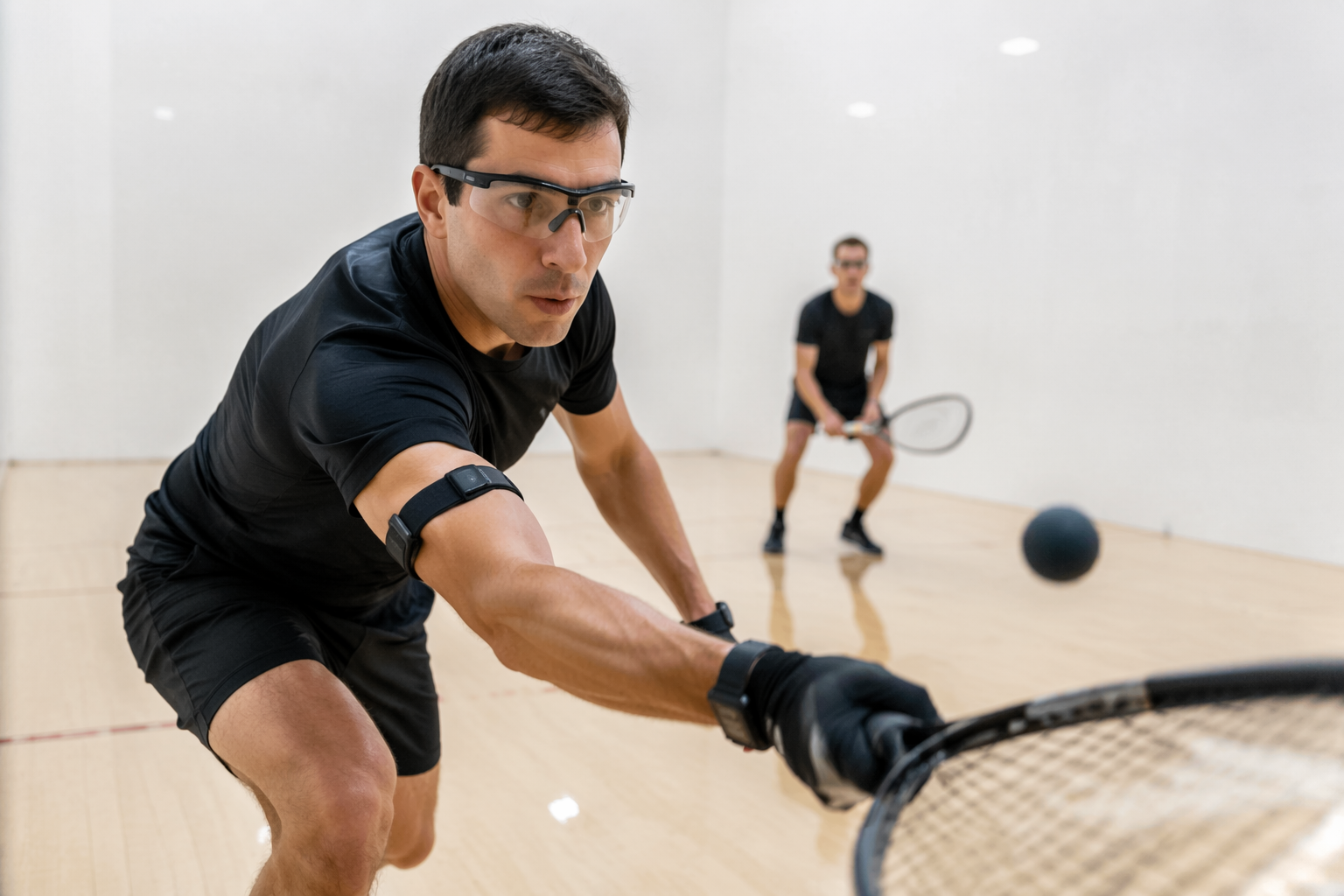
Wearable fatigue research has also shown strong results even when the sensor load is reduced from four IMUs to two or even one, with overall performance of at least 88 percent.
Injury prevention is not a side benefit
A 2018 epidemiological study of squash and racquetball found that lower-extremity injuries were the most common body region injured, accounting for 37 percent in the extrapolated emergency-department cohort. Strains and sprains also showed up prominently across the trunk, lower extremity, and upper extremity, which fits a sport built on explosive starts, lunges, and abrupt stops.
Boston Children’s Hospital lists risks in racquet sports, including racquetball, such as facial collisions and overuse injuries like tennis elbow. If a player’s workload climbs while movement efficiency drops, the warning may arrive before the soreness turns into a missed week of play.
What it costs and how to use it well
The pricing is finally in range for serious amateurs. Entry-level devices can start under $150, while broader sensor platforms can run from roughly $100 to $600 depending on the number of components and the kind of reporting they provide.
Still, the data only helps if it changes a decision. Numbers matter when they are folded into a review process, a coach’s eye, and a structured development plan. Raw data by itself does not make a better backhand, but data that pinpoints when a swing slows, when fatigue starts to distort footwork, or when workload is rising too fast can make practice sharper the same day.
Why racquetball is ready for this shift
Joe Sobek codified the game from paddle and handball traditions, and the sport later surged to an approximate peak of 10 million U.S. players and 14 million players in more than 90 countries during the late 1970s to early 1990s. The first issue of National Racquetball magazine appeared in September 1973, and the first NRC Pro Stop was held in Houston from September 27-30, 1973.
IBM and Agassi Sports Entertainment announced a multi-year collaboration in November 2025 to build an AI-powered platform for global racquet sports.