Beach ultimate emerges as a distinct branch of the sport
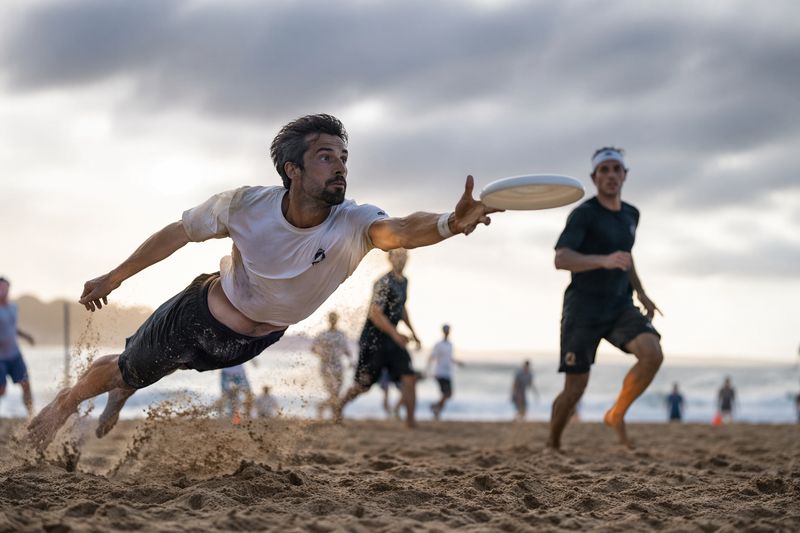
Beach ultimate has outgrown the idea of being ultimate frisbee with a little sand underfoot. On a 75x25 meter field, the game compresses into tighter windows, shorter cuts and a heavier premium on balance, throwing touch and repeat effort, which is why the beach version now stands as its own competitive branch. It still lives by the core ultimate values of Spirit of the Game, self-officiating and non-contact play, but the way those principles unfold on sand has built a separate culture around the sport.
A smaller field changes everything
The first thing that separates beach ultimate from grass ultimate is geometry. WFDF’s beach format uses a smaller 75x25 meter field and is generally played 5-a-side, though 4-on-4 is gaining popularity. That shift is not cosmetic. Fewer bodies on a condensed field force offenses to win space with timing rather than brute separation, while defenders have less room to recover if a cutter gets a step.
Sand also changes the body. Cuts are shorter, plants are less explosive, and every change of direction asks more from stabilizers in the hips, ankles and core. BULA’s fitness material notes that sand and grass activate different muscles, and that the softer surface changes force transfer through the body. WFDF also points to the lighter feel of barefoot play and says the softer surface can reduce hard-ground injuries, a factor that has helped some athletes extend their careers.
Two formats, one sport’s identity
Beach ultimate now sits on a split but connected rule structure. WFDF publishes separate official beach rules, and the current version is the 5-on-5 Beach Ultimate rules, effective from 2025-01-01. BULA recognizes two formats, 4-on-4 Beach Ultimate and WFDF 5-on-5 Beach Ultimate, while also making clear that most leagues, tournaments and World Championships around the world are played 5-on-5.
That distinction matters because roster construction changes with the format. Five-on-five rewards teams with versatile players who can handle, cut and defend in long points without a large bench. Four-on-four, used by major events such as Wildwood in New Jersey and Boracay Open in the Philippines, stretches the field even further and intensifies the burden on each player. In both versions, beach ultimate demands athletes who can read space quickly and survive long stretches of sand-burned fatigue.
The sport’s origin story runs through Texas and Rimini
Beach ultimate did not appear fully formed at a resort tournament. WFDF traces the first beach ultimate tournament to Texas in 1986, then marks the first international beach tournament in 1989 at Paganello in Rimini, Italy. That sequence gives the sport a clear origin story, moving from a domestic experiment to a global event in only a few years.
The institutional arc sharpened after that. In 1999, the Beach Ultimate Lovers Association was created to assist, educate and promote the Spirit and the Game of Beach Ultimate worldwide. By the end of 2009, WFDF says beach ultimate was being played in 25+ countries and there were 100+ tournaments, including leagues, around the world. A year later, WFDF approved a motion to accept beach ultimate as its own disc sport, a formal recognition that the beach game had evolved into something closely related to grass ultimate, but meaningfully different from it.
Paganello became the sport’s cultural anchor
If there is one tournament that explains why beach ultimate has its own prestige, it is Paganello. The tournament’s history page says it began as a weekend between friends and grew into one of the most prestigious beach tournaments in the ultimate world. WFDF’s history page identifies Paganello as the first international beach tournament, and Paganello’s own event history frames it as a beach ultimate world cup that also includes freestyle.
That combination matters. Paganello is not just a competition calendar stop, it is a symbol of how beach ultimate developed its own rituals, travel culture and status markers. Players who chase it are not only chasing a title, they are buying into a beach-specific identity where atmosphere, athletic style and global reputation all carry real weight.
The championship ladder has become fully developed
Beach ultimate’s institutional maturity is visible in the championship structure that now surrounds it. WFDF says BULA organized the first World Championship of Beach Ultimate in Figueira da Foz, Portugal, in 2004. More than two decades later, Portugal remained central to the sport’s biggest stage: the 2025 World Beach Ultimate Championships in Portimão drew 136 teams from 38 countries and more than 2,500 participants across 10 divisions.
WFDF called that the largest beach ultimate event it has ever staged. The scale tells its own story. This is no longer a niche side tournament for grass players looking for a summer detour. Open, Women’s, Mixed and masters divisions now sit inside a championship ecosystem large enough to support national programs, specialized training and deep international travel circuits.
Why the beach game keeps pulling elite players in
Beach ultimate’s appeal is not just the setting. The sand creates a lighter, more fluid visual style, but it also rewards a very specific kind of athlete, one who can thrive under constant instability and still throw accurately when legs are burning. Because every movement on sand costs more energy, teams need players who can handle multiple roles and remain sharp late in points, which gives the format a different roster logic from grass.
That is also why the sport keeps drawing players who want a longer runway in competition. The surface can be kinder to the body than hard ground, yet still punishing enough to separate specialists from part-timers. Beach ultimate has built a prestige layer of its own because it asks for a distinct skill set, lives under its own rules and delivers marquee events like Paganello and the world championships on terms that grass ultimate cannot simply copy.
Beach ultimate now has the markers of a mature branch of the sport: a defined field, its own rulebook, competing formats, a championship ladder and a tournament culture with a clear icon in Paganello. The beach game no longer borrows identity from grass, it has earned a distinct one of its own.
Sources
- [1]wfdf.sport
- [2]beachultimate.org
- [3]rules.wfdf.sport
- [4]paganello.com