Big League Wiffle turns backyard game into pro-style spectacle
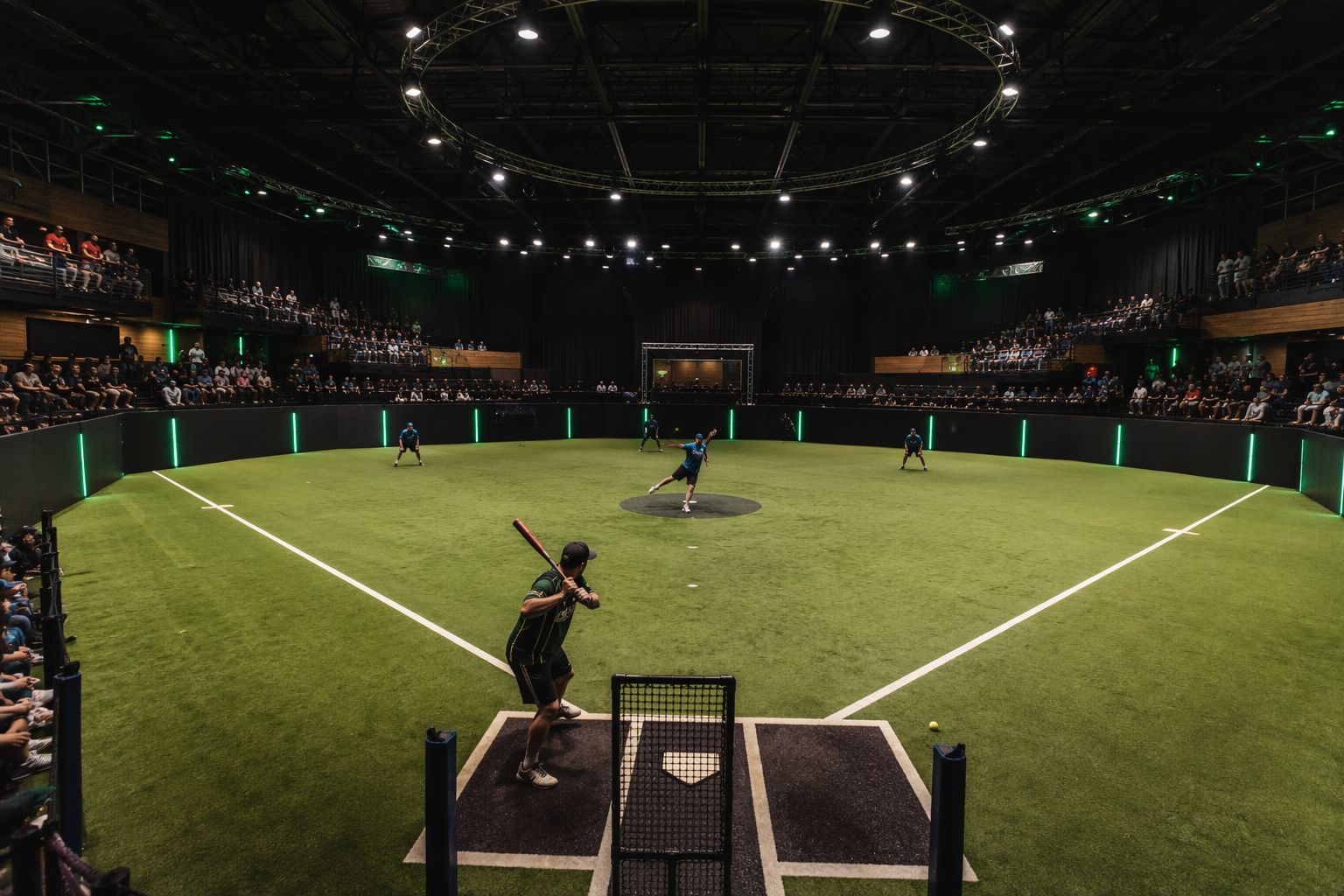
The smoke clearing inside INTENNSE Arena at Assembly Studios did more than reveal a field. It framed Big League Wiffle as a sport trying to pass a legitimacy test, with about 500 fans seated above artificial turf, a named franchise on the line and Indianapolis native Brendan Dudas ready for the New York Green Apples’ first game of the season.
Atlanta showed the product BLW wants to sell
The setting matters because it strips away almost everything people associate with backyard Wiffle Ball. Instead of a driveway, there is a television-ready arena in Doraville, Georgia, opened in 2023 and built to hold 700, with lights, staging and a controlled crowd environment that makes the game feel packaged rather than improvised. That is the point of the presentation: BLW is not asking fans to treat it like a one-off stunt, but like a league with a venue, a calendar and a repeatable show.
The Atlanta showcase also offered a useful scale check. With roughly 500 fans in the building, the league was filling most of a venue that is not oversized for its niche, which gives the atmosphere energy without making the event feel empty. BLW’s own event listings also push that idea forward, with regular-season and playoff dates at Assembly Studios in July 2026 and an All-Star Game listed for St. Louis on Friday, July 24.
Brendan Dudas gives Indiana a real stake in the league
If BLW needs proof that its appeal reaches beyond novelty, Dudas is exactly the kind of player that helps make the case. The league’s player profile lists him as 31, from Indianapolis, and working as a high school teacher and baseball coach, which gives him a grounded public identity that fits a league trying to look credible, not cartoonish. The same profile calls him a three-time NWLA champion, and that competitive résumé matters in a sport where reputation and execution are part of the attraction.
The Indiana connection is not just a regional nod. Dudas, wearing a New York Green Apples uniform, gives local readers a hometown anchor in a national setup, and he does it from a position of earned legitimacy rather than nostalgia alone. A player who teaches and coaches baseball by day, then shows up with championship credentials in organized Wiffle Ball, is the kind of figure that helps BLW argue this is a talent-driven league.
From a childhood game to a franchise circuit
BLW’s origins are a patchwork of grassroots beginnings and polished reinvention. MLB.com traced the idea back to 2009, when Logan Rose was 10 years old and playing in Brighton, Michigan, before the concept matured into something bigger. BLW’s own profile says the modern league began during the COVID-19 pandemic as a backyard league with four teams, then expanded into 10 city-based franchises competing across the country.
That evolution is the real business story. A four-team backyard setup can survive on enthusiasm; a 10-franchise league needs identity, scheduling, player development and enough market interest to justify the travel and production. BLW’s description of itself as America’s first professional wiffle ball league only lands if the league can keep matching the language with infrastructure, and Atlanta was built to do exactly that.
The New York Green Apples are part of that franchise logic. City-based branding gives BLW a cleaner sports structure than a loose exhibition circuit, and it helps the league sell rivalries, season arcs and individual players as part of a larger table of standings rather than isolated performers. That is where the competitive stakes begin to look real.
Crowd numbers, celebrity lift and the entertainment pitch
Attendance claims make the case even stronger. A BLW Instagram post about Atlanta said seven of eight sessions were sold out, with an average of 347 fans per session. For a league built around an unconventional version of baseball, those are the kinds of numbers that move the conversation away from curiosity and toward repeat demand.
The league has also gained a little celebrity oxygen along the way. In 2025, Cronkite News reported that actor Kevin Costner helped launch BLW at Scottsdale Stadium, a reminder that the brand is now comfortable operating in the intersection of sports, entertainment and live-event marketing. Scottsdale, Atlanta and St. Louis are not random stops on a backyard tour; they are markers of a league trying to build a recognizable footprint.
That matters culturally as much as it does commercially. Wiffle Ball has always carried the memory of cul-de-sacs, summer afternoons and improvised rules, but BLW is betting that the same game can work as a curated spectacle when the players have profiles, the franchises have names and the crowd has a place to sit. Dudas and the Green Apples make that pitch believable because they put a human face on the transition.
BLW still has to prove that the model can hold up beyond a hot opening night, but the pieces are in place: a 700-seat arena, a 31-year-old Indianapolis champion-teacher-coach, a 10-franchise structure and a calendar stretching from Atlanta to St. Louis to Scottsdale. That is no longer backyard nostalgia dressed up for a night, it is the outline of a sports product trying to last.
Sources
- [1]indystar.com
- [2]blwwiffleball.com
- [3]stadiumjourney.com
- [4]mlb.com
- [5]cronkitenews.azpbs.org
- [6]instagram.com
- [7]eventbrite.com