British Dodgeball manual details complex referee structure for matches
A ball can graze a shoulder, two players can go down at the same instant, and a catch can look clean from one angle and hopelessly messy from another. British Dodgeball’s Referee’s Manual V3 is built for those moments, giving a neutral main referee overall control and up to five allocated referees to keep the match readable at full speed. The system is not decoration. It is the hidden machinery that lets elite dodgeball feel fair when the action moves too fast for casual judgment.
The referee structure that holds the match together
British Dodgeball updated Referee’s Manual V3 on January 14, 2025, and the document is clear about who is in charge. The neutral main referee carries overall responsibility for the match, including briefing assistant referees and coaches or captains, conducting safety checks, recording sanctions, and making sure the schedule stays on track. That central role matters because dodgeball is constantly producing borderline moments that need one final decision, not a debate at the edge of the court.
Around that main referee sits a layered officiating crew. Teams must provide up to five allocated referees, usually including two return-line assistant referees and two back-line assistant referees, with a centre referee role depending on the event. The structure looks complex because the game demands it. A single official cannot reliably cover every touch, line fault, or activation sequence in a sport where the ball and the feet are moving almost continuously.
Why the game needs more than one set of eyes
The manual gives each official a job that matches the pace of the sport. Return-line referees watch for line faults and ball activation, while back-line referees watch for line faults and help the centre referee make active, independent decisions. That split is important because dodgeball is not only about whether a hit landed. It is also about whether the ball was put into play correctly, whether a player stepped out, and whether a catch or block met the rules at the exact moment it happened.
Those responsibilities show why the officiating model is a legitimacy engine, not a bureaucratic extra. In a sport built on split-second exchanges, a missed line fault or a bad activation call can change an entire set. British Dodgeball says the standards were created to support the development of match officials in the UK and to encourage standardized officiating across the sport, which gives local and national events a common language for what counts and what does not.
Cards, sanctions, and the discipline trail
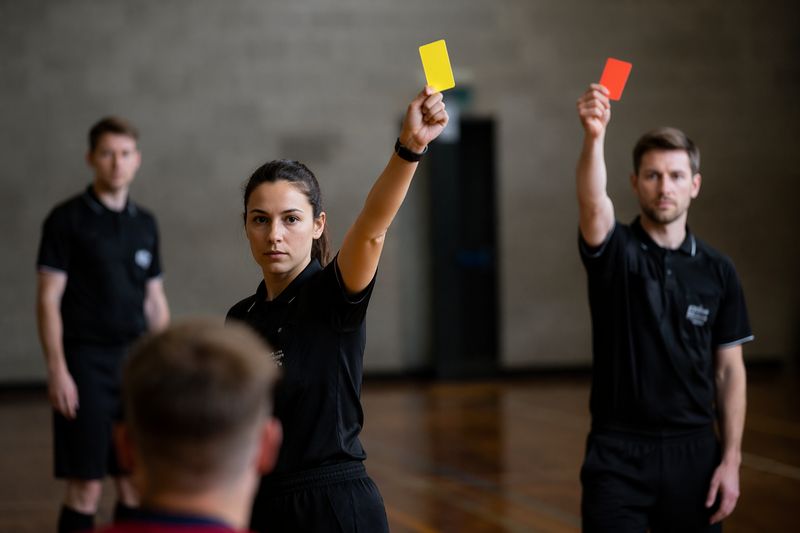
The discipline system is just as structured as the officiating crew. British Dodgeball’s sanctioning guidelines say yellow cards, red cards, and other penalties are usually issued on the day by the referee or event coordinator, but the disciplinary committee can also act retrospectively. That gives the sport an immediate response for in-match behavior and a second layer of review for cases that need follow-up after the final whistle.

The paperwork matters too. Referees record blue cards, yellow cards, and red cards on the scoresheet and report them after the match. For junior events, the referee notifies the coach rather than the player directly. Those rules create consistency across age groups and event types, while also making sure the discipline process leaves a clear paper trail instead of fading into memory once the match is over.
How penalties change strategy in real time
The World Dodgeball Federation’s 2026 cloth rules push the sanction system from administration into tactics. Under those rules, when a player receives a blue card, the team plays short-handed for the rest of the current set and the entire following set. That is not a symbolic reprimand. It is a manpower penalty that changes how a team attacks, defends, and survives the end of a set.
The federation also states that its current rules document is the active guide for sanctioned events, which means the disciplinary system is part of live competitive strategy, not a side note. A blue card can force a coach to protect bodies differently, slow the pace, or sacrifice aggression to get through the punishment window. In a tight match, that penalty can reshape the final minutes as much as a thrown ball or a clean catch.
Safety, consistency, and the pace of elite dodgeball
The deeper logic behind all of this is simple: dodgeball moves too quickly to rely on informal judgment. When a catch looks simultaneous with a floor touch, or when a player’s foot skims the line during a scramble, the sport needs a referee structure that can answer immediately and consistently. British Dodgeball’s manual and sanctioning guidelines turn those moments into a system, not a guess.
That system also protects player safety. Safety checks sit with the main referee, discipline is written down, and sanctions can follow the match when necessary. The result is a sport that can handle dangerous play without improvisation and can settle disputed calls without losing control of the game. Elite dodgeball earns credibility through that infrastructure, and the officials are what make the speed possible rather than chaotic.