British Dodgeball says success depends on tactical decisions under pressure

Elite dodgeball is not a test of who can throw hardest. The best teams win by reading the count, stealing possessions, and turning catches into momentum before the other side can reset. British Dodgeball’s development pathway makes that point plain: the sport starts with basics and fun at U9, then climbs toward wider movement skills, catch-and-dodge combinations, and pressure decisions that decide adult matches.
The real currency is control
At the youngest stages, British Dodgeball wants U9 players to build basic physical skills and enjoy the game. That matters because the sport’s later layers do not work if the first layer is shaky: balance, movement, throwing shape, and the confidence to react to a live ball all come first. By U11, U13, U15, and U17+, the brief changes sharply. Players are expected to expand movement patterns, combine dodges with catches, and start understanding time and numerical situations, which is the point where dodgeball stops looking like a playground scramble and starts looking like a possession game.
That progression continues into the adult game, where the framework calls for deeper tactical awareness and the ability to adapt both individual and team strategy on the fly. The key detail is not just that adults should be better, but that they should be better at reading strengths and weaknesses, both their own and their opponents’. In other words, elite dodgeball is not about throwing every ball as hard as possible. It is about choosing the right throw, at the right moment, with the right players on the floor.
Catching is a decision, not just a skill
British Dodgeball’s coaching material treats catching as a technical and tactical act at the same time. That is why its drills include Catch Me If You Can, Insta-Catch, Wall Catch, and Slow-Motion Dodgeball, where players must try to catch the first ball while dodging or blocking a second one. The lesson is simple and ruthless: a catch is rarely just an isolated flash of hands. It is usually the result of a player making the right read under pressure, while managing space, timing, and the danger coming from another angle.
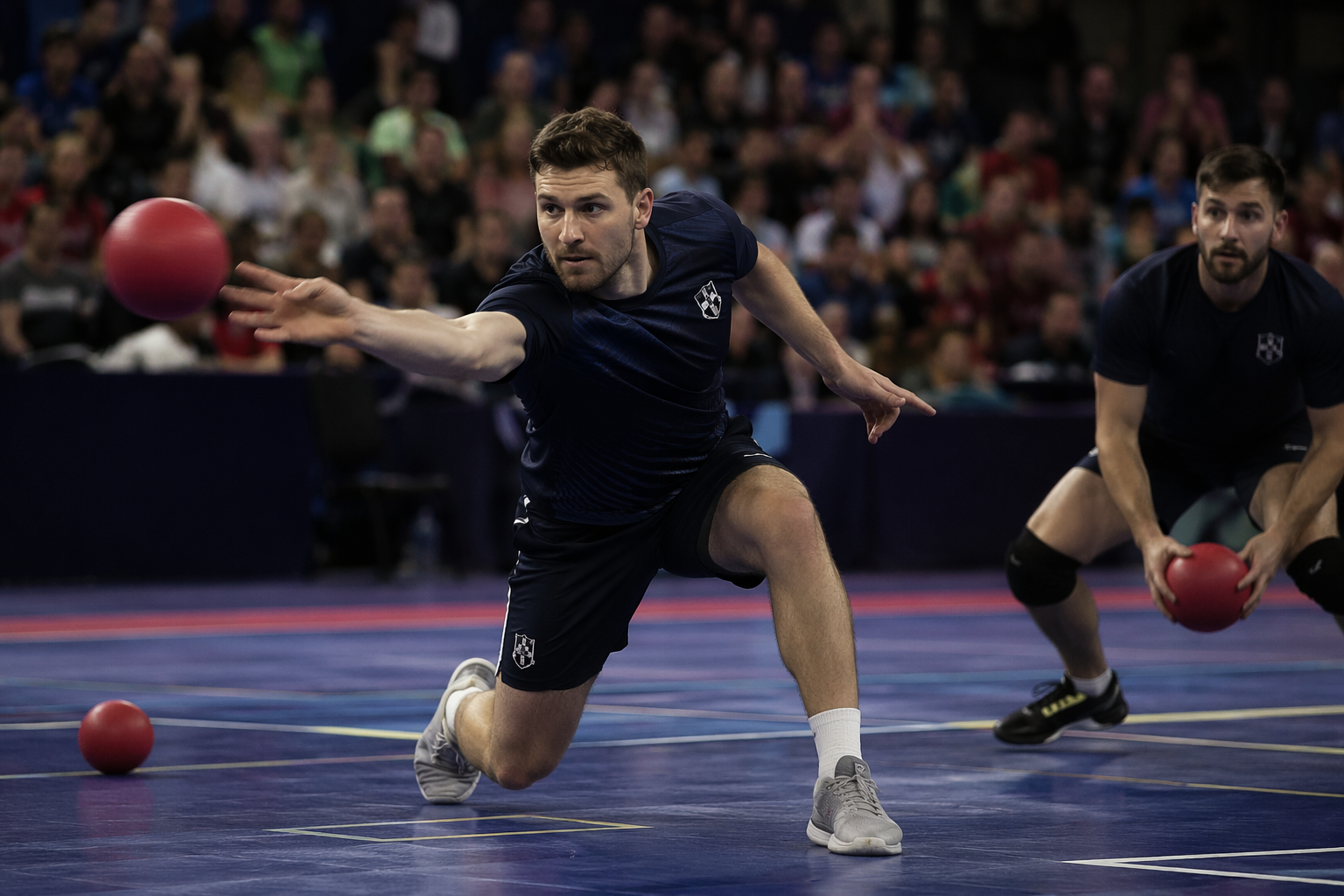
That is also why the organization’s coaching pathway matters. Its Level 1 Award covers basic tactical understanding, while the Level 2 Certificate in Coaching Dodgeball is designed to teach technical corrections, offensive and defensive strategies, tactical understanding, ruleset application, and how to adapt rules to speed player development. British Dodgeball says there are more than 3,000 qualified dodgeball coaches in the UK, which gives that coaching model real reach rather than just theoretical neatness.
The rulebook rewards numbers, not noise
The World Dodgeball Federation’s cloth rules show why the sport is so much more than a throwing contest. The official rules document is the active guide for sanctioned events, and the 2026 cloth rulebook explicitly includes sacrifice play and simultaneous play. That matters because it tells you what the sport values at the top level: not only the hit itself, but the situation that the hit creates.
The rule structure is built around live and dead balls, the opening rush, throwing attempts, blocking, disarming, catching, eliminated players, boundaries, and the neutral zone. Once those parts are understood together, the game makes more sense. Teams are constantly weighing whether a throw should be used to win a player outright, force a block, set up a catch, or create a sacrifice that improves the count for the next exchange. At elite level, a team that understands player-count management is often more dangerous than one with the biggest arm.
That is why sacrifice play is such an important tactical marker. A player can throw in a way that is designed to be traded, not necessarily to survive the exchange, if the resulting shape of the court leaves the team better positioned. Simultaneous play carries the same message: timing and sequencing matter, because the outcome can hinge on how a pair of actions collide in the same moment. High-level dodgeball is full of these small margins, and the rulebook is written to make them matter.

The pathway from school sport to elite thinking starts early
British Dodgeball’s school-facing numbers show how wide the base is. Its school brochure says more than 613,000 UK schoolchildren take part in dodgeball each week, making it the second most popular team sport in UK schools. It also cites research saying one-third of primary pupils want more dodgeball than any other sport. Those figures explain why the sport’s tactical education has to begin young: if dodgeball is already popular in primary schools, the teaching has to move beyond simple throwing games and toward the decision-making that keeps players involved as the game gets faster.
British Dodgeball’s 2024 Schools Championship Survey gives that picture more texture. It sampled 162 pupils from 19 primary schools and 18 high schools across 28 counties in the UK, which shows the sport’s reach across ages and regions. The older 2019 status report went further, saying dodgeball was the most in-demand sport in primary schools and the fourth most participated team sport among UK young people aged 5-16. Put together, those numbers show a pipeline that starts with enthusiasm and only becomes competitive if coaching teaches players how to think.
The sport’s modern shape did not appear by accident
The tactical version of dodgeball sits inside a much broader international structure. The World Dodgeball Federation says it was formed in July 2011, after the sport’s international development created demand for unified governance. It now spans multiple formats, including foam, cloth, rubber, beach, trampoline, and digital, which says a lot about how the game has expanded beyond the school hall image that still clings to it.

The international scale is hard to miss. The federation says the largest event in the sport’s history drew more than 1,400 athletes and officials from 36 countries across all six continents. It also says it welcomed 14 new full member federations at its December 14, 2025 AGM, its largest slate of full-member admissions since 2019. That kind of growth only reinforces the same point British Dodgeball makes at the grassroots level: once the sport becomes organized, the best teams are the ones that think fastest.
A sport that starts simple ends complex
A more formal origin story places dodgeball’s mid-19th-century development at St Mary’s College in Norfolk, when Dr James Carlisle allegedly brought it from Africa to England. The exact origin may be debated, but the contrast is not: the sport began as a simple throwing-and-evading game and has become a governed, tactical contest shaped by age-stage coaching, official rules, and international competition.
That is the real lesson in British Dodgeball’s framework. U9 players are taught to move and enjoy the game; U11 to U15 players learn to combine actions and read situations; U17+ players begin to handle bigger tactical demands; adults are expected to adjust strategy against specific opponents. The throw still matters, but at the top level it is only the first sentence in a much longer argument.