British Dodgeball tactics guide shows how to attack and counterattack
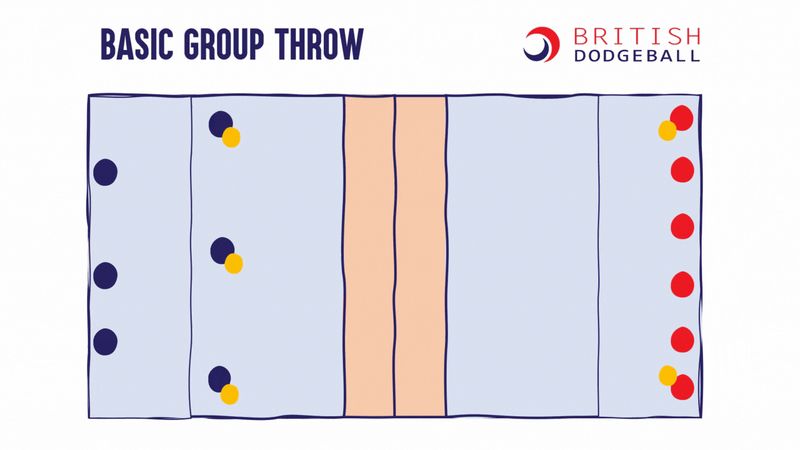
The thrower is told to get as close to the target as possible, pick a vulnerable opponent and throw with as much power and accuracy as possible. British Dodgeball’s tactics framework treats the sport as a chain of decisions rather than a blur of arm strength.
How British Dodgeball turns offense into a system
British Dodgeball’s Level 1 tactics resource starts with the single-ball attack. Distance matters because the closer release shortens reaction time, and target selection matters because the best throw is wasted if it goes at the safest body on the court.
The same coaching logic applies to the basic group throw. When multiple balls leave together, they are harder to track, and that reduces the chance of a clean catch. In practice, offense is less about one heroic missile and more about coordinated timing, with two or more releases forcing defenders to divide attention and making the ball-control game work for the attacking side.
Players are most vulnerable when they are at the front of the court. That is why the post-throw movement is not an afterthought. Level 2 teaching tells players to stay in their lane when moving up court to attack and counterattack, and to keep that same lane discipline when retreating after throwing.
The three linked engines of scoring
Scoring turns on three linked elements: structured offense, disciplined retreats and catches that flip momentum.
• Structured offense creates the opening. A close single-ball attack or a coordinated group throw forces defenders to commit early.

• Disciplined retreat preserves numbers. After the release, the thrower is supposed to back off without drifting into the middle of the court, where exposure rises fast.
• Catches reset the balance. A clean catch does not just save one defender, it can restore a teammate and hand the momentum back immediately.
USA Dodgeball’s rules make a valid catch dependent on control and one point of contact inbounds, so the highlight only counts if the catcher actually secures it cleanly inside the court. One catch from one live ball brings in one teammate in out order, and the entering player becomes live once they establish one point of contact inbounds.
A rally that shows how elite teams manufacture points
A real-style possession sequence usually unfolds in a way that makes the system obvious:
- The attacking side keeps the ball moving until a defender at the front of the court is forced to show early. That front position is the most vulnerable spot on the floor.
- The lead thrower closes distance and aims at the vulnerable target instead of launching from far away. The goal is not spectacle; it is a release angle that arrives before the defender can settle.
- A second attacker throws on the same beat or just behind it, creating the basic group throw effect. The defender now has to read two balls at once, which is exactly why the clean catch becomes harder.

- Both throwers retreat into their lanes after releasing. That keeps them ready to dodge while denying the other team an easy counterthrow at a stranded body.
- If the defense secures one ball cleanly, the catch can bring a teammate back in out order, and that new player becomes live as soon as one point of contact is established inbounds. The side that just looked under pressure suddenly has more bodies, more lanes and more room to counterattack.
Why the modern game looks more organized than its reputation
The modern sport has also been pushed into a far more formal frame. Dodgeball appears in three basic forms, team versus team, one player versus all, and every-person-for-themselves, and ten or more players makes a good game.
The first recorded dodgeball in a physical education setting was at St. Mary’s College in Norfolk in 1884, and the game spread to the United States in the early 20th century.
The tension did not disappear. In 2011, the Windham School Board in Windham, New Hampshire voted 4-1 to remove dodgeball and other human target games from the curriculum amid concerns about violence and bullying. At the same time, the international game kept tightening its own structure, with representatives from several countries agreeing to form the World Dodgeball Federation in July 2011, world championships held in Graz, Austria in 2024, and championships becoming biannual after the largest WDBF World Championships ever in 2022.
USA Dodgeball’s 2026 rules update shows that the sport is still actively evolving, with changes shaped by player feedback, competitive analysis, safety, inclusivity and alignment with the World Dodgeball Federation.