CDC study finds tackle football causes far more head impacts than flag football
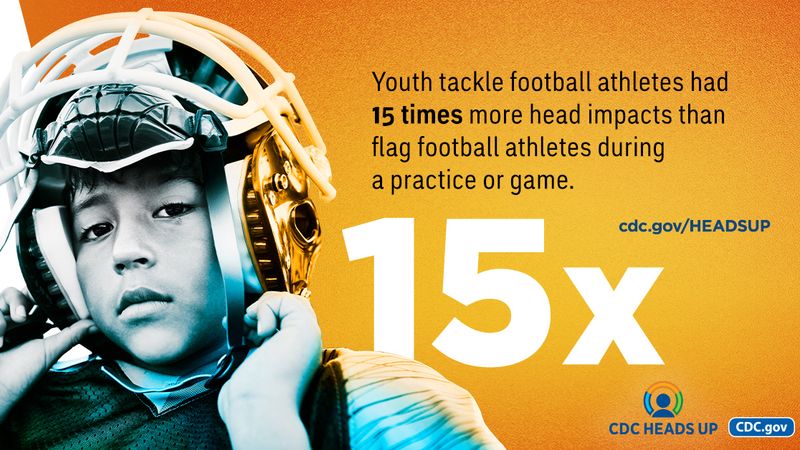
Youth tackle football athletes ages 6 to 14 sustained 15 times more head impacts than flag football players in a CDC study, and the gap widened to 23 times more high-magnitude hits at 40g or more. That makes flag football the clearer lower-contact entry point into the sport, but not a promise of zero risk.
What the CDC numbers actually show
The strongest number in the study is also the easiest to understand: tackle football players took far more head impacts than flag football players during practices and games. Tackle athletes sustained a median of 378 head impacts per athlete over the season, and PubMed’s summary of the same work lists tackle players as 14.67 times more likely to sustain a head impact.
The study recorded 186,239 head impacts. The paper appeared in Sports Health in 2021, and Mathematica’s publication page for it is dated Sept. 1, 2021.
Why flag football is different, and why that still does not make it no-contact
Flag football has long been promoted as a safer alternative to tackle football, and this study helps explain why. In tackle, routine blocking and tackling create repeated opportunities for the head to absorb force. Flag removes those standard collisions, which is why the head-impact count drops so sharply.

But lower-contact is not the same as contact-free. Players still move at speed, fall, collide with the ground, and make contact near the flag-pull area, so the sport still demands coaching, spacing, and discipline.
Where the research is strong, and where parents should be careful
The study measured actual exposure rather than assumptions about safety. Flag football had already been promoted as a safer alternative, but examinations of head-impact exposure in flag compared with tackle were limited when this work was done.
The study measures how often heads are hit and how hard those hits can be. It does not make football risk-free, and it does not erase the broader youth-injury picture that CDC already warns about. CDC’s parent handout lists football as having the highest number of sports-related concussions and other traumatic brain injuries among youth, and it defines a concussion as a bump, blow, or jolt to the head, or a hit to the body that causes the head and brain to move quickly back and forth.
CDC’s parent guidance says 63% of concussions in high school football result from tackling.
How families can use the data when choosing a first football experience
If the goal is to introduce a child to football concepts while reducing head-impact exposure, the CDC numbers point in one direction. Flag football gives young players a way to learn spacing, route running, pursuit angles, and field awareness without the constant collision load that comes with tackle. For many families, that makes it a logical first stop before any move to padded football.
The choice still depends on what a family wants from the experience. If the priority is limiting repeated head impacts, the data support flag as the lower-contact option. If the priority is preparing for tackle later, then flag can serve as an on-ramp, but the transition should be understood as a new level of exposure, not a mere equipment change.
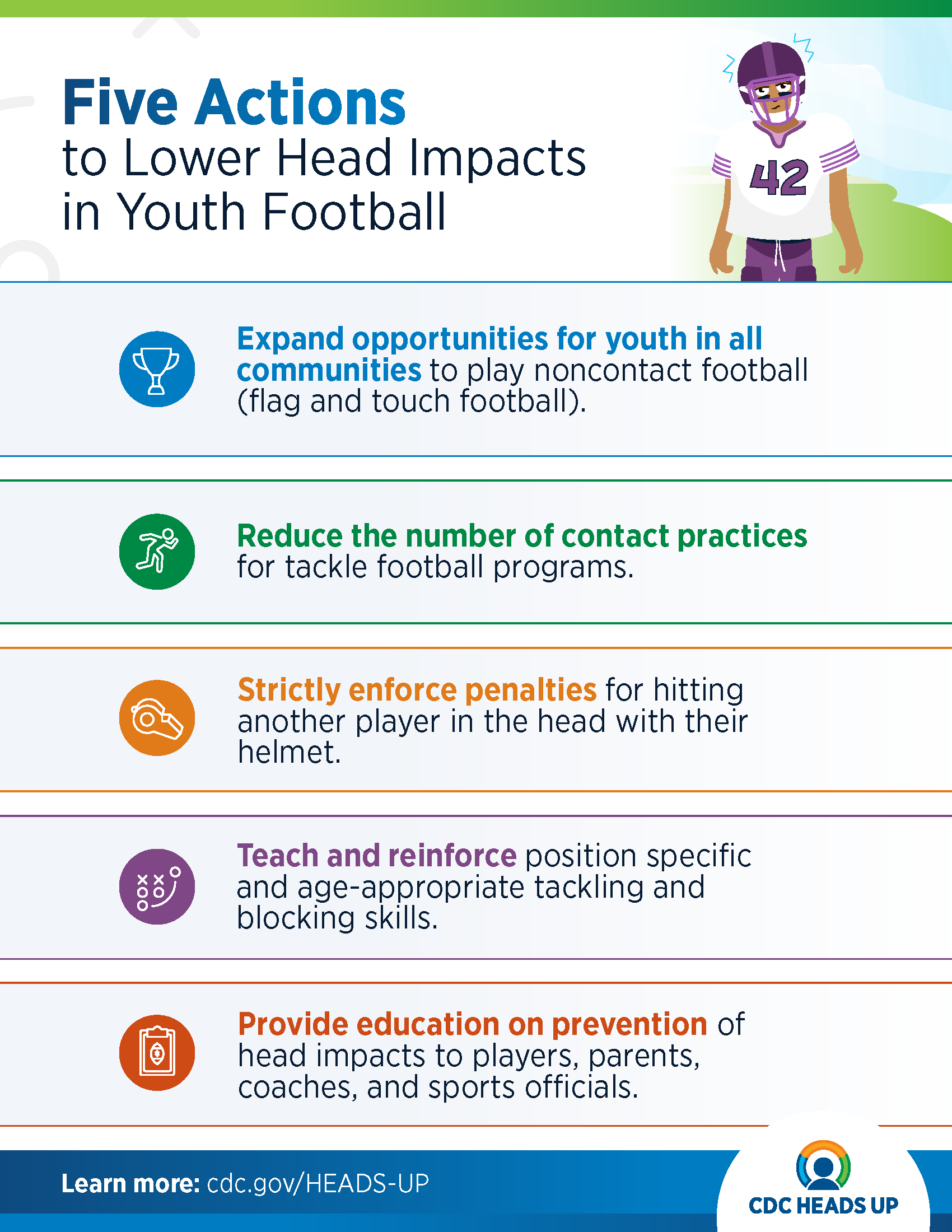
A practical checklist for families and leagues starts with the same question: how much unnecessary head contact is being built into the program?
• Use flag football as the entry point when the goal is to reduce routine head impacts.
• Treat flag as lower-contact, not no-contact, because falls and ground contact still happen.
• Teach players to avoid dangerous contact at speed, even when the rules forbid tackling.
• Keep conditioning and fair play central, because speed and control matter in a sport where players still collide.
Why the CDC has been pushing this conversation for years
Mathematica announced on Sept. 14, 2016 that it would conduct a youth football concussion study for CDC, and a Mathematica paper dated July 1, 2021 focused on differences in head-impact exposures between youth tackle and flag football games and practices and the prevention strategies those differences suggest.
Sources
- [1]cdc.gov
- [2]mathematica.org
- [3]pubmed.ncbi.nlm.nih.gov
- [4]ovid.com