Columbia High School teenagers documented ultimate’s birth in 1970
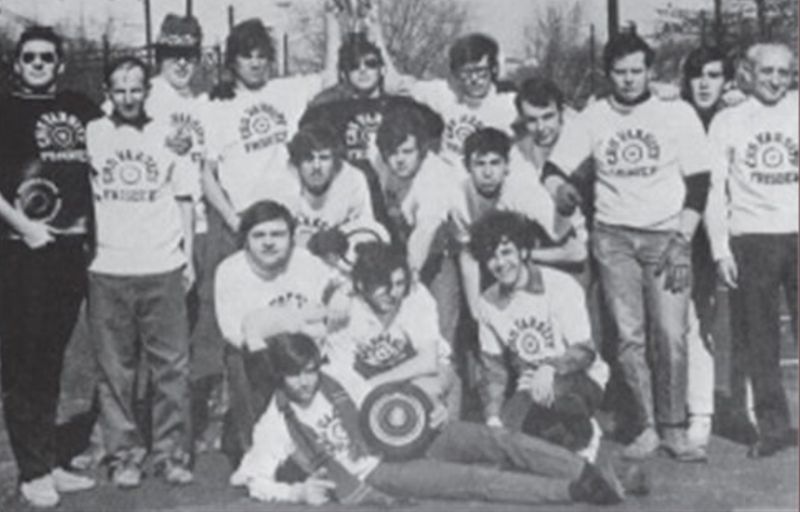
Columbia High School did not invent ultimate by improvising one afternoon and leaving it at that. Joel Silver brought a frisbee-football idea back from Mount Hermon to Maplewood, persuaded the student council to add Frisbee to the curriculum, and by the fall of 1969 he had Bernard “Buzzy” Hellring and Jonathan “Jonny” Hines building the game with classmates. USA Ultimate’s archive places the sport’s modern birth in the summer of 1968, but the crucial move came when those teenagers decided the rules mattered enough to write them down.
How a school experiment became a sport
The setting was as bare-bones as it gets. WFDF’s history says the first games were played with a Wham-O Master disc in a parking lot, and the only lines on the field were the goal lines, often marked by telephone poles or piles of players’ coats. That detail matters because it shows the founders were not trying to mimic football, basketball, or soccer so much as strip the game down until the movement and spacing made sense on their own terms.
What followed in 1970 was the real pivot point. Silver, Hellring and Hines produced the first written rules under the Columbia High School Varsity Frisbee Squad name, then followed with a second set of rules that same year. That is the moment ultimate stops looking like a schoolyard invention and starts behaving like a sport with a governing idea: the players themselves are responsible for making the game work.
The rules were the innovation
That is still the most important thing to understand about ultimate’s origin. The founders did not just preserve a memory of pickup games, they documented how the game should be played, and USA Ultimate says the sport is still played largely according to the rules they developed. In a sport where self-officiation is part of the identity, that origin is not a charming footnote. It is the operating system.
Jon Hines became more than a name on a rule sheet. USA Ultimate says he later founded the Princeton team and played in the first college game in 1972, which ties the Columbia experiment directly to the next stage of growth. Bernard “Buzzy” Hellring did not get to see how far the game would spread, because USA Ultimate says he died in 1971, just as ultimate was moving beyond the walls of a New Jersey high school.
The first scorelines that made the game real

The first interscholastic ultimate game gives the story a box score that reads like the birth certificate of a league. WFDF says Columbia High School played Millburn High School on Nov. 7, 1970, and won 43-10. That is not just a local scrimmage dressed up as history. It is a documented game, between two schools, with a final score, which means the sport had already reached the point where opponents, not just participants, understood what they were looking at.
A year later, the circle widened again. WFDF says the first conference of ultimate teams formed in 1971 and included five New Jersey high schools, among them Columbia and Millburn. That is the kind of expansion that turns a campus oddity into a competitive network. Once multiple schools are playing each other, the game no longer belongs to one lunch period or one parking lot. It begins building its own calendar.
Then came the first college game, and the numbers sharpen the story even more. WFDF says Rutgers played Princeton on Nov. 6, 1972, with Rutgers winning 29-27. WFDF also notes that this game was played on the same site as the first intercollegiate football game, exactly 103 years later. That kind of historical rhyme is hard to fake: one field, one century apart, and a new sport sliding into a place already marked by another American college tradition.
Why the Columbia story still shapes elite ultimate
The sport’s spread after that was fast by any standard. USA Ultimate’s archives describe ultimate moving to colleges around the Northeast, then around the country, and gaining enough traction for unofficial national championships in the mid to late 1970s. That growth would have looked very different if the founders had treated the game as a loose campus pastime instead of a rules-driven competition.
That is why Columbia’s origin story still lands. The sport’s culture of player responsibility did not emerge later as a nice philosophical extra, it was baked in when Silver, Hellring and Hines wrote the first and second rule sets in 1970. Elite ultimate still carries that imprint every time players manage a foul call on the field and every time a team accepts that the game only works if the players enforce it themselves.
The cleanest way to tell the story is through the sequence of decisions made between 1968 and 1972: Silver bringing the idea from Mount Hermon, the student council putting Frisbee into the curriculum, the fall 1969 experiments, the 1970 rulebooks, the 43-10 win over Millburn, the 1971 New Jersey conference, and the 29-27 Rutgers-Princeton college game. Taken together, those moments show exactly how ultimate moved from teenage invention to organized sport, and why the rules written in Maplewood still define the game at its highest level.