Commanders boost Virginia girls flag football as statewide growth surges

Virginia girls flag football has crossed from a small cluster of pilot teams into something that looks statewide, and the Washington Commanders are spending real money to speed that change. With 51 high school programs preparing to field teams and more than 1,000 athletes expected to take part, the sport is close enough to VHSL’s sanctioning line that the decision now shapes how schools budget, travel and build rosters.
Why 51 programs changes the conversation
The number that matters most is not just 51. It is what that figure means inside the Virginia High School League’s structure: a board document on girls flag football says a new sport has to reach 50% plus one of the number of teams, which is why statewide participation is no longer a nice-to-have detail. Fifty-one programs gives the sport the kind of footprint VHSL usually wants before it treats an emerging activity as a real varsity pathway.
That scale also separates girls flag football from the usual one-county experiment. Prince William County Public Schools said its inaugural girls flag football season in fall 2025 included 12 of the division’s 13 high schools fielding teams, a countywide commitment that shows the sport can spread beyond one showcase school. Put that next to 51 programs across the Commonwealth, and the picture is no longer of a novelty. It is of a structure taking shape fast enough to demand policy.
What the Commanders are putting behind the push
The Washington Commanders said in an Aug. 4, 2025 news release that they were making a seven-figure investment to grow girls flag football across the DMV. The team tied that investment directly to sanctioning, saying its Virginia plan for state adoption would begin with the inaugural season in fall 2025 and pointing to support from 51 schools throughout the Commonwealth.
That support is not symbolic. The Commanders’ girls flag football materials say their backing includes monetary contributions, equipment, resources and trainings, and supported teams have also received financial assistance, 25 custom Nike uniforms and an NFL FLAG kit with footballs, flags and instructional materials. In a sport where a school can be a few sets of gear away from opening a roster spot, that kind of package lowers the barrier to entry in a hurry.
The footprint is showing up in Loudoun County too. The Commanders have backed clinics at Potomac Falls High School, Loudoun Valley High School and Lightridge High School, giving the sport a visible presence in one of the state’s most active suburban sports markets. Potomac Falls and Loudoun Valley have also been highlighted in coverage around uniforms and protective headbands, the sort of practical details that matter when a program is trying to look like a real team on day one.
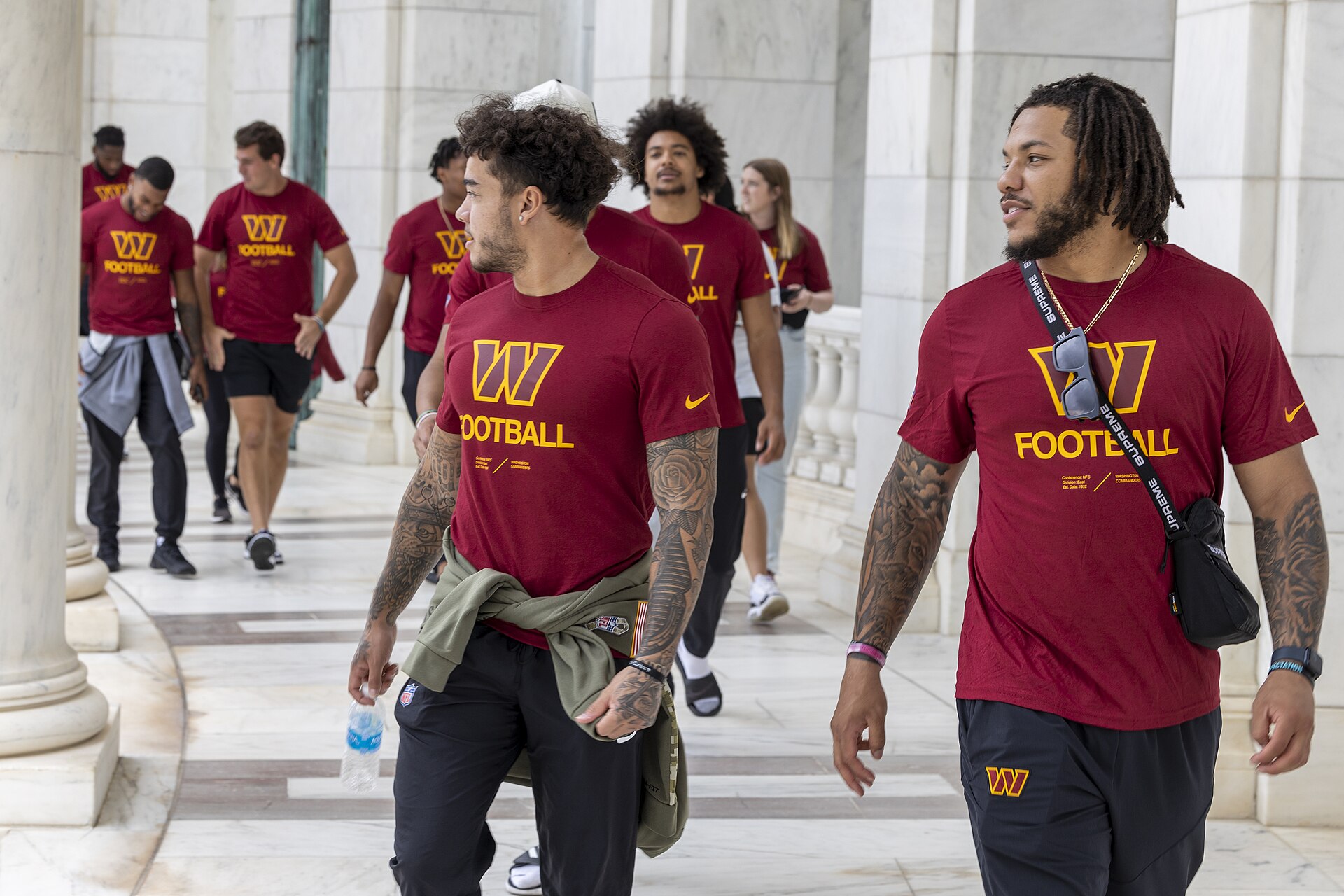
What sanctioning would change for schools
Sanctioning would not just give girls flag football a seal on paper. It would change the way schools treat the sport from the top down. Once VHSL recognizes it as an official sport, athletic departments can build schedules, staffing and travel around a standardized season instead of stitching together a patchwork of independent games and clinic-level events.
That matters for coaches first. A sanctioned sport brings more legitimacy to hiring and assigning coaches, which in turn shapes practice time, player development and safety. It also matters for funding, because official sports are easier to fold into athletic budgets for uniforms, officials, transportation and field space instead of leaning so heavily on one-off donations and outside support.
For players, the payoff is just as concrete. Sanctioning creates clearer competition, a real postseason track and the kind of visibility that comes with league play. It also makes the sport easier to defend inside a school building, where every new roster spot and bus route has to compete with already established programs.
Why the nearby precedent matters
Virginia is not making this decision in a vacuum. The Commanders’ girls flag football materials say the sport is already officially sanctioned in Maryland and Washington, D.C., and Maryland’s Public Secondary Schools Athletic Association sanctioned girls flag football on April 24, 2026. That gives Virginia schools a nearby model for what an official pathway can look like once a state commits.
Those neighboring examples matter because they strip away the argument that girls flag football is too early or too niche for high school sanctioning. Maryland and D.C. have already moved into an official framework, and Virginia now has both the participation numbers and the private-sector backing to do the same. The question is whether VHSL turns 51 programs and more than 1,000 athletes into a durable varsity lane, or leaves the sport to keep growing one clinic, one county and one donation at a time.
Sources
- [1]wusa9.com
- [2]commanders.com
- [3]go.boarddocs.com
- [4]youtube.com