ESPN FootGolf faceoff shows why soccer and golf fit together
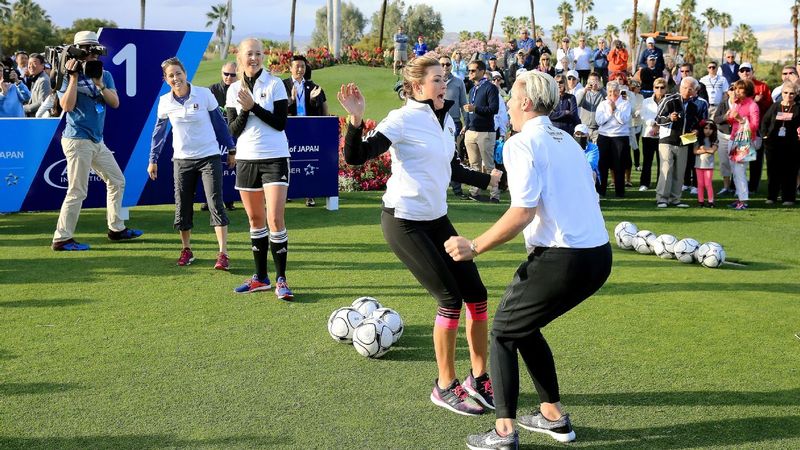
Paula Creamer and Jessica Korda in golf shoes, Abby Wambach and Julie Foudy on the same side of the tee: that pairing gave FootGolf something most niche sports never get, instant cultural shorthand. The six-hole ANA Footgolf Faceoff on March 30, 2016, ended with Team Japan winning the exhibition, but the bigger result was how cleanly the event translated a hybrid game to viewers who knew either soccer, golf, or both.
Why the ESPN crossover worked
The matchup had an unusually broad vocabulary of star power. Creamer and Korda gave golf fans familiar LPGA names, while Wambach and Foudy brought the authority of American women’s soccer icons, two players whose reputations already carried weight far beyond a single exhibition. ESPN’s framing of FootGolf as a hybrid where soccer meets golf did the rest, because the concept was legible in one sentence and the personalities made the rules feel instantly relevant.
That is what separated the event from a throwaway celebrity segment. The sport did not need a long explanation to make sense, because the action was self-evident: kick a ball, read the turf, manage distance, and try to finish in the fewest shots. The faceoff also gave FootGolf the rare advantage of being introduced by athletes who represented two different sporting cultures without either side feeling forced.
The match itself carried real sporting texture
LPGA’s recap described the inaugural ANA Footgolf Faceoff as a six-hole, match-play exhibition, which matters because it gave the showdown a competitive structure instead of a loose demonstration. Team USA featured Creamer, Korda, Wambach, and Foudy, while Team Japan delivered the winning performance. That result gave the event credibility, because the story was not just that famous names showed up, but that they competed under a format with a clear winner.
The international layer added another dimension. The LPGA tied the scene to memories of the 2011 and 2015 FIFA Women’s World Cups, and that context sharpened the symbolism of the matchup: this was not simply golf borrowing soccer stars, but a sport built to let soccer instincts and golf instincts meet on equal ground. Wambach and Foudy were not decorative guests, they were the bridge between the athletic identities FootGolf wants to unite.
FootGolf’s rules are simple enough to travel
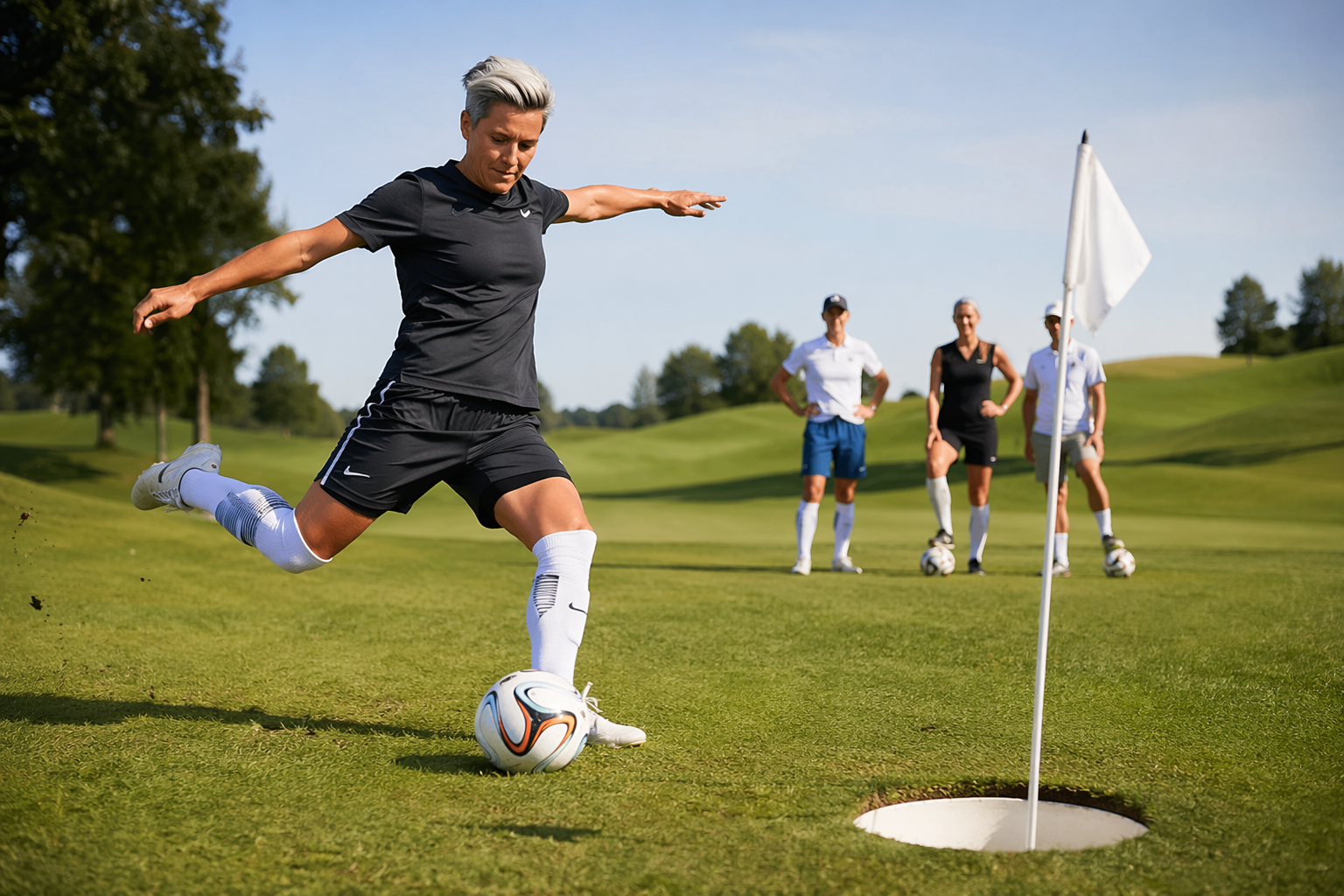
FootGolf’s appeal starts with how little explanation it requires. The Federation for International FootFootGolf describes it as a sport played by kicking a standard size 5 soccer ball toward oversized 21-inch cups, aiming to finish each hole in as few shots as possible. Its rules specify that the ball must be a regulation number 5 ball with a circumference of 68 to 70 cm and a weight of 400 to 500 grams.
That simplicity is part of the business case for the sport. FIFG also says FootGolf is played with minimal supervision and depends on player integrity and etiquette, which lowers the barrier for courses, organizers, and casual groups. A game that can be understood in a glance and administered without heavy oversight can scale from a friendly round to national championships and international tournaments without changing its core identity.
From Dutch roots to a global competition calendar
Modern FootGolf is commonly traced to the Netherlands in 2008, and the early competitive timeline shows how quickly it escaped novelty status. FIFG says the first FootGolf World Championship was held in Hungary in June 2012 with 79 players from 8 countries, a modest starting point that still established a formal international stage. That foundation matters because it shows the sport built a governing structure before it had mass recognition.
The scale is far larger now. FIFG’s 2026 World Championship page lists Acapulco, Mexico, with 1,240 participating players from 64 teams for a 12-day event. That kind of field changes the conversation around the sport: FootGolf is no longer just a clever crossover, but a competition system big enough to sustain national programs, international travel, and a global schedule.
The American pipeline formed quickly
The United States moved early. The American FootGolf League was founded on November 19, 2011, and it staged the first FootGolf tournament in the country on July 22, 2012 at Chula Vista Resort in Wisconsin Dells, Wisconsin. Those dates place the American game close to the sport’s modern global launch, which helped give the U.S. a practical runway before mainstream awareness caught up.
By 2014, AFGL had launched the U.S. FootGolf Pro-Am and says it offered the first-ever cash purse in FootGolf history. That step is important because prize money changes how players and outsiders read a sport. Once a competition has a financial stake, it begins to look less like a one-off attraction and more like a legitimate ladder for serious play.
What the celebrity spotlight really proved
Sky Sports later argued that more ex-professional footballers should consider competitive FootGolf, and the ESPN faceoff explains why that view has traction. Former soccer players arrive with the exact skill set the game rewards: touch, angle control, pace judgment, and the ability to strike a ball cleanly under pressure. Golfers bring course management and precision, and FootGolf lets both skill sets matter without forcing one sport to dominate the other.
That is why the Wambach-Foudy-Creamer-Korda pairing resonated so strongly. It showed that FootGolf can be translated for mainstream audiences without being watered down, because the game is easy to understand yet still difficult to master. The exhibition at Rancho Mirage, with Japan defeating Team USA in a six-hole match, did more than fill a television segment. It showed a sport with enough structure, identity, and cross-sport appeal to stand on its own as a serious bridge between two global games.
Sources
- [1]espn.com
- [2]lpga.com
- [3]footgolf.sport
- [4]footgolfusa.com
- [5]skysports.com