FIFG explains FootGolf match play rules for team competition
Eleven players go on the course, but the captain has to divide them across three individual matches, two four-ball matches and two foursomes, while managing seven substitutes per match, six players left in the pool and a maximum squad of 24. That structure creates the sport’s most interesting tension: you are not just picking talent, you are deciding where to buy stability, where to chase points and where a pairing can survive the pressure of alternate-shot golf with a soccer ball.
How the team sheet really works
The Orlando World Cup team format uses that architecture.
Team match play in FootGolf is not a one-size-fits-all exercise. Singles can steady a lineup when a team needs a clean point. Four-ball can open the door for a more aggressive scorer to attack while a partner provides cover. Foursomes force two players into one shared rhythm.
Why match play feels different from stroke play
In FIFG match play, a player or pair plays directly against an opponent. The scoring is hole by hole, not round by round: a hole is won by finishing in fewer strokes than the opponent, and the match ends once one side leads by more holes than remain to play. A hole can also be conceded at any time.
That format changes the rhythm of a FootGolf match the moment one side gets ahead. A player down early can stop thinking in terms of survival and start thinking in terms of pressure. A side that is ahead does not need to win everything, only enough holes to stay in front of the holes remaining.
If a situation is unclear, the sides may agree on a course of action, but they cannot agree to ignore a rule or penalty. If they still cannot settle it, they should play two balls or find a referee or official.
The foursomes trap and the pairing puzzle
Foursomes are where a captain can most clearly win or lose the morning. Two players share one ball and must alternate shots, and the team chooses the starting player on each hole. After the tee shots, order is determined by the ball furthest from the hole, and if a stroke is made in the wrong order, the side automatically loses the hole.
That rule gives pairings a very specific feel. One player may drive the ball well, while the other may be the steadier closer. A captain looking at a foursomes slot has to think about who can absorb pressure, who can recover from an awkward lie and who can keep the sequence clean when the hole turns messy.

In golf, foursomes is alternate-shot play in which two partners compete as a side by playing one ball in alternating order on each hole, and wrong-order play in match play can cost the hole. FootGolf follows the same competitive logic, with substitutions, caddie input and team structure layered into the format.
Why substitutions change the swing of a match
Substitutions are unlimited in the match-play rulebook, but they can only happen between holes and must be announced before the next hole begins. It is one of the format’s sharpest tactical tools. A captain cannot wait until a hole has gone wrong and then improvise mid-flight; the move has to be made in advance.
A lineup can swing quickly once the first few holes are gone. A foursomes pair that starts slowly may need a reset at the next legal break. A player who is carrying momentum in singles can be held back for a later slot. A four-ball unit can be built to chase points aggressively, because one player’s birdie-equivalent effort can protect the other’s mistake.
The World Cup stage behind the rulebook
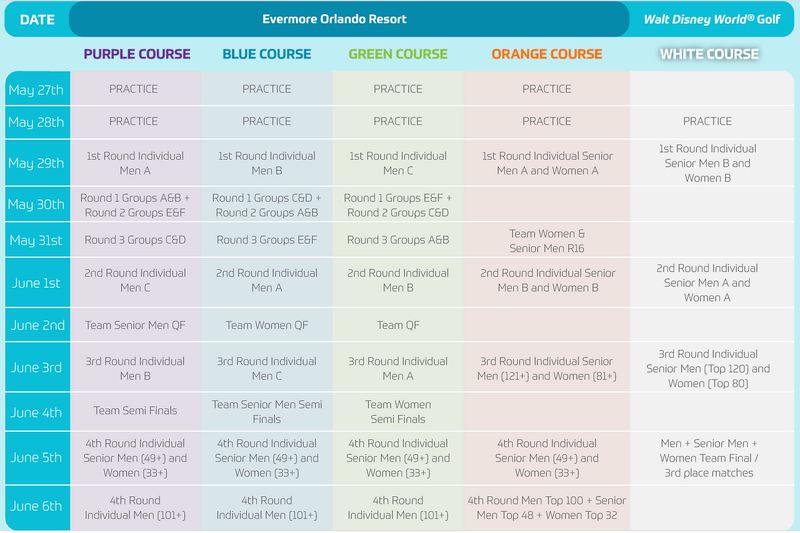
The modern version of this format was on full display at the 4th FIFG FootGolf World Cup, held from May 27 through June 6, 2023, in Orlando, Florida, across Walt Disney World Golf and Evermore Orlando Resort. The official tournament guide lists about 1,000 players from 40 countries across Men, Senior Men and Women, while an official Orlando World Cup page lists 39 countries and 970+ players.
The 2026 FIFG FootGolf World Championship in Acapulco is scheduled as a 12-day event, with individual play from May 27 to June 1 and team play from June 2 to June 7, and the event page lists 1,240 participating players and 64 teams.
A sport built on rules, governance and growth
FIFG created its rulebook in 2012 and updated it occasionally to improve player experience, professionalism and fairness. The world championship traces a clear growth line: Hungary in June 2012 with 79 players from 8 countries, Argentina in January 2016 with 227 players from 26 countries, Morocco in December 2018 with 503 players from 33 countries, and the United States in May 2023 with 972 players from 39 countries.
FIFG calls itself the sport’s official governing body worldwide, overseeing competitions, rules, players and member countries. Its committee structure includes a competitions arm, a rules committee and a World Cup committee. In Mexico, FootGolf’s local roots trace back to 2005 under the name Fut-Golf, and the Mexican FootGolf Federation was founded in Monterrey in 2012 with support from the American FootGolf League.
Sources
- [1]footgolf.sport
- [2]orlando2023.com
- [3]randa.org
- [4]usga.org