FIP padel court dimensions define the sport's geometry
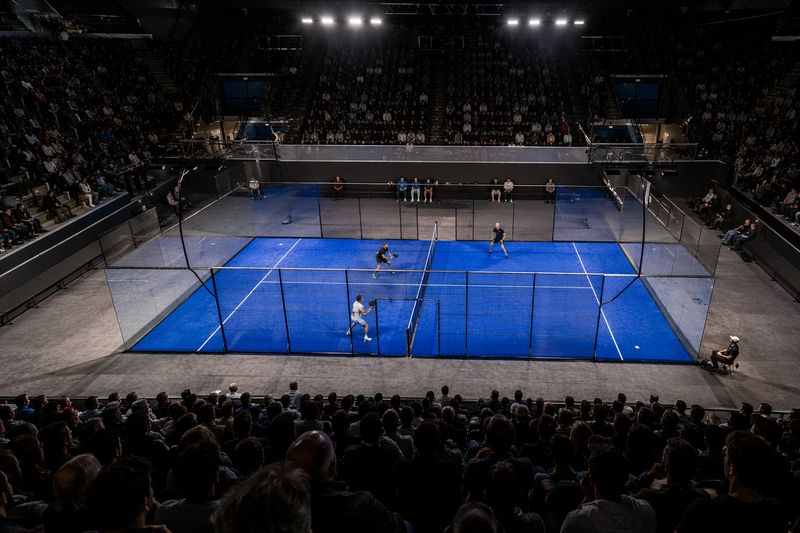
A padel court that only looks like a 20 x 10 rectangle can still miss the sport’s real standard. The International Padel Federation’s rules turn that footprint into a precise competitive space, where millimetres in line paint, wall height and overhead clearance change how every serve, return and rebound plays out.
The rectangle is only the beginning
The playing area is 10 metres wide by 20 metres long, measured inside the enclosure, with a 0.5% tolerance. That is the first test for any builder, club owner or coach: if the dimensions drift, the court stops being a regulation court and becomes a loose imitation. The two halves must be perfectly symmetrical, the net splits the court in half, and the service lines sit 6.95 metres from the net.
That geometry is not decorative. It dictates where the server stands, how deep the returner can sit, and how much room remains for the lob that pulls a pair out of position. Even the central service line has a fixed role, extending 20 centimetres beyond the service line, while every line on the court must be 5 centimetres wide. Those are the marks that keep the sport honest because padel is built on exact rebound angles, not just on enclosure.
Why height matters as much as length
The floor plan is only half the inspection. FIP sets the minimum free height throughout the court at 6 metres, and it recommends 8 metres for new facilities. No obstruction, including spotlights, can invade that space. For players, that is the difference between a true overhead contest and a court where lobs die under a low ceiling before they ever become a tactical problem.
The net itself is also tightly defined: 10 metres long, 0.88 metres high at the centre and 0.92 metres at the posts. Those figures help explain why padel feels compressed without becoming claustrophobic. There is enough vertical room for lobs, bandejas and smashes to matter, but not so much that the walls lose their value as part of the rally.
Glass, mesh and rebound are part of the sport
The enclosure is not just a boundary. FIP says glass courts must comply with tempered or plate glass standards and points builders to its Courts Homologation annex. In older regulations, the Crystal variant laid out end-zone wall areas 3 metres high by 4 metres long, with metal mesh completing the enclosure up to 4 metres at the extreme edges.
That construction affects the whole match. A clean glass rebound stays playable; a poor one can turn a tactical shot into a dead ball or an unsafe ricochet. Mesh, glass and wall transitions also change how quickly players can read the next bounce, which is why padel rewards anticipation and body positioning as much as power. A facility may look padel-inspired with transparent walls and a netted fence, but if the materials and homologation do not match the rules, the bounce is not competition-grade.
The court was born from a space problem
The sport’s origin story explains why its geometry is so distinctive. In 1969, Enrique Corcuera built a 20 x 10 metre enclosed court at Las Brisas in Acapulco, Mexico because he did not have room for a full tennis court. He surrounded the space with walls and metal netting, and the solution became the template for a new sport.

That compact blueprint later needed an international rulebook. The International Padel Federation was founded in Madrid on 12 July 1991 by the Argentine, Spanish and Uruguayan padel associations. The first FIP World Championships followed in 1992 in Spain, split between Madrid and Seville. What began as a practical answer to a space constraint became the standard that now defines the sport at every level.
Global growth made the standards harder to ignore
Padel is no longer small enough to survive on loose construction habits. FIP’s World Padel Report 2024 says the sport is played in 130 countries, with almost 20,000 clubs and more than 63,000 courts worldwide. FIP also said that at the beginning of 2024 the sport had crossed 60,000 courts, and Europe alone accounted for more than 42,600 of them, about 70 percent of the total.
That spread makes the court specs matter beyond one club or one city. A facility in Madrid, Asunción or Aichi-Nagoya now has to fit the same geometry as a venue in Acapulco or Seville if it wants to host serious play. Standardization is what allows coaches to teach the same angles, players to trust the same bounce, and owners to avoid building surfaces that look right but behave wrong.
Competition status now reaches well beyond club play
FIP has also tightened the sport’s competitive structure. Starting in 2024, it established a single official international ranking for professional men and women, managed together with Premier Padel and the CUPRA FIP Tour. That move makes the court blueprint even more important because the same dimensions now connect local facilities to an organized global ladder.
The sport’s calendar has widened too. FIP says padel was added to the South American Games in 2022 and the European Games in 2023, and it has been confirmed for the Aichi-Nagoya 2026 Asian Games. The 2027 European Games programme will also include padel as a medal sport. Under Luigi Carraro’s federation, and alongside bodies such as the Olympic Council of Asia and the European Olympic Committees, those placements show that the court’s geometry now travels with the sport into major multisport settings.
A quick check for whether a court is truly regulation-ready
• Measure the playing area inside the enclosure: 10 metres by 20 metres, with a 0.5% tolerance. • Confirm perfect symmetry between the two halves. • Check the net: 10 metres long, 0.88 metres high at the centre, 0.92 metres at the posts. • Measure the service lines: 6.95 metres from the net, with the central service line extending 20 centimetres beyond the service line. • Verify all lines are 5 centimetres wide. • Look up: 6 metres of free height is the minimum, and 8 metres is the preferred target for new builds. • Inspect the enclosure materials and homologation: tempered or plate glass, with the correct wall and mesh structure.
A court that clears those marks is built for the sport as FIP defines it. Anything less may be playable, but it is only padel-inspired until the geometry, the materials and the clearance all line up.
Sources
- [1]padelfip.com