Five callahans that defined defensive momentum at WJUC 2026
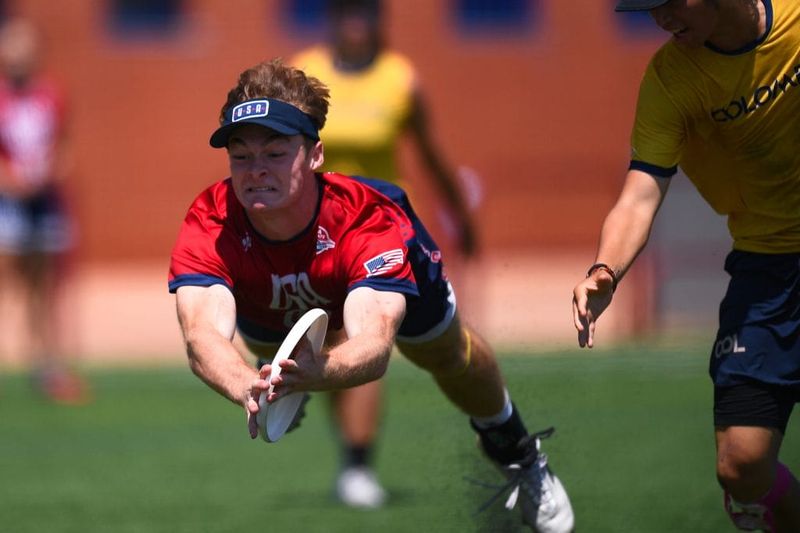
Ethan Austin-Cruse’s layout in the mixed quarterfinal against Colombia was the kind of play that needs almost no translation. A block, a catch in the opponent’s end zone, and a point all happen in one motion, which is why the callahan lands so hard in youth worlds settings like Logroño, Spain. At the 2026 WFDF World Junior Ultimate Championships, that single sequence captured pressure, anticipation, and momentum swing in a way every sideline understood immediately.
Ethan Austin-Cruse against Colombia
The clearest image from the July 24 callahan roundup is still the one from the mixed quarterfinal, where Team USA’s Ethan Austin-Cruse laid out to secure the score against Colombia. It happened in a tournament that had already been running for eight days at Ciudad Deportiva Pradoviejo, with 1,046 players from 47 teams filling the brackets across Open, Mixed, and Women’s play. In a field that large, a clean defensive score does more than add one to the ledger. It compresses the entire emotional state of the point into a single catch, and that is exactly why the play traveled so well through the WJUC crowd and broadcast audience.
That one moment also showed how little explanation a callahan needs. A casual fan can see the defender’s read, the bid, and the immediate turn into offense without knowing any of the tactical language behind it. For players, though, the significance is sharper: it means the thrower’s options have been reduced, the defender has won the route, and the offense has been punished for a mistake with a point against its own scoreline.
The red-zone trap
The reason callahans are so vivid at WJUC is that they usually happen where the field is tightest and the decisions are hardest. In junior elite play, the red zone is where a thrower’s reset can become risky, where a handler can get caught late on a continuation, and where one poaching defender can turn a safe possession into a sudden turnover. Ultiworld’s July 24 package leaned into that tension by treating the callahan not as novelty, but as a universal language for how defense steals offense’s certainty.
That matters in Logroño because the event was built around constant pressure. WFDF framed the championship as an eight-day competition, and Ultiworld’s streaming guide said 100 games were scheduled to be broadcast live, including all quarterfinals, semifinals, and medal matches. When that many junior international games are visible in real time, the best callahans become easy to recognize: a thrower forced into a bad reset, a defender reading the lane a beat early, and the sideline reacting before the disc even settles in the end zone.
The poach read
The play that turns on a poach is often the one that reveals the most defensive sophistication. A young team does not get a callahan by accident if it has built the habits that let a help defender drift into the thrower’s blind spot, then attack the disc without losing the score in the other direction. That is where the WJUC examples become more than highlight material. They show teams that have learned how to manufacture the overlap between pressure and anticipation, rather than waiting for chaos to hand it over.
That skill set has a clear tournament payoff. In the pool play upset on July 15, Belgium beat the USA 11-9 and Japan defeated Canada, results that proved the bracket was already unstable before elimination rounds began. Once games get that tight, callahans do not just end possessions. They announce which side is reading space faster and who is willing to commit to a risky, point-changing read in a game where small edges matter as much as raw speed.
The deep-line read
Not every callahan comes from a static trap near the brick mark. Some are born from a deep defensive read, when a junior defender recognizes the line early, closes the angle, and turns the opponent’s own high-stakes throw into a score in the other direction. That kind of play is especially powerful at WJUC because it does not look like a lucky interception. It looks like a system working exactly as designed, with spacing, mark pressure, and field awareness all lining up for one instant.
The beauty of the callahan is that it instantly communicates momentum. One team is advancing with the disc, the next is staring at the back of its own end zone, and the game changes sides without any dead time. In Logroño, where the tournament brought together the world’s best young ultimate athletes and welcomed families and friends from across the globe, those swings mattered because the crowd could feel them immediately. A deep-line callahan is one of the few plays in ultimate that reads like a touchdown and a turnover at the same time.
Why these five plays felt universal
Ultiworld’s July 24 feature selected five favorite callahan plays from WJUC, and the selection worked because each one spoke the same language even if the teams and divisions were different. Canada finished as Open champion, the USA took Mixed, and France won Women’s, but the defensive scores that stuck in memory were the ones that made the tournament feel larger than the medal table. They showed how junior programs around the world are teaching defense to create offense with intention, not just athleticism.
That is the bigger shift underneath the highlight reel. WFDF governs flying disc sports worldwide and is recognized by the International Olympic Committee, and a junior world championship in that ecosystem becomes more than a showcase of future stars. It becomes a proof of concept for how fast tactical knowledge is spreading, from one poached lane to one end-zone layout to the next. The callahan remains ultimate’s most legible highlight because it is the moment when strategy, effort, and scoreboard pressure all land in the same catch.
Sources
- [1]ultiworld.com
- [2]wfdf.sport