Flag football began as a safer World War II pastime on military bases

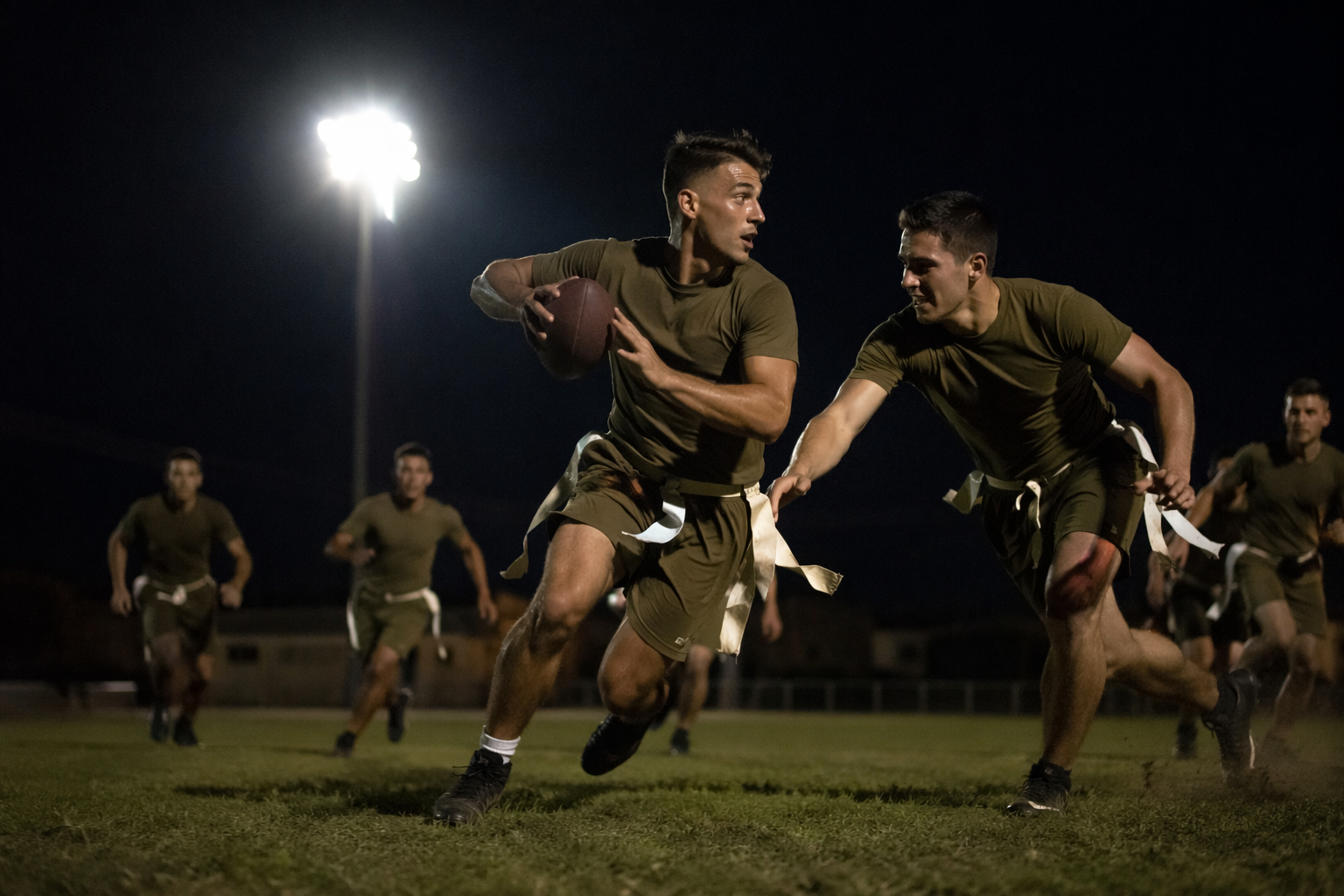
Flag football was born as a workaround, not a branding exercise. On U.S. military bases during World War II, soldiers played a noncontact version of football called touch and tail football, keeping the passing, timing, and competition while stripping out the collisions that made tackle football harder to stage safely and consistently. Britannica says the first official games are believed to have been played at Fort Meade, Maryland, a detail that anchors the sport’s origin in wartime practicality rather than in modern youth leagues.
A wartime game built for portability
The appeal was straightforward: if you could field enough players and find some space, you could play. The format did not need full pads, heavy equipment, or the kind of setup tackle football demands, which made it ideal for military life and later for civilian recreation. Britannica says the sport was shortened to flag football after the war, and that soldiers helped carry it into the American mainstream when they returned home.
That origin still explains the sport’s shape. Flag football is played by two teams of five players each, and the five-on-five structure compresses the field into a game of spacing, routes, and quick decisions. Instead of absorbing contact, defenders pull a flag to stop the play, which preserves football’s rhythm while changing its physical cost.
Why the game outlived its origin story
Flag football lasted because it solved a problem that never went away. Football fans wanted the strategy, passing, and scoring of the sport without the collision burden, and this version could be organized in places where tackle football would have been impractical. The game’s noncontact design made it easier to adapt for schools, recreation programs, and mixed-age play, which helped it move beyond its military roots.
Britannica’s account also shows how stable the core format has been. The sport is still defined by the same features that made it useful on base: no tackling, flag pulls instead of hits, and a five-player framework that keeps the action moving. That simplicity is a big reason the game never felt like a watered-down imitation of tackle football. It became its own sport because it kept the competitive backbone and changed the risk profile.
From base recreation to organized competition
The postwar spread was not instant, but it was durable. Britannica says flag football caught on in the United States after soldiers came home, and by the 1960s the National Touch Football League had been founded in St. Louis, Missouri. That step mattered because it gave the game a more formal competitive structure, showing that what began as a military-base pastime could support organized leagues.
The sport’s influence also spilled into other noncontact football formats. The National Federation of State High School Associations says modern 7-on-7 football has roots in flag football and evolved into school physical education, intramurals, and practice drills in the 1960s and 1970s. That lineage matters because it shows flag football did more than survive on its own terms. It became a template for how coaches and schools taught football concepts without full-contact repetition.
Girls, schools, and the NFL pipeline
The biggest recent driver of growth has been girls’ participation. In 2023, the National Federation of State High School Associations said about 500,000 girls ages 6 to 17 played flag football, a 63 percent increase since 2019. In an earlier NFHS report, 28 states were offering girls flag football, with additional states in pilot or pending stages, and Illinois High School Association executive director Craig Anderson said adding the sport furthers the IHSA mission of creating participation opportunities for high school students in Illinois.
The National Football League has helped accelerate that expansion. NFL media said NFL FLAG now includes more than 1,800 locally operated leagues and more than 650,000 youth athletes across all 50 states and Canada. The NFL also said in 2026 that about 4.1 million youth play flag football in the United States, more than 50 percent higher than in 2020, and that the sport is offered at the high school level in 39 states.
Those numbers show a sport moving through multiple pipelines at once. It is no longer just a recreational offshoot of football culture. It is a school sport, a youth participation engine, and a development path that fits the realities of modern scheduling, facilities, and safety expectations.
The international stage changed the ceiling
Flag football’s rise is now global as well as domestic. The International Federation of American Football says it has 81 member federations, and Olympics.com says more than 20 million people across 100 countries play the sport. Those figures help explain why flag football no longer looks like a niche American adaptation. It has become a format with institutional reach across continents.
Its Olympic breakthrough pushed that status even further. The International Olympic Committee added flag football to the LA28 program alongside cricket, lacrosse, baseball and softball, and squash. The IOC said the Los Angeles 2028 program keeps the core athlete quota at 10,500 and adds 698 quota places for the five additional sports, while Olympics.com says flag football will debut in a five-on-five format drawn from 10-player squads.
Why the WWII origin still matters now
The wartime beginning is not a footnote. It explains why the sport feels so transportable, why it can thrive in school gyms and open fields, and why it fits so easily into modern participation systems. The same qualities that made touch and tail football useful on military bases, safety, low equipment needs, and a fast-learning structure, are the qualities that now support its growth in youth leagues, state associations, and international competition.
The Pro Football Hall of Fame adds another layer to that story by noting how deeply World War II disrupted the NFL itself, including the loss of 23 NFL men. Against that backdrop, flag football’s military-base origin looks less like a novelty and more like a survival mechanism from a period when American football had to keep adapting to war, scarcity, and new uses. That practical DNA still runs through the sport every time a flag pull replaces a tackle and the game keeps moving.
Sources
- [1]britannica.com
- [2]americanfootball.sport
- [3]olympics.com
- [4]nfhs.org
- [5]media.nfl.com
- [6]profootballhof.com