FootGolf began in the Netherlands and spread worldwide
FootGolf looks improvised until you trace its modern path. The sport’s breakout story starts in the Netherlands, moves through a few precise organizing milestones, and ends up with a world championship that drew 40 countries. That arc explains why a game that feels quirky on first glance has become durable enough to travel.
The Netherlands built the modern version
The earliest FootGolf history is not a neat origin myth. New Paltz Golf Course says the sport’s beginnings are unclear and could be attributed to many countries or people at the same time, with roots as early as 2001. The clearer modern turning point came in 2008, when the first nine-hole FootGolf tournament on a golf course, played as the sport is known today, was organized in the Netherlands by Michael Jansen and Bas Korsten.
That Dutch moment matters because it shows FootGolf was not just a backyard mashup that happened to catch on. Playeasy traces the sport to the Netherlands in 2008 as well, tying its creation to Korsten and Jansen and to the kind of casual repetition that makes a game portable: Korsten’s brother’s professional soccer team used to kick balls from their training area to the changing room in as few kicks as possible. The sport’s modern form grew out of that kind of repeatable idea, not from an elaborate invention.
A City of Fort Wayne page later summarized the sport in one clean line: FootGolf originated in the Netherlands and spread to more than 16 countries around the world. That is the key inflection point. Once the format left its place of origin, it could be copied, standardized, and played on existing golf property without rebuilding the whole sport from scratch.
What FootGolf actually is
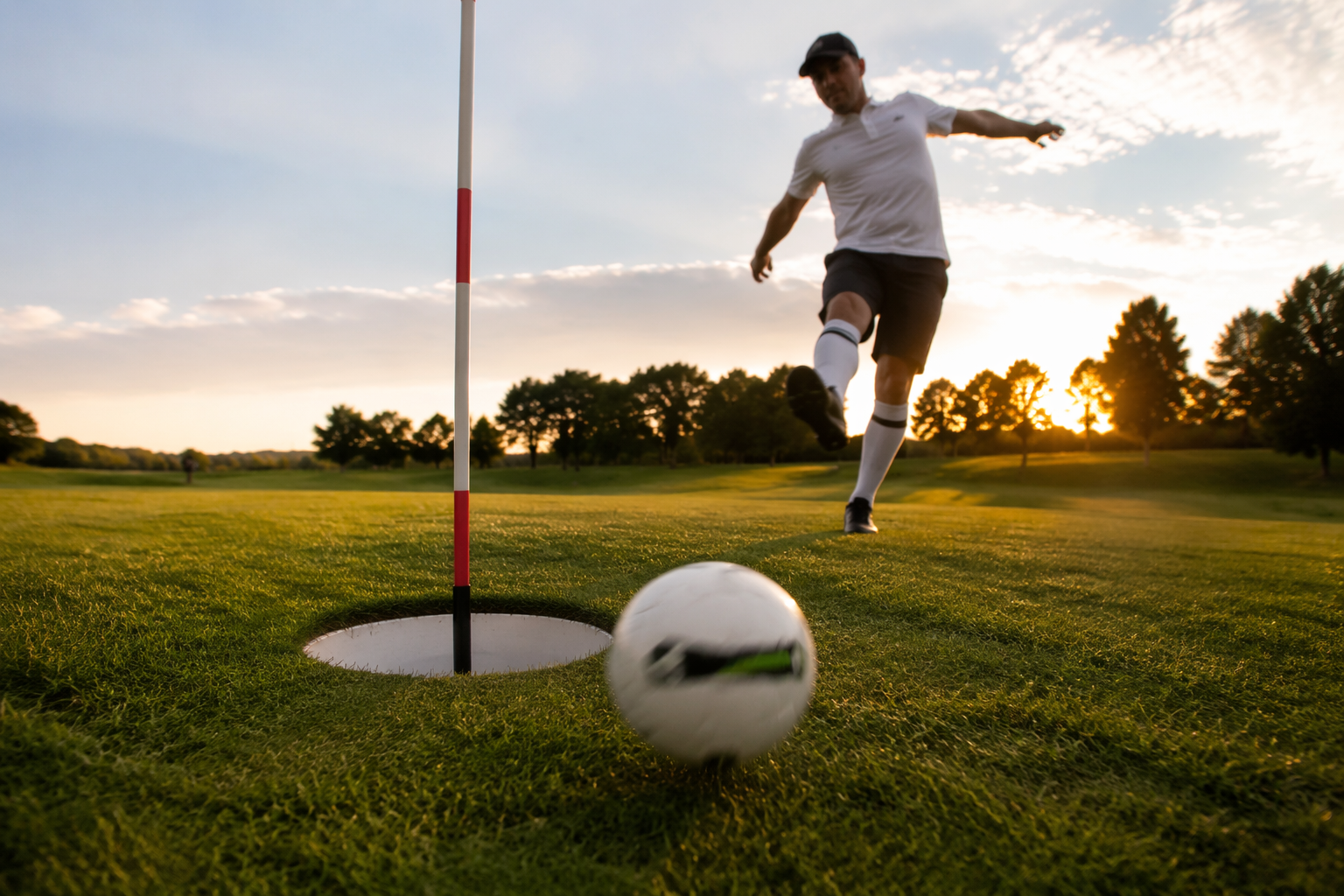
In an April 22, 2016 explainer, Derek McNulty described FootGolf as “a precision sport where players kick a soccer ball into a cup in as few shots as possible.” That definition is the whole appeal in one sentence. It keeps the soccer action of kicking the ball, but it borrows golf’s scoring logic, course discipline, and emphasis on accuracy.
That simplicity is why the game can travel. Once a sport has a shared ball, a defined target, a standard scoring system, and expected conduct on a golf course, it becomes easier to reproduce in another country. FootGolf’s rules are readable to both football fans and golf players, which gives it crossover appeal that many niche sports never get.
The sport’s design also explains its institutional growth. A game built around kicking a soccer ball into a cup on a golf course needs common standards if it is going to move across borders. That is where governing bodies, tournament calendars, and official championships become part of the product, not just the packaging.
A clear timeline of the sport’s rise
- As early as 2001, early antecedents of FootGolf were already being attributed to different countries and different people, which is why the origin story is broader than a single invention date.
- In 2008, Michael Jansen and Bas Korsten organized the first nine-hole FootGolf tournament on a golf course in the Netherlands, establishing the version of the sport that is now most widely recognized.
- On November 19, 2011, FootGolf USA says the American FootGolf League was founded, giving the sport a formal organizing base in North America.
- On July 22, 2012, the first FootGolf tournament in the United States was held at Chula Vista Resort in Wisconsin Dells, Wisconsin, showing how quickly the game moved from concept to event structure.
- By 2015, the sport was visible enough that Traditions at the Glen was opening the area’s first dedicated FootGolf course in early June, a sign that golf facilities were beginning to carve out space for the format.
- By 2023, the FIFG FootGolf World Cup had become the sport’s fourth World Cup, with 40 countries participating in an 11-day event featuring both individual and team competitions.
That timeline shows more than growth. It shows a sport becoming legible, repeatable, and exportable in stages. Each step added another layer of credibility, from the first organized Dutch tournament to a U.S. league, to dedicated courses, to a world championship with global reach.
The U.S. expansion showed the model could work anywhere
The American buildout is especially important because it proves FootGolf was not dependent on one European market. The American FootGolf League’s launch in 2011 and the first U.S. tournament in 2012 at Chula Vista Resort in Wisconsin Dells gave the sport a North American foothold within a year. That pace matters in sports business terms: it shows how a format can move quickly when it plugs into existing golf infrastructure.
The 2015 opening at Traditions at the Glen in the area’s first dedicated FootGolf course is another revealing marker. Once clubs and courses start dedicating space to the sport, FootGolf is no longer just a novelty event. It becomes a recurring use of golf land, with enough demand to justify permanent routing and public visibility.
Why FootGolf travels so well
FootGolf’s portability comes from its hybrid identity. Soccer supplies the motion and the ball, golf supplies the course, the scoring, and the precision-based challenge. That combination makes the sport easy to explain, easy to stage, and easy to recognize even in countries that did not invent it.
The Federation for International FootGolf describes itself as “the world’s governing body for the sport of FootGolf,” and that kind of central authority is what helps a niche game become an international one. A world body can standardize play, connect national groups, and build a calendar that reaches beyond one region. FIFG materials also point to a Youth World Cup 2026 in Germany and a FootGolf World Championship in Acapulco, Mexico, both signs that the sport’s competitive structure keeps widening.
FootGolf’s unlikely modern origin story is that it did not spread because it was vague. It spread because it became specific enough to copy. The Netherlands gave it a recognizable form, the United States helped prove it could scale, and the world championship stage turned a simple idea into an international sport with real staying power.