FootGolf rounds take 2 to 2½ hours on shortened golf holes
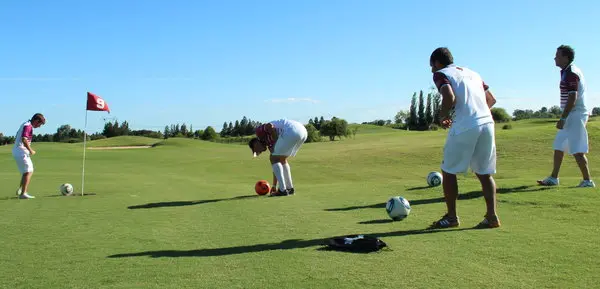
FootGolf trims the biggest barrier for newcomers right away: time. World Center Events says a round usually takes 2 to 2½ hours on 9 or 18 shortened holes, compared with about 4½ to 5 hours for regular golf, and the game uses a regulation size-5 soccer ball plus a 21-inch diameter cup.
How a round is built
World Center Events describes FootGolf as a combination of soccer and golf played on a golf course, but the structure is its own clear draw. Players move through shortened holes in the familiar start, advance, finish rhythm of golf, only the scoring tool is a kick rather than a club strike. That format keeps the course logic intact while making the day shorter and the equipment load lighter.
USA FootGolf adds another layer of precision to that setup, calling FootGolf a sport in which players kick a soccer ball into a 52cm cup away from golf greens in as few shots as possible. The cup size matters as much as the clock: at 21 inches, or roughly 52cm, the target is large enough to welcome kicking, but still small enough to reward placement, distance control, and course management.
Why the pace changes the experience
The time savings are what make FootGolf feel accessible before anyone ever tees off. A 9-hole round can fit neatly into an afternoon, while an 18-hole round still stays far shorter than a standard golf outing, which makes the sport easier to slot into a busy schedule. That difference is not cosmetic. It is the main reason FootGolf works for adults who do not have half a day to spare, families looking for a shared activity, and soccer players who want an easy entry point into a new sport.
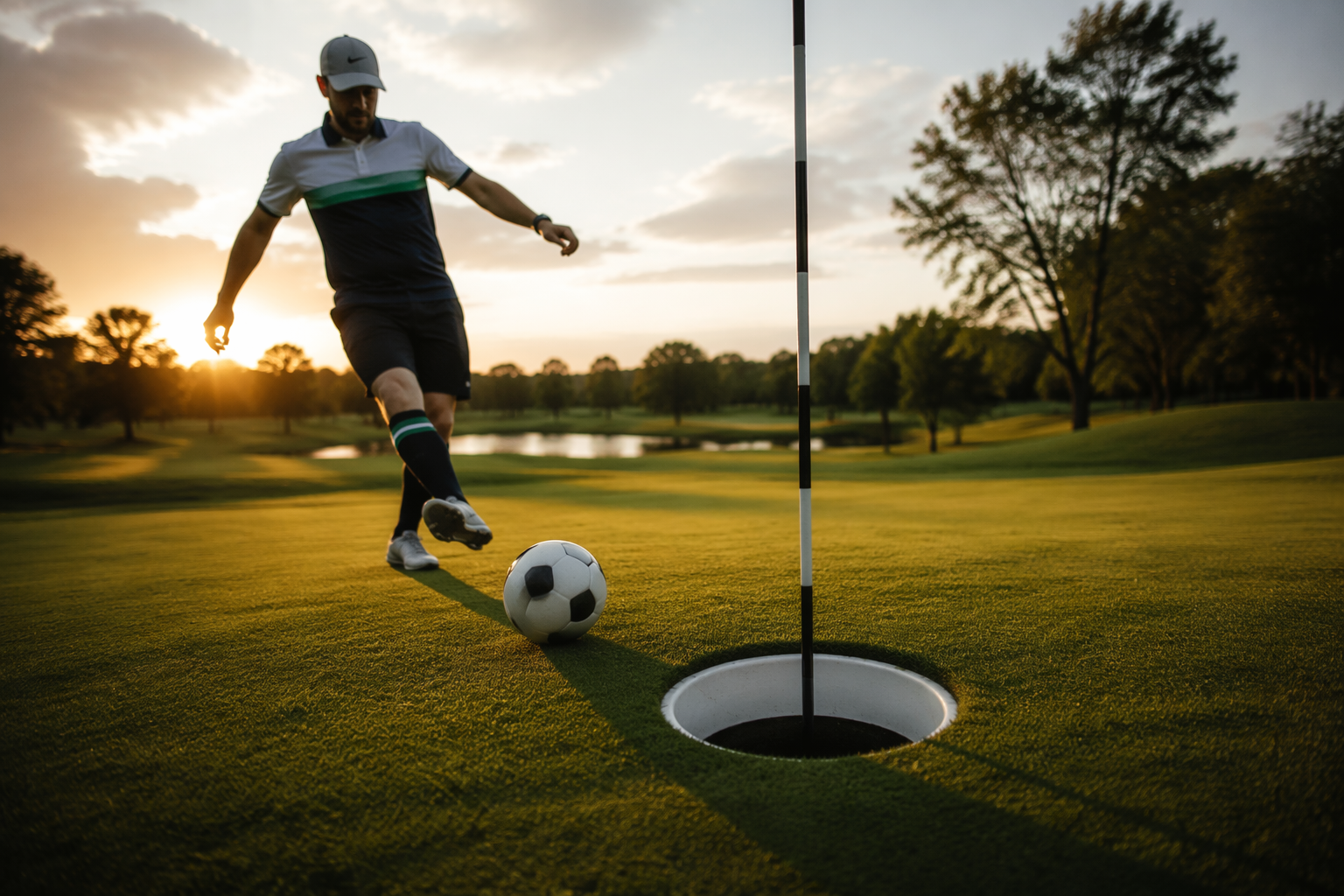
The larger cup also lowers the frustration level without removing the challenge. There is still pressure to hit the line, manage angles, and finish in fewer kicks, but the design avoids the steep equipment and technique barrier of traditional golf. USA FootGolf says the game can be "as fun or competitive as you want," a description that fits the way many courses present it as a casual outing with room for serious play.
FootGolf also has a social pull that golf often struggles to match. USA FootGolf encourages players to bring golfer friends and family to the course, and that cross-over appeal helps explain why the sport can feel welcoming to people who already know the rhythm of golf but do not want a full day on the links.
The rules and the governing structure
The Federation for International FootGolf, which describes itself as the world’s governing body for the sport, frames FootGolf as a precision game played from the teeing zone toward the hole on the green zone with minimal supervision and a heavy emphasis on player integrity and consideration for others. That wording matters because it shows FootGolf is not a novelty spin-off with loose standards. It is a structured sport built around self-policing, pace, and respect for other players.
In the United States, the American FootGolf Federation says it introduced FootGolf to North America in 2011 and has spent more than a decade building the sport’s structure and promoting it competitively and socially. That timeline gives the game a clear base in the American market, even as the sport’s roots stretch beyond one country. FootGolf Dublin says the origins are unclear and can be traced to several countries at roughly the same time, as early as 2006, which helps explain why the sport developed internationally rather than through one single founder story.
The terminology can also be confusing at first glance. A comparison of the two major versions notes that Footballgolf is governed by the World Footballgolf Association, while Footgolf is governed by FIFG. That distinction matters when reading event listings or course descriptions across different regions, since the names are similar but the governing bodies are not.
The global competition scene is already established
FootGolf is not just a casual recreational option. The 4th FIFG FootGolf World Cup ran from May 27 through June 6, 2023, in Orlando, Florida, with 1,000 players from 40 countries competing in Men, Senior Men, and Women divisions. The tournament was staged across five different 18-hole FootGolf courses at Walt Disney World Golf and Evermore Orlando Resort, which shows the scale needed to host the top level of the sport.
That World Cup setup also showed how FootGolf can be spread across multiple resort courses without losing its competitive identity. The competition used both individual stroke play and team match play, a sign that the sport has matured into a format with layered championship structures rather than a one-off exhibition. The venue mix in Orlando made the point even more clearly: FootGolf can be slotted into established golf properties without reinventing the entire course model.
Youth development is part of that growth as well. FIFG says the first Youth World Cup opened in Gahlenz, Germany, with 22 nations participating, a strong indicator that the sport is building an age pipeline instead of relying only on adult recreational play. That youth footprint matters for the future because it connects the sport’s accessible format with international competition and a wider player base.
For anyone approaching FootGolf for the first time, the appeal is immediate and measurable. A standard soccer ball, a shortened 9- or 18-hole layout, a 21-inch cup, and a 2 to 2½ hour round make the sport easier to try than traditional golf, while FIFG’s rule structure and the World Cup circuit show it already has the depth of a serious international game.
Sources
- [1]worldcenterevents.com
- [2]footgolf.sport
- [3]usafootgolf.org
- [4]footgolfusa.com
- [5]orlando2023.com
- [6]footgolf-dublin.ie
- [7]fifg.bluegolf.com
- [8]fgolf.se