Grand Rapids girls flag football team fills local opportunity gap
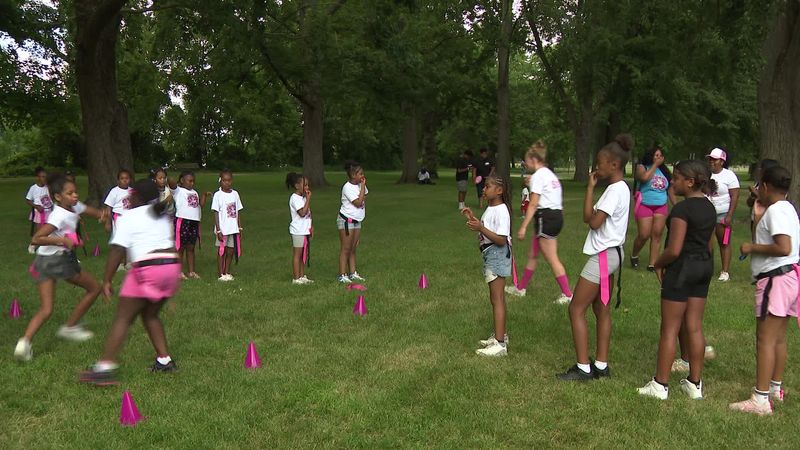
In Grand Rapids, the Bulldog Bratz are what access looks like when someone stops waiting for permission. The city’s first and only all-girls flag football team exists because Ashley Whitehead built it, funded it and made the case that girls who want football should not have to squeeze into somebody else’s version of it. What looks like a roster is really a response to a gap, and the size of that gap is the story.
A team built because the space did not exist
Whitehead said she has been a football mom for six years, long enough to see what her daughters wanted from the game and what was missing around them. She watched them enjoy football with their brothers, and that simple backyard reality turned into a bigger idea: create a place where girls would not feel intimidated or left out. That is the foundation of the Bulldog Bratz, and it matters because the team was not built as a novelty. It was built to meet demand that already existed.
Grand Rapids did not just need another team name. It needed a place where girls could show up, learn the sport and belong in it from the first snap. Whitehead’s decision to fund the team herself turned that idea into something tangible, not theoretical. In flag football, access often starts with equipment, coaching and enough committed adults to keep the whole thing moving, and the Bulldog Bratz have all three because someone chose to make them happen.
The roster is the proof
The players make the best argument for the team because their reasons are specific and familiar. One athlete said she has always enjoyed football with her brothers. Another said she wanted a team after playing football in gym class and hearing there was a league in Grand Rapids. Those are not abstract motivations. They are signs of a sport waiting just beneath the surface, with girls already interested and simply looking for an organized doorway in.
That doorway brings more than reps and route running. The players talk about sisterhood, confidence and making friends through a game they already love. That combination is why the Bulldog Bratz land as more than a sports story. When a team gives girls a place to be visible, competitive and together, it creates social infrastructure as much as athletic development. For a lot of youth athletes, that is the difference between trying a sport once and staying with it.
Assistant coach Ashley Harris puts the sharper point on it: the gap is real, and the Bulldog Bratz alone cannot fill it. That is the part people miss when they treat girls flag football like a feel-good add-on. One team can prove the interest, but it cannot satisfy all of it. Harris’ hope is that other teams see what Whitehead built and decide to launch too, because growth only matters if it creates more entry points than the first one did.
The season is also a logistics test

Whitehead has already run into the problem that exposes how thin the local ecosystem still is. She has been reaching out for games and realizing that options in the area are limited. Travel will likely be required, and the only matchup she had found was a Detroit team. That detail is more important than it sounds. A sport can have enthusiasm, but if it does not have opponents, schedules become road trips and access becomes geography.
That is why the Bulldog Bratz matter as a community-building pipeline rather than a one-off story. The team is not just asking whether girls want to play. It is showing what it takes to keep them playing: a founder willing to pay the way, parents willing to organize around it, coaches willing to recruit, and enough local buy-in to turn interest into a season. In practical terms, that is how a new sport becomes normal.
The national numbers back up the direction of travel
The broader landscape shows that girls flag football is moving from the margins into formal adoption. The NFHS says 17 state associations have sanctioned girls flag football, six more states are voting on sanctioning in 2026, and 15 others are running independent or pilot programs. That is not a finished map, but it is a real one. It shows a sport still evolving, still uneven, but no longer easy to dismiss as a passing experiment.
The NFHS rules changes in 2026 also point to a sport being built as it expands. State associations now have the option to adopt a fourth field diagram, and the rules standardize that all teams start with seven players. Those details matter because they make the sport easier to organize across different places, which is exactly what emerging school sports need. The cleaner the framework, the easier it is for local teams to plug in.
Michigan is building a pathway, not just a moment
Michigan is already part of that growth. The Detroit Lions hosted the 2026 Michigan Girls High School Flag Football Championship at Ford Field on June 7, 2026, and the Detroit Lions Foundation has partnered on all-girls flag football clinics there as well. That tells you the state is not waiting for the sport to arrive fully formed. It is laying down a structure around it, one clinic and one championship at a time.
NFL Play Football has also built girls flag football resources and a league locator for youth programs, which gives families and organizers a place to start when they are trying to find the next step. Put that alongside what Whitehead built in Grand Rapids and the picture gets clearer. The Bulldog Bratz are not a standalone curiosity. They are an early, local answer to a national sport finding its shape, and they show exactly how girls flag football grows when someone decides the door should already be open.
Sources
- [1]woodtv.com
- [2]nfhs.org
- [3]detroitlions.com
- [4]playfootball.nfl.com