Holyoke Ball rulebook reveals the geometry behind kickball strategy
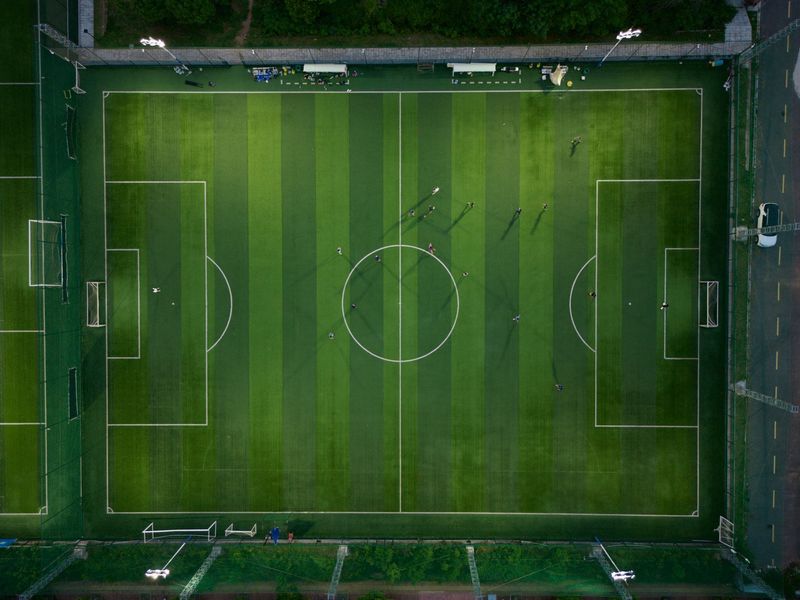
Holyoke Ball’s 2026 rulebook draws the field as a 60-foot square, then adds a pitching strip 42 feet 5 1/8 inches from home plate and sideline space 12 feet outside the foul lines. That geometry compresses reaction time, opens some lanes and closes others, and turns every short kick into a decision about angle, speed and risk.
The field sets the tempo
In Holyoke Ball’s setup, kickball plays faster in the infield than its casual reputation suggests. A square with equal 60-foot sides leaves no deep outfield gap to hide in, while the home-to-second and first-to-third diagonals measure 84 feet 10 1/4 inches, enough space to create force-outs but not enough time for defenders to drift lazily into place. The pitching strip, set 42 feet 5 1/8 inches from home, gives the kicker a real read on the roll before contact and a chance to pick a spot instead of simply blasting through the ball.
A kicker facing a controlled roll has enough time to decide whether to drive the ball up the middle, poke it toward an empty line, or deaden it for a safer reach. The same compact geometry forces defenses to set their feet early, because once the ball leaves the pitcher’s hand, a few steps in the wrong direction can turn a routine play into a base hit.
Why placement beats power
Holyoke Ball adds more structure than many players expect from a backyard game. Cones mark base and sideline reference points, the kicking box is defined around home plate, a bunt line sits 21 feet from the center of home, and 34-foot defender lines keep fielders from crowding in too soon. Those boundaries create a game inside the game: the offense is trying to pick a lane before the defense can collapse it, while the defense has to stay legal and still be close enough to react.
A bunt-style tap becomes one of the most useful swings in kickball. A soft touch down the line, or just behind the infield, can beat an overaggressive third baseman or force a hurried throw from a shallow fielder who had to hold behind the 34-foot line. In baseball terms it looks like a sacrifice bunt; in kickball terms it is a placement play that exploits the shorter distances, the straight lines, and the fact that the ball is moving on the ground rather than flying through the air.
The same geometry rewards an outfielder charging a short kick, but only if the angle is right. Because the field is a square rather than a broad diamond with deep gaps, a softly struck ball into the grass can be attacked quickly, yet the throw still has to beat runners who are already closing on the next base. If the first touch is clean, the defender can erase a single; if it skips or glances off a line, the ball can roll far enough to create an extra base in a hurry.
The force play at second is built into the layout

The diagonal from home to second, measured at 84 feet 10 1/4 inches, makes kickball’s force logic obvious. A runner moving from first to second can be pressured by a ball hit on the ground into the infield, and the defense can use that shortened space to turn a force play before the runner settles into the bag. Holyoke Ball’s rulebook and WAKA’s rules summary both include forced outs and one-base advancement on an overthrow, shaping how quickly the defense must decide whether to keep the ball in front or make a throw.
That is why a routine ground kick can become a race to second rather than a search for a highlight play. The closest defender is not trying to make a spectacular out, just a fast, accurate one, because the 60-foot side and the 84-foot diagonal leave little margin for slow hands or a high throw. The field rewards the team that can turn the first clean touch into the first clean transfer.
How the official ball and roster change the math
The World Kickball Association’s rules summary keeps the format tight: 10 fielders, 7 innings if time allows, 2 base coaches, bouncies, no head shots, one base on an overthrow, forced outs and no ghost men. It also defines the official ball as a 10-inch red kickball inflated to 1.5 psi. Those details shape strategy because fewer defenders and a large, soft ball make positioning more important than brute force, while the controlled bounce option changes the shape of the pitch itself.
Each team should field at least 8 players and no more than 10, which means the defensive alignment can shift from full strength to a thinner shell without changing the basic geometry of the game. The bouncy pitch, where the ball must bounce at least twice before the plate and cannot cross higher than 1 foot, adds a second layer of timing for the kicker. Instead of reacting to a baseball-style delivery, the kicker has to read a rolling or hopping ball and decide whether to drive through it, wait on it or place it into space.
From playground memory to adult league sport
The modern adult version of kickball has a longer and more organized backstory than the recess version most people remember. The earliest known rules and diagrams for a game very close to modern kickball appear in Emmett Dunn Angell’s 1910 book Play, and Nicholas C. Seuss’s description followed seven years later in 1917. The first known organized adult kickball league formed in Virginia in the late 1970s, showing how the sport moved from schoolyard familiarity into a structured adult format.
The organization itself began in 1998, when four friends in a Washington, D.C., bar turned a social idea into the World Adult Kickball Association, later known as the World Kickball Association and ClubWAKA. Des Moines Parks and Recreation advertises coed kickball as a relaxed, social league with drinks available.
Sources
- [1]holyokeball.com
- [2]kickball.com
- [3]dsm.city
- [4]sportsfoundation.org