How a point starts, builds and ends in Ultimate Frisbee
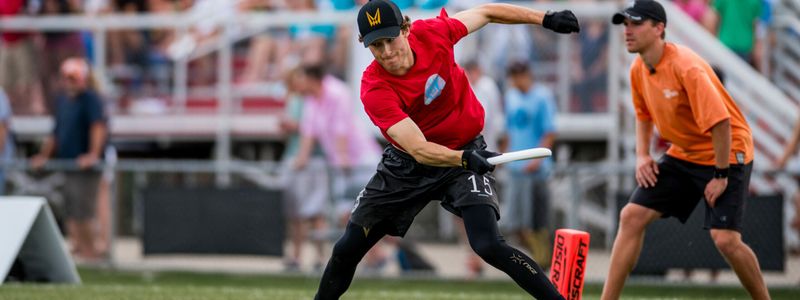
One Ultimate point begins before the offense ever touches the disc. The defense pulls, the offense has to move the disc by passing, and the first big race is really against the stall count. Once that sequence clicks, the sport’s pace becomes much easier to read.
The pull sets the point in motion
A regulation Ultimate field is a rectangle 70 yards long and 40 yards wide, with 20-yard end zones at each end. Seven players go on the field for each team, and each point begins with both teams lined up on the front of opposite end zone lines before the defense throws the pull to the offense. That opening throw matters because possession does not start with a jump ball or a tip-off, but with a long reset throw that immediately gives the receiving team something to solve.
From there, the offense cannot run with the disc. The holder pivots, looks for a teammate, and tries to move the disc by completing passes while defenders crowd throwing lanes and try to force a difficult throw. That is the basic rhythm of the sport, and it is why one clean catch can look calm on the surface while the defense is already forcing a decision.
The stall count is the clock you can hear
The stall count is the pressure point that new viewers notice fastest. In USA Ultimate’s rules, the marker counts up to 10 seconds, and if the thrower has not released the disc before stall 10, it is a turnover. The 2020-2021 Official Rules add an important detail: a legal count from one to ten takes a minimum of 9 seconds.
That detail matters because the marker is not supposed to just blaze to 10 and immediately yell stall. The rules say the marker should be sure the disc was not yet released and that the count was not fast. In practice, that means the offense is fighting both time and space, while the defense is fighting to keep the count steady and the throwing window small.
This is where Ultimate’s point-by-point drama lives. A cutter who is free for a second can become covered by the next count, and a thrower who waits one beat too long can turn a live possession into a turnover. The same rule shapes youth pickup games and elite club championships because the clock pressure is always there, even without a scoreboard clock in the middle of the action.
What actually flips possession
Turnovers do not only come from stall 10. They also happen on dropped passes, interceptions, and certain out-of-bounds situations, which is why a point can swing in a single step or a single bad read. A throw that looks safe can become a turnover if the receiver bobbles it, and a pass that hangs too long can be picked off and sent the other way in an instant.
Because Ultimate is self-officiated, players are expected to know the restart procedures well enough to keep the game moving without referees stepping in on every stoppage. USA Ultimate’s rules preface says the rules assume no player will intentionally violate them, and the restart method is meant to simulate what most likely would have happened if the infraction had not occurred. The same rulebook calls an intentional infraction cheating and a gross offense against sportsmanship, which is why the game depends so heavily on players handling contested catches, blocked passes, and sideline calls correctly.
Spirit of the Game is built into the mechanics
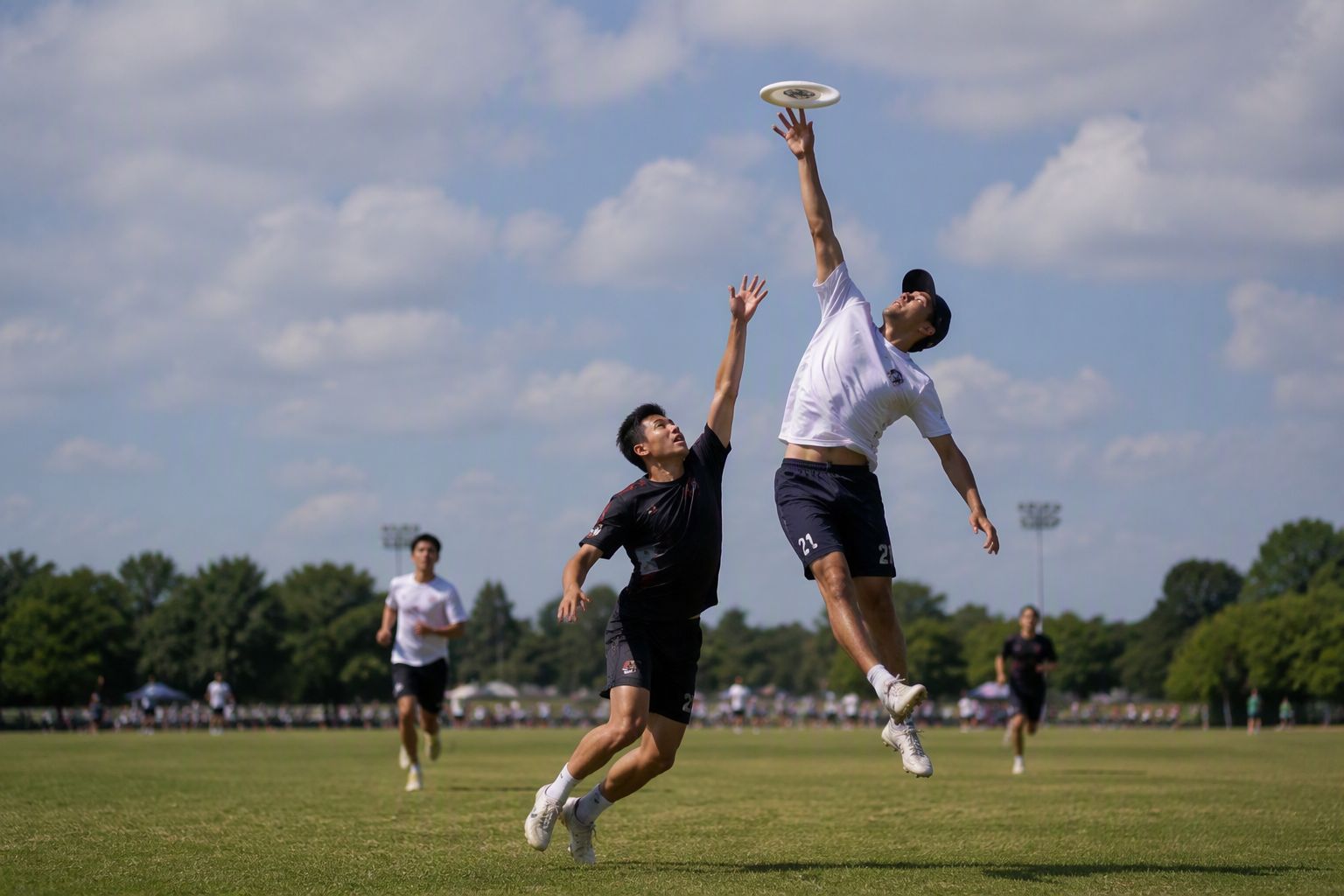
Ultimate’s self-officiated identity is not just a cultural slogan, it is part of how possession restarts and calls are made. USA Ultimate’s materials describe Spirit of the Game as a system that builds trust by asking each player to know and uphold the rules, and its Spirit of the Game language makes clear that players make their own calls on the field. That creates a different kind of game flow from sports built around referees, because the players themselves have to recognize what happened and decide how the point should continue.
That philosophy has never existed without debate. WFDF has documented a long-running argument over spirit versus the observer system at the highest levels of competition, and commentary from Ultiworld in 2012 and 2013 reflected the same tension, including arguments for more formal officiating in some settings. USA Ultimate’s 2020 observer manual, revised in January 2020, listed Jon Bauman, Hank Cary, Jerome Connell, Greg Connelly, Will Deaver, Mitch Dengler, Mike Gerics, Janna Hamaker, Margo Hasselman, Byron Hicks and Vic Kamhi among its authors and contributors, showing how the sport has built structure around self-officiation without replacing it.
How a point actually ends
The scoring rule is simple: if the offense catches a legal pass in the opponent’s end zone, it scores a point. That is the cleanest part of the sport, and it is also what makes a single point such a good teaching tool. The pull starts the sequence, the offense survives or loses the stall count, and the possession either ends in a score or flips to the other team.
Once that loop is clear, the game stops looking random. A layout catch near the goal line, a stalled throw under pressure, or a sharp block in the lane all fit the same pattern: start, build, break, finish. One point tells the entire story in miniature.
Where the sport came from
Ultimate’s modern origin is usually traced to Columbia High School in Maplewood, New Jersey. WFDF says Joel Silver introduced the idea to the Columbia High School student council in 1968, and the first game was played in 1969 between two groups of students using a Wham-O Master disc. USA Ultimate’s background materials also describe the sport as developed in 1968 by students at Columbia High School.
That origin still shows up in how the game is framed. USA Ultimate describes Ultimate as a low-cost sport requiring minimal equipment, offering single and mixed-gender play, and building community beyond the field. It is a good fit for a game whose whole structure is built around a disc, a count, and a set of players who have to keep the point moving on their own.
Why the current rules matter
The rulebook changed, too. USA Ultimate’s archive says the 11th Edition Rules were no longer current as of January 1, 2020, and the 2020-2021 official rules superseded them. That matters because some older terminology and procedures still linger in conversation, especially around stalling, observers, and how a point is restarted after a stoppage.
Even so, the viewer-facing basics stay the same. A pull starts each point, the offense advances by passing, the stall count applies constant pressure, and any turnover flips possession instantly. Once those four pieces are clear, Ultimate becomes much easier to follow, from the first pull to the last catch in the end zone.
Sources
- [1]usaultimate.org
- [2]archive.usaultimate.org
- [3]wfdf.sport
- [4]ulta.world
- [5]ultiworld.com