How flag football grew from wartime recreation to global sport
American soldiers did not invent flag football as a novelty. They turned it into a practical version of football on military bases during World War II, where touch and tail football offered speed, space, and competition without the collision costs of the tackle game. That origin still explains the sport’s appeal today: it was built to be played with limited equipment, limited room, and far less physical risk than traditional football.
From wartime recreation to a cleaner rulebook
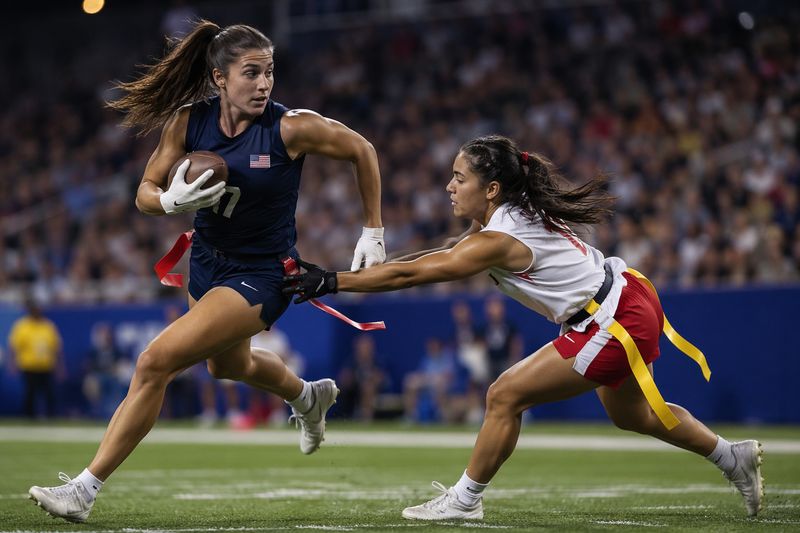
Britannica traces the sport’s roots to that wartime setting and notes that the name was later shortened to flag football. The key shift was not just cosmetic. The game evolved around a clear noncontact identity, with defenders stopping the ball-carrier by pulling flags instead of tackling, and with modern rules forbidding physical contact such as blocking and tackling. That structure made the sport easier to organize, cheaper to play, and more accessible in places where full football infrastructure was unavailable.
The result was a game that spread because it solved a practical problem. You do not need shoulder pads, a full line of scrimmage, or a large roster to make it work. You need a ball, a few players, and enough space to run routes and pull flags. That simplicity helped flag football move from a military recreation into a mainstream pickup and organized youth sport in the United States after the war.
Why the modern version looks so different from tackle football
Flag football is still unmistakably football, but its design changes the rhythm of every play. Britannica describes it as a two-team game of five players, with defense relying on flag pulls rather than hits. That creates a version of football where acceleration, spacing, timing, and improvisation matter more than brute force.
Those features also shape the sport’s broader appeal. Because contact is sharply restricted, flag football can be taught and played in settings that would struggle to support tackle football, including schools, recreation programs, and international development pipelines. It is the football code that travels well because it is not tied to the expensive and physically demanding machinery of the full-contact game.
The global scale is no longer in doubt
The modern growth story is built on numbers that are hard to ignore. The NFL says flag football is now played by approximately 20 million people in more than 100 countries, while NFL materials also point to more than 4.1 million youth participants in the United States alone. That domestic youth base has climbed by more than 50% since 2020, a strong indicator that the sport’s rise is not confined to international showcase events.
The school game is growing too. NFL reporting says flag football is now offered at the high school level in 39 states, and the number of young women playing on high school teams increased by nearly 60% from 2024 to 2025. That matters because the sport’s expansion is not only geographic, it is demographic. Flag football is widening access for athletes who may never have had a clear path into football participation before.
Olympic inclusion turned momentum into credibility
The biggest institutional stamp came in October 2023, when the International Olympic Committee approved flag football for the Los Angeles 2028 program at the 141st IOC Session in Mumbai. It joined baseball and softball, cricket, lacrosse, and squash as additional sports for LA28, placing flag football in a category reserved for disciplines with real international traction.
That decision gave the sport a new benchmark. Olympic inclusion is not just a trophy for the rulebook; it is a signal that the game now has the scale, structure, and global relevance to fit the Olympic model. For a sport that began as wartime improvisation, the path to Los Angeles 2028 gives the history a rare kind of clarity.
The World Games preview showed the competitive standard
Flag football was already building an international résumé before the Olympic announcement. It served as a demonstration sport at the 2022 World Games in Birmingham, Alabama, where the United States won the men’s final and Mexico defeated the host United States in the women’s final. That event gave the sport a recent, visible benchmark for elite play outside the NFL ecosystem.
The World Games mattered because they showed that flag football’s best teams are not operating in a vacuum. National programs now develop talent, prepare rosters, and compete for medals in a format that has real international stakes. The event also offered a preview of the kind of cross-border matchup that makes Olympic inclusion feel less like a marketing push and more like a formal recognition of an existing competitive map.
The world championships show the hierarchy is already established
IFAF has given the sport a more continuous championship structure. Its senior men’s World Flag Football Championship was first held in Austria in 2002 and has taken place every two years since. That long-running schedule matters because it shows the sport has already spent more than two decades building an international calendar, not just a one-off showcase circuit.
The 2024 championship in Lahti, Finland was the largest ever, with 55 teams from 32 nations. The United States won both the men’s and women’s world titles, extending a dominance that is now deeply established: the U.S. men have won five straight world championships and the U.S. women have won three. Those results give the Olympic conversation a competitive baseline. The sport is global, but the current standard-bearer is still unmistakably American.
The next step is professionalization
The NFL has been one of the sport’s biggest institutional accelerants, promoting flag football through NFL FLAG, the Pro Bowl’s flag format, and the NFL FLAG Championships. In March 2026, the league announced a partnership with TMRW Sports to develop a professional flag football league for women and men, a sign that the sport’s business case is expanding beyond youth participation and international tournaments.
That move points to the sport’s next phase. Flag football is no longer being treated only as a developmental tool or an Olympic side story. The league’s growing involvement, combined with the rise in youth participation, high school adoption, and international championships, shows a sport whose infrastructure is becoming more formal, more visible, and more commercially attractive.
Why this rise is different from a fad
Flag football’s credibility comes from the traceable line between its origins and its current shape. It started as wartime recreation, was built around noncontact rules, and was adopted by institutions that recognized its low-cost, high-access design. The game’s movement from military bases to school fields, world championships, and the Olympic program is not a sudden trend line. It is the logical result of a sport that was always easier to scale than tackle football, and now has the governing, competitive, and commercial machinery to match.
Sources
- [1]britannica.com
- [2]olympics.com
- [3]nfl.com
- [4]media.nfl.com
- [5]americanfootball.sport