How flag football’s 5-on-5 rules reshape strategy and scoring
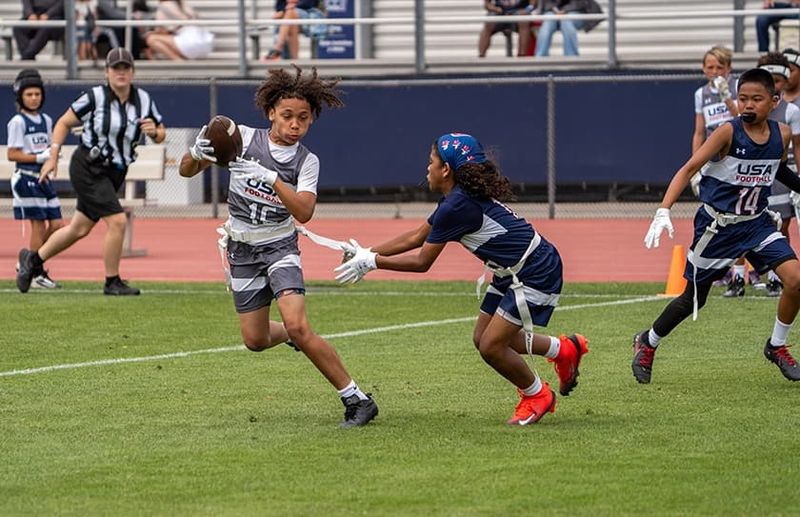
On a 50-by-25-yard field, five-on-five flag football has no blocking, no linemen, and a shorter clock between snaps. The game becomes a test of spacing, ball security, and quarterback timing instead of trench play and brute force.
The field changes everything
In IFAF Fives, offenses get four downs to reach midfield and four more downs to score once midfield is crossed.
Because the field is short, one bad snap or one missed route can swing an entire possession. Offenses do not have the luxury of long, grinding drives built around repeated contact. They have to sequence plays with purpose, because getting to midfield is only half the job and the red zone is still waiting.
USA Football uses the IFAF five-on-five framework for official international competition, including exhibitions like the International Bowl. The IFAF five-on-five framework is the standard for international play.
No blocking means space is the battleground
The biggest conceptual change for new viewers is the absence of blocking. There are no linemen, the center is eligible as a receiver, and all offensive players can catch passes. Contact is forbidden, and the 2023 IFAF rulebook describes the sport as non-aggressive and non-contact while still competitive.
In tackle football, protection schemes buy time. In flag football, the offense wins by moving defenders with routes, motion, spacing, and timing before the rush ever lands. The center being a receiver also stretches the defense in a way most fans do not expect.
Lateral plays are allowed behind the line of scrimmage, and multiple quarterbacks can be used. That gives offenses more ways to move the ball without relying on one static pocket.
The rush count is the hidden clock
Defensive blitzers must line up at least seven yards from the line of scrimmage and identify themselves before the snap, so pressure is controlled rather than chaotic. That keeps the game non-contact, but it does not remove the threat of pressure.
For a quarterback, that changes the rhythm from the first read. There is less time to hold the ball, fewer chances to wait for a play to develop, and much more value in quick decisions. A good flag offense is built on timing routes, pre-snap clarity, and throws that arrive before the defense closes space.
The blitz is a declared assignment. A smart defense times the rush and forces hesitation; a sloppy one gifts easy completions because the offense knows where the pressure is coming from.
The no-run zone forces creativity near the goal line

The most important rule for new fans to watch near the end zone is the no-run zone. In the five-yard area in front of each end zone, plays must be passes. That single rule wipes out the easiest short-yardage answer in tackle football: line up, lean forward, and punch it in.
Instead, compressed-field scoring becomes a passing problem. Offenses have to win with route concepts, spacing, and timing, not power. That is why red-zone possessions can look more like basketball sets than football bruising. Defenses know a pass is coming, and the offense knows that the easy answer is gone.
Scoring is quick, but the details matter
IFAF Fives uses 20-minute halves, two timeouts per half, and 25 seconds between plays. Touchdowns are worth 6 points, safeties are worth 2, and extra-point tries come from either the 5-yard line or the 10-yard line. That pace keeps the game moving, but it also leaves less room for recovery after a mistake.
The short play clock magnifies quarterback timing. A late substitution, a slow huddle, or a blown read matters more because there is less dead time to reset. The pace also makes game management more aggressive, because two timeouts per half disappear quickly when every possession feels like a scoring chance.
The penalties that most often trip up new viewers are the ones tied to space and movement: shielding, flag guarding, and impeding the rusher. When you see a drive stall or a big play wiped out, it is often because a player gained an unfair lane or protected a flag instead of creating a clean football move.
Why the Olympic and global stage changes the stakes
Flag football will debut at the Olympic Games Los Angeles 2028. The sport’s roots go back to the early 1940s, when it emerged during World War II as a lower-injury recreational version of American football for military personnel.
The 2024 IFAF Flag Football World Championships in Lahti, Finland were the largest ever, with 55 teams from 32 nations and 660 athletes. The United States swept both gold medals, with the men winning their fifth straight world title and the women their third.
The women’s game also got a major boost at the 2022 World Games in Birmingham, Alabama, the first true global showcase for women’s flag football. It gave the women’s side of the sport a stage that matched the scale of the men’s competition and helped accelerate the Olympic pathway.
The NFL has also pushed the sport into a bigger spotlight. In May 2025, the league confirmed that NFL players would be eligible to compete in flag football at LA28, and Roger Goodell has said he expects active players to appear at the Games. That raises the ceiling on star power, but it also raises the tactical stakes, because Olympic rosters could mix elite flag specialists with current NFL talent.
The pathway is already built
IFAF’s championship structure now runs through world championships and continental championships across regions including the Americas, Asia-Oceania, Europe, and Africa. The 2025 IFAF Americas Continental Championship is a milestone on the road to the world championships and LA28.