How iFlag built flag football’s booming tournament ladder

iFlag has spent years turning flag football from scattered local runs into a tournament ladder with actual weight behind it. The organization, formerly USA Flag, says it is “on the forefront of pushing the sport for Olympic inclusion,” and that mission shows up in the way its events are built: qualifiers lead to nationals, nationals feed worlds, and worlds now pull teams from multiple countries into the same bracketed weekend.
The ladder starts with structure, not hype
The key to iFlag’s model is that its official qualifying Open, National and World Championship tournaments are owned and operated by staff, not left to a loose patchwork of independent events. Those tournaments deliver 2x to 5x ranking points, and winners can earn paid entries toward Nationals or Worlds. That matters because it gives every game a consequence beyond the trophy on the field: the bracket itself becomes the pathway.
That system is what turns participation into progression. In a sport built on accessibility, anyone can put together a roster and play, but only official events move teams up the ladder in a meaningful way. Instead of a flat calendar of weekend tournaments, iFlag has created a ranking engine that rewards consistency, success, and repeat appearances across the season.
Tampa is the proving ground
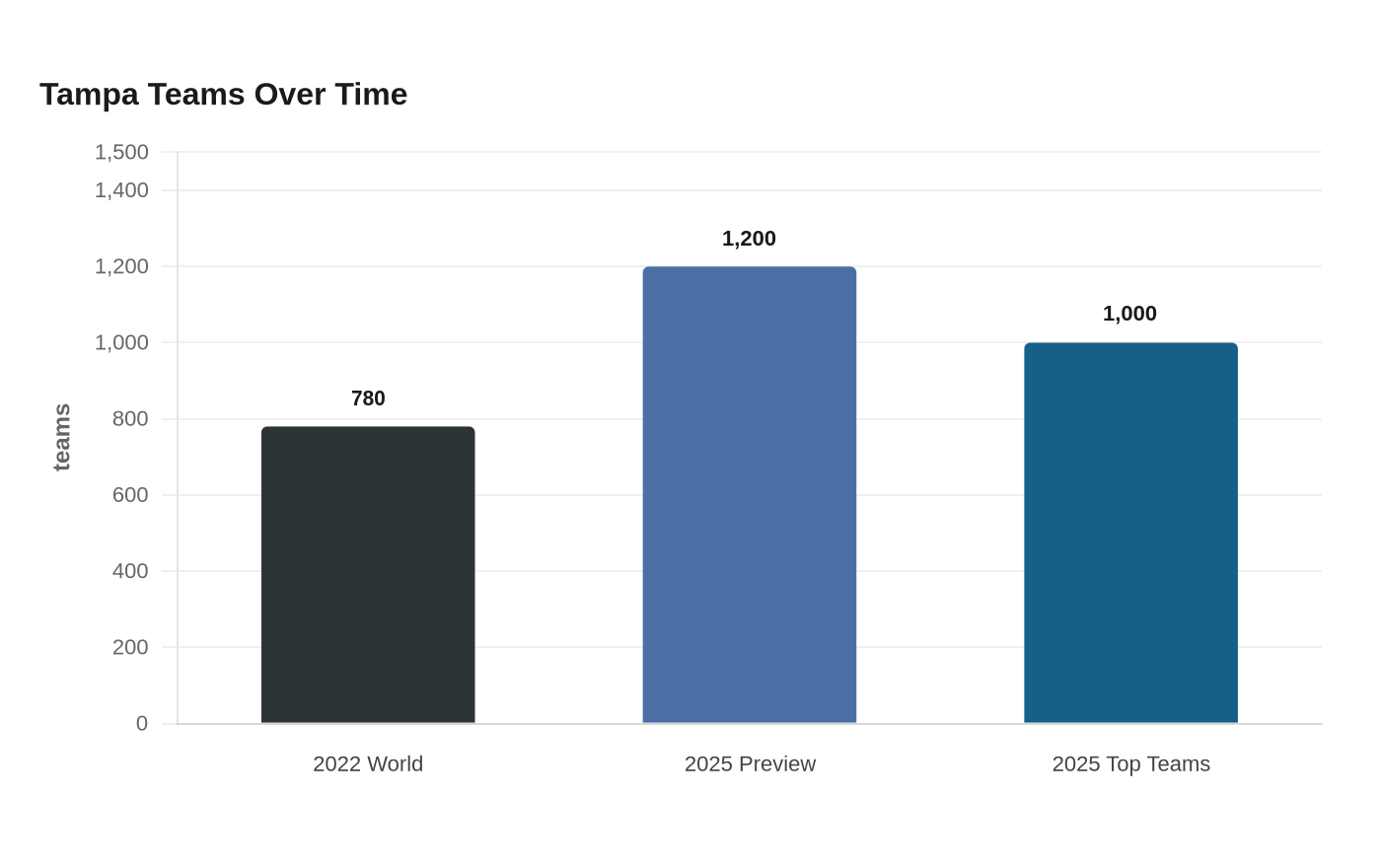
The scale of iFlag’s championship weekends shows how far the sport has moved. Its 2022 World Championship in Tampa drew more than 780 teams over three days and was split across 32 divisions. That is not a novelty event with a handful of elite squads; that is a serious tournament economy, with enough volume to sort teams by age, gender, and competitive track without collapsing into chaos.
The growth did not stop there. A 2025 Tampa World Championships preview projected more than 1,200 teams, while iFlag’s 2025 World Championships page placed the event in Tampa, Florida, from January 15-19, 2025. Another iFlag preview said the 2025 Tampa World Championships would host roughly 1,000 of the world’s top teams from the United States, Canada, Panama and other countries. Tampa has become iFlag’s laboratory for scale, and the numbers show a sport that can now support a true championship weekend, not just a showcase game.
The same page family helps explain how large the operation has become beyond team count alone. iFlag says it broke a Guinness World Record in Tampa by hosting the largest flag football tournament ever, bringing 11,779 athletes to Tampa’s Sportsplex. That is the kind of figure that changes the conversation around the sport: flag football is no longer just easy to start, it is now large enough to require a real event infrastructure.
How teams move through the system
The path is straightforward once you understand the architecture:
- Teams enter official Open tournaments, where iFlag staff run the event and rankings matter.
- Strong results earn 2x to 5x ranking points, which help teams climb the ladder.
- Winners can receive paid entries toward Nationals or Worlds, turning one good weekend into a bigger opportunity.
- Teams that keep advancing land in iFlag’s National and World Championship fields, where the brackets get deeper and the stakes get higher.
That structure solves a problem every growing sport faces: how to separate casual participation from championship contention without shutting out the grassroots base that keeps the game alive. iFlag’s answer is to make the pathway visible and repeatable. If you win in the right place, the next stop is already mapped out.
Broadcast coverage gives the ladder a public stage
The championship model does not stop at the field. iFlag says the Tampa World Championships aired on CBS Sports Network, with pro-division windows listed for February 22 and February 23. National television changes the value of a tournament bracket, because it adds visibility for players, teams, and the sport’s most competitive tier.
That broadcast footprint also fits the international angle. When a tournament can pull teams from the United States, Canada, Panama and other countries, and place them on a national cable platform, it starts to resemble the event-driven structure that other established sports use to grow their audiences. The ladder is not just about who wins. It is about which events are important enough to build a calendar around.
The next rung keeps rising
iFlag’s public calendar shows that the system is still expanding. Its 2026 Tampa World Championships page listed January 14-18, 2026 in Tampa, Florida, extending the same championship hub into another season. The broader horizon is even clearer in Las Vegas, where iFlag points to a 2028 World Cup. That puts the sport on a trajectory that is bigger than one city or one weekend.
This is why iFlag matters in the flag football conversation. The organization did not just host large tournaments, it built a repeatable ladder with rankings, qualifiers, national exposure, and international reach. In a sport chasing mainstream and Olympic legitimacy, that machinery is the story.
Sources
- [1]iflag.org