How kickball became a structured school sport in 1971
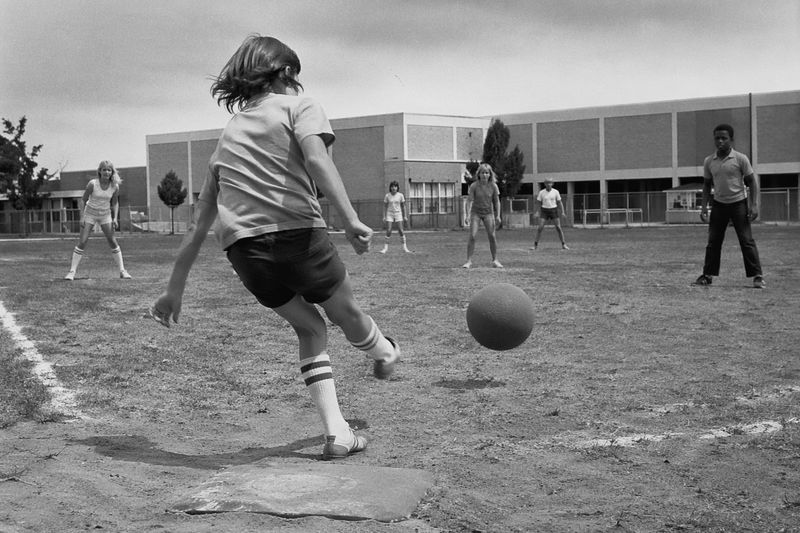
Kickball’s place in school sports was not an accident of playground culture. In Dade County Public Schools, a 1971 authorized course of instruction for the Quinmester Program turned the game into a structured unit for grades 7-12, with lessons built to be taught, observed, and graded. The guide treated kickball as more than a casual diversion: it was a way to teach body control, field awareness, turn-taking, and the habits that made school PE function.
The 1971 guide put kickball inside the curriculum
The Dade County course guide, filed in ERIC as ED093881, is the clearest proof that kickball was built into physical education on purpose. It was organized into eight parts, including course guidelines, a course description and broad goal, behavioral objectives, course content, learning activities and teaching procedures, evaluation plans, and a bibliography. That structure matters because it shows kickball was approached like any other school subject unit, with defined outcomes and a teacher’s plan for how to deliver them.
The guide says beginning kickball was designed as a lead-up game to softball. That framing made the sport useful in a school setting because it connected a simple class game to a more formal field sport, while giving students a chance to develop skills they could carry into other activities. The stated goal was straightforward and expansive at the same time: students were supposed to gain enough skill to enjoy kickball as a lifetime sport in school and leisure settings.
The lesson design was equally deliberate. The guide included warm-up exercises, drills, skills practice, and teacher evaluation, which means kickball was treated as something that could be broken down, taught in pieces, and assessed. It also built in observation skills, basic skills, course content knowledge, and social and personal attitudes, so the unit was not just about kicking a ball hard or reaching a base safely. It was also about how students watched the game, understood the rules, and behaved in a shared space.
Why kickball fit the logic of physical education
Kickball stayed in schools because it solved a practical teaching problem. It is simple enough to fit into a class period, but it still gives teachers enough moving parts to teach motor control, game sense, and sportsmanship. A teacher can watch a student plant a foot, judge a rolling ball, rotate through the bases, and react to pressure, all in one activity. That combination made kickball especially useful in a curriculum that wanted visible outcomes.
That same logic fits the broader history of physical education. SUNY Cortland’s account of PE history describes school sports as developing through a top-down model, with goals centered on fitness, social development, and health. Kickball sits neatly inside that tradition because it is easy to organize from above, easy to supervise, and easy to adapt for mixed groups of students. The game’s school value came from control and measurability as much as from fun.
Modern PE still works through the same curriculum mindset. The CDC defines physical education as a planned, sequential K-12 curriculum based on national standards, and its PECAT tool is built to help schools analyze curricula through outcomes, content, and assessment components. That language could almost have been written for the 1971 Dade County guide, which already relied on objectives, content, learning activities, and evaluation. The difference is that today’s standards language is broader and more formal, but the underlying logic is strikingly similar.
Kickball has adapted to inclusion, not disappeared
The game’s school life did not freeze in 1971. It kept evolving as educators used it for different student needs and different levels of access. In Kansas State Department of Education materials, kickball still appears in a softball activity library through lead-up games such as Alaskan Kickball and Revenge Kickball. Those entries show that kickball remains a modular teaching tool, one that can introduce striking, throwing, catching, and base-running concepts before students move into softball-style play.
The same pattern appears in adapted physical education. Perkins School for the Blind publishes a modified kickball activity that uses adapted equipment and rule changes, tying the game directly to adapted PE and national standards. The point is not to preserve kickball in a museum case, but to make it playable for students with different needs while keeping the same core idea: learn the game by participating in it.
A 2019 East Carolina University story about Wintergreen Intermediate School in Greenville, North Carolina, shows that approach in action. Second- through fourth-grade students played beep kickball, and an adaptive PE teacher said the activity gave blind students a chance to be together and play. That detail matters because it shows how the sport’s school role shifted from basic instruction in a general PE unit to a more inclusive tool for shared participation.
The origin story is messier than the school version
Kickball’s long life in schools can make it seem like a fixed American original, but the game’s origin story is disputed. The Society for American Baseball Research notes one theory that credits Nicholas Seuss, a Cincinnati Park Board playgrounds director, with inventing kickball around 1917. The World Kickball Association disputes that single-inventor account, which leaves the game with a more complicated public-play history than the tidy version often repeated in gyms and on playgrounds.
That uncertainty does not weaken the school story. If anything, it helps explain how the game traveled so easily into classrooms, playgrounds, and later adult leagues. The game was already part of public recreation before it became a formal lesson unit, and that made it adaptable to school settings that needed low-equipment activities with clear rules. The World Adult Kickball Association, founded in 1998, shows how far the game later moved beyond youth PE into organized adult play.
What the 1971 model reveals about today’s PE priorities
The 1971 guide and today’s curriculum tools point to the same core truth: schools keep kickball when they want a game that can teach skills without overwhelming the class. In 1971, the emphasis fell on behavioral objectives, warm-ups, drills, and teacher evaluation. Today, the emphasis still includes outcomes and assessment, but inclusion has become far more visible, with adapted equipment, rule changes, and lead-up games built into the system.
That shift shows how PE priorities have changed. Skill development still matters, but so do inclusion, safety, and the ability to assess progress in a structured way. Kickball survives in that environment because it can serve all of those purposes at once: it teaches movement, rewards cooperation, and gives teachers a game they can shape to the class in front of them.
Sources
- [1]files.eric.ed.gov
- [2]cdc.gov
- [3]www2.cortland.edu
- [4]pe-kansas.com
- [5]perkins.org
- [6]news.ecu.edu
- [7]sabr.org
- [8]kickball.com
- [9]en.wikipedia.org