How official World Dodgeball Federation matches are played under cloth rules
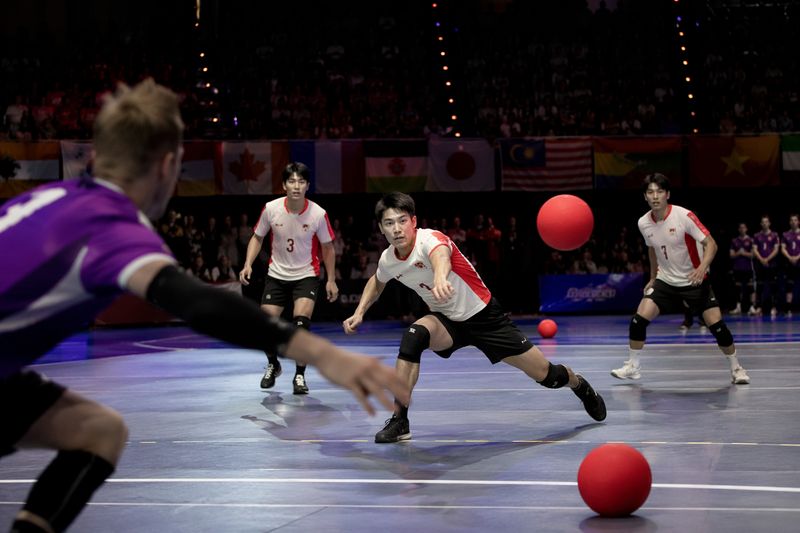
A WDBF cloth match is built to be read at a glance: 18 meters long, 9 meters wide, with at least 1 meter of free space on every side and five balls set on a marked center line. The federation treats the posted rules document as the current active guide for sanctioned events, so the floor plan is not decoration, it is the sport’s operating system. In cloth play, the neutral zone line sits 2 meters back from center and the five ball markings on the line are spaced 1.5 meters apart, which is why the game starts with layout before it starts with speed.
The court tells you where every possession begins
That geometry matters because WDBF dodgeball is designed to prevent ambiguity. The neutral zone, center line and attack space define where teams can pressure, where they must hold, and where a ball can become a live problem in a split second. On a court that compact, every step has consequences, and the rules are written to keep those consequences consistent from one sanctioned event to the next.
The federation’s 2026 cloth rules were published in May 2026, and they were shaped through consultation with athletes, referees, continental confederations, national federations and technical leaders. That matters because the current rulebook is not just a housekeeping update, it is the version WDBF says will govern sanctioned play while earlier major rulesets remain available during transitions for national and territorial organizations. In other words, the game is standardized enough that a player, official or coach can walk into a new event and recognize the same basic map.
The cloth ball changes the skill test
The equipment is just as precise as the court. WDBF cloth dodgeball uses 5 balls, and they are not playground rubber balls. Each one has to be textured no-sting cloth, built with a 2 to 4 millimeter foam layer, a butyl bladder and webbing inside, and the official circumference is 17.78 centimeters, or 7 inches.
Those specs change how the sport feels in play. The ball’s 1.6 to 1.8 psi pressure window affects grip, spin, speed and how catchable the ball is when it reaches a hand at full pace. That is why elite players care about feel as much as power, because the same ball that leaves a hand hard must still be controllable enough to handle, block or secure cleanly under pressure.
A match moves in strict phases
A WDBF cloth match is split into two equal halves of 20 minutes, with a 5-minute halftime break and a side switch at the break. That structure gives the sport a clear rhythm: the opening push to establish control, the long middle where live balls and catches decide possession, and the late stages where discipline matters as much as throwing accuracy.
The official framework also covers the opening rush, live-ball definitions, catches, blocking, eliminated-player movement, boundary rules, simultaneous play, ball retrieval and penalties. That list sounds administrative until you watch a high-level set unfold. Once the balls are live, a catch can restore a teammate, boundary mistakes can kill a possession, and movement rules keep eliminated players from becoming part of the live sequence again.
For fans trying to track a set possession by possession, the important thing is this: the early part of a half is about claiming usable balls, the middle is about turning those balls into outs or catches, and the end is about surviving without giving away free opportunities. The rules keep all of that readable even when the pace gets frantic.
Cards are where close matches turn
WDBF cloth rules make blue, yellow and red cards decisive game-management tools. A blue-carded player goes to the penalty area for the rest of the current set and the entire following set, a yellow card sends a player to the penalty area for 5 minutes of match time, and a red card leaves the team short-handed for the rest of the match.
The blue card carries the sharpest structural risk. If a team cannot field at least 1 player because of a blue-card penalty, it immediately forfeits the current set, and under the 2026 cloth rules it also forfeits the following set. That is the kind of penalty that can swing a match without a single throw changing hands, which is why discipline becomes a tactical issue late in tight sets.
The world stage has made cloth central
The sport’s governance has grown alongside the rulebook. The World Dodgeball Federation formed in July 2011, after representatives from several countries agreed to create it, and the first Dodgeball World Championship followed in Kuala Lumpur in 2012. By 2024, the world championship had become a full international event in Graz, Austria, staged August 11-17 at RAIFFEISEN SPORT PARK GRAZ.
That 2024 championship was important for cloth because the format had been added to the world stage in 2022, and the event featured men’s, women’s and mixed cloth divisions. One cloth medal table put the United States on top, with Malaysia second and Australia third, which shows how international the top end of the game has become. Cloth dodgeball is no longer a side experiment on the championship schedule; it is one of the formats that defines the highest level of the sport.
One membership count put the federation at 80 members in 2021, a sign of how widely the sport has spread as the rulebook has become more precise. That growth helps explain why the federation keeps the active rules posted and preserves prior major versions during transitions: the sport now has enough international reach that consistency is part of the product.
Why the rhythm matters
Once you understand the court, the ball and the cards, an official WDBF cloth match stops looking like chaos and starts looking like a sequence. The 18-by-9-meter floor sets the geometry, the 7-inch cloth ball sets the skill test, the two 20-minute halves set the clock, and the card system sets the line between hard play and costly mistakes. That is what makes modern cloth dodgeball fast, technical and brutally disciplined from the first rush to the final whistle.