How to master the racquetball receiving position and return of serve
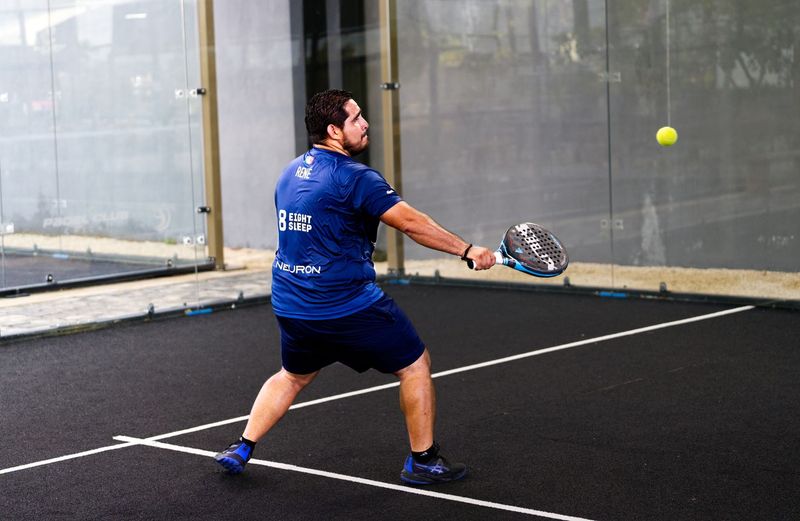
The first ball after the serve decides far more racquetball rallies than the scoreboard suggests. If you begin in the wrong place, you give away angles before the return even leaves your strings; if you settle into the middle of the court, about an arm and a racquet length in front of the back wall, you keep more options open against a server who already has the edge.
The middle-court compromise
William & Mary’s serve-return guide puts the receiver in a very specific spot: the middle of the court, about an arm and a racquet length in front of the back wall. That distance is the compromise that matters most in racquetball. It leaves you close enough to handle a serve headed to either side, but far enough back to read the ball off the front wall and side walls without getting pinned to the glass.
That positioning also matches the reality of the game’s first exchange. The guide is blunt about the pressure on the returner, noting that the receiver is at a distinct disadvantage. In practical terms, that means the goal is not to win the rally instantly, but to deny the server easy lanes and keep the court from shrinking before the second shot.
Build the ready posture before the ball leaves the server’s hand
The stance only works if the body is ready to move in any direction. William & Mary recommends holding the racquet about waist high across the body, preferably supported by the left hand, staying athletic with knees bent and weight on the balls of the feet, and using a loose backhand grip. Those details may sound small, but together they create a neutral starting point that can turn into a forehand, backhand, or emergency reach without a long reset.
• Keep the racquet at waist height, not floating up near the chest. • Let the left hand support the racquet across the body for stability. • Stay low with bent knees and pressure on the balls of the feet. • Hold the racquet loosely with a backhand grip so the face can adjust fast. • Avoid standing stiff or square, because that delays the first step.
The biggest posture mistake is bending at the waist. William & Mary advises against it because it makes breathing harder and forces you to stand up again anyway when you move, which adds a wasted motion right when speed matters most. In a sport where the ball can die off the front wall or kick hard off a side wall, that extra rise can be the difference between a clean return and a scramble.
Read the serve, not just the server
Leo Vasquez, program director of the Maverick Athletic Club in Arlington, Texas, demonstrated return-of-serve strategy in a 2014 Fort Worth Star-Telegram and DFW OT video, and the lesson remains simple: position yourself to respond to the serve rather than chase it. That distinction is crucial because the receiver has to cover a weak serve, a drive serve, and a ball that dies off the wall without overcommitting to any one answer.
Against a drive serve
A drive serve pressures you horizontally, so the middle-court start keeps both lines visible. From there, the loose backhand grip lets you turn the racquet quickly without a big grip change, which matters when the ball arrives fast and low.
Against a softer serve or a dying ball
A softer serve can tempt you to creep forward too soon, but that is where many fast-exchange mistakes begin. If you drift in before the bounce is fully read, you lose time recovering when the ball dies off the front wall or catches the side wall in a way that shortens the return.

Against a serve that moves late
Late movement off the wall punishes players who start upright or too tight. A balanced, bent-knee stance keeps your center of gravity low enough to react without a false step, which is exactly why the ready posture matters more than a flashy swing at the start of the rally.
Why the first exchange matters so much in standard play
USA Racquetball’s rules make the point structure clear: the objective of each rally is to win by serving or returning so the opponent cannot keep the ball in play, and only the serving side scores points in standard play. That means the serve is one of the few chances to score directly, and the return is the first chance to strip away that advantage. The official rules pages for the game, courts and equipment, and play regulations reinforce the sport’s geometry and why the receiving position is such a tactical fulcrum.
That structure explains why the middle-court stance is not passive. It is a defensive setup with offensive consequences, because a strong return can force a weaker next shot or turn the server’s advantage into a neutral rally. In racquetball, the gap between surviving the serve and controlling the rally is often one clean return and one bad first step.
The sport’s history keeps rewarding the same fundamentals
Racquetball’s best players have long won through the same serve-return discipline. USA Racquetball’s Hall of Fame page on Marty Hogan says he was born on January 22, 1958, won his first professional title in 1975 in Burlington, Vermont, and finished with more than 150 combined pro tournament victories over a forty-year career. That kind of longevity is a reminder that elite racquetball has always rewarded repeatable fundamentals more than improvisation alone.
Ed Andrews’ Hall of Fame page tells a similar story in a different form. It lists four AARA National Singles Championships in 1980, 1981, 1985, and 1986, and notes that he won every game in those four tournaments. Dominance like that starts with reliable first-ball habits, because a player who controls the return keeps opponents from ever settling into their preferred rhythm.
USA Racquetball’s history and publications pages also show how deeply the sport values institutional memory. The same organization has continued to maintain the official framework for rules, play, courts, and equipment while the game evolves around it. That continuity matters to coaches because it keeps the language of the receiving position, and the habits attached to it, from getting lost.
The modern game still runs on the same setup
The business side of the sport shows that racquetball still has an active national base. On February 1, 2023, USA Racquetball announced that HEAD Penn Racquet Sports had extended its tenure as the official ball provider. On February 18, 2025, it announced Gearbox Sports as the official brand of USA Racquetball, and on March 21, 2025, it announced that the US Open Racquetball Championships would return in 2026. Those moves point to a sport that still has commercial partners, official standards, and marquee events worth building around.
That larger structure is why the receiving position remains such an essential coaching topic. Equipment may change, and the calendar may add new partnerships and events, but the court still rewards the same truth: if you win the first geometry of the rally from the middle of the floor, you keep the second shot alive long enough to matter.