How Ultimate Frisbee tournaments really work, from pulls to schedules
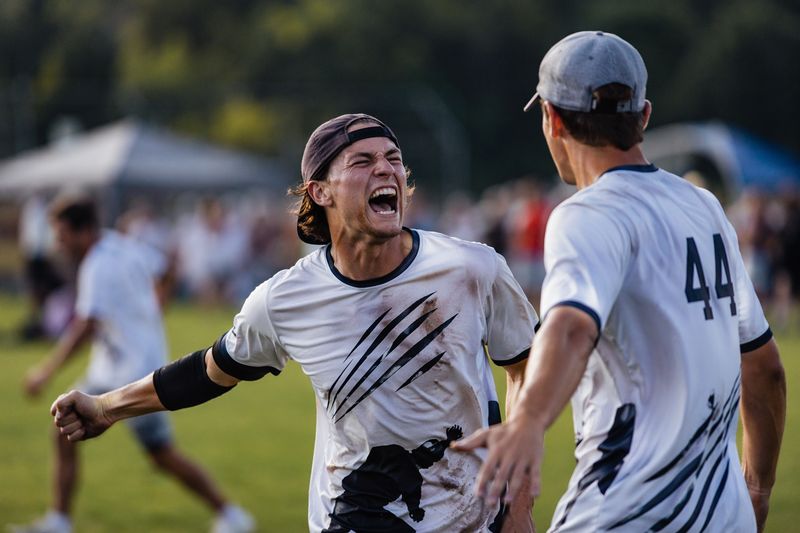
Two teams of seven cover a 70-yard by 40-yard field with 20-yard end zones, and each point begins with a pull. The real grind is everything that happens after that first launch. A legal catch in the attacking end zone scores; an incomplete pass turns the disc over immediately; and the thrower has 10 seconds to get it out while the marker counts the stall.
Ultimate is built around Spirit of the Game, which puts fair play on the athletes themselves. Players are expected to know the rules and make their own calls without neutral officials, so a weekend tournament tests pacing, communication, and how sharp teams stay after the first game legs start to go.
How a tournament day gets packed so tight
The congestion starts with the competition limits. In state events using full-length games, teams can play three games in a day and six over a weekend. Sectional, conference, and regional events are even tighter, capped at no more than five games per day and no more than nine over two days, with games at least to 11 points and at least 60 minutes long. That is why a Saturday can feel less like a leisurely bracket and more like a logistics drill.
Picture a team in pool play. It wakes up for an early round, sits through a short recovery window, then gets shoved back out for another game before lunch or late afternoon. If the bracket is set to reward pool finish, one bad point margin can decide whether that team lands in the top half of the draw or spends the afternoon in consolation.
Older formats allowing five games per day or eight per weekend have been replaced in part by newer guidance in USA Ultimate’s competition materials.
What a real game clock does to strategy
The score target tells only part of the story because the clock can overrule it. Event rules can change game length, halftime length, timeouts, starting time point assessments, uniform requirements, and observer operations, but those changes have to be set before competition begins. In one current USA Ultimate Pro Championships rules set, games go to 15 with a soft cap at 90 minutes and a hard cap at 105 minutes. Another event set uses an 80-minute soft cap and a 95-minute hard cap.
That means coaches are managing two games at once: the one on the field and the one against the timer. Before a soft cap, teams can play a more conventional style, pressing throws and stretching the field. After a cap hits, every possession changes shape, because finishing the current point becomes the priority and the math can shift from “reach 15” to “survive the next possession.” If the game is tied when hard cap hits, one more point decides it, the sudden-death finish everyone calls universe point.
Once hard cap takes effect, no two-pointers are available except for a disc already in the air. USA Ultimate adopted that rule after a game once ran 30 minutes late into the next round because a trailing team was trying to set up a tying two-pointer to force universe point.
An 11-9 game might not mean one team dominated to the target. A 13-12 or 14-13 result can mean the cap, not the nominal point goal, decided the ending.
Why pools, brackets, and field logistics matter as much as the throws
Tournament structure is built around moving teams efficiently from pool play into bracket play, and every field has to serve more than one master. Results have to be posted by midnight, spirit ratings have to be moved through the results pipeline, and organizers have to use an approved format.
Field logistics also shape the fan experience. Fields are standardized, the pull restarts every point, and the 10-second stall count keeps possessions from stretching forever. Halftime is one of the variables that can be changed before competition starts.
That compression also changes roster management. Deep lines matter because five games in a day or nine in two days is a brutal ask, especially when every point is self-officiated and every contested play costs energy. Coaches cannot just chase the best seven for 90 minutes and hope for the best. They have to think in blocks, conserving legs for the back half of the day and deciding when a line can absorb one more shift.
The observer layer keeps the whole thing from collapsing
Ultimate still runs on self-officiation, but observers are a crucial part of the tournament ecosystem. USA Ultimate’s observer certification clinics are two-day trainings that cover code of conduct, officiating philosophies, mechanics, drills, and the game-day experience. The observer system sits alongside the official rules when caps, timing, and tricky sideline situations start stacking up.
A weekend with multiple fields, posted results, spirit ratings, and hard caps is also a labor problem. Observers help keep games moving when the margin between a clean end and a delayed next round is measured in minutes.
How the sport got to this point
Modern ultimate was created in the summer of 1968 at Columbia High School. Unofficial national championships were being held by the mid-to-late 1970s, and the National Championships were first staged in State College, Pennsylvania, in 1979 with only a men’s division. Flying disc sports were later demonstrated at the 1989 World Games in Karlsruhe, Germany, and ultimate became a medal sport at the 2001 World Games in Akita, Japan.