How Wiffle Ball field design shapes competitive strategy
AWA Wiffle puts the pitcher 36.5 to 38 feet from the plate, sets bases 45 feet apart, and angles foul lines at 75 degrees. Those measurements change what pitchers, hitters, and defenders can do on every ball in play.
AWA sets the competitive baseline
AWA Wiffle gives the cleanest picture of how modern competitive design works. Its rules set the foul lines to intersect 4 feet behind home plate. It also puts a 14-inch by 7-inch backstop behind the plate, bans bunts and stealing, requires a no-bunt line 8 feet from home, caps mound speed at 59 mph, and limits innings to six runs in three-inning games.
That setup compresses the action into a space where the pitcher cannot simply overpower hitters, but also cannot live safely outside the zone. The no-steal rule and the 6-run cap push value back toward contact and placement, while the three-inning format makes every baserunner and every clean defensive throw matter immediately.
The mound distance decides how the ball moves, and how hitters react
The difference between 36.5 feet and 38 feet sounds small until a Wiffle Ball leaves the pitcher’s hand. At that range, movement arrives fast enough to force a decision before the hitter can fully read the spin and break, especially with a 59 mph ceiling that keeps pitchers honest but still leaves room for sharp action. The pitcher is not trying to simply throw hard, but to challenge the strike zone with movement that arrives late.
Other competitive formats show the same logic. The Cornhusker State Games uses a 38-foot mound, while World Baseball Academy’s 2024 tournament rules call for a 35-foot pitching distance. Springville, Utah, suggests 37 feet from the rubber to the strike zone. A shorter distance favors quicker, nastier movement, while a slightly longer one gives hitters a fraction more time to track the ball and defend the plate.
Strike zone design changes the whole at-bat
Wiffle Ball’s strike zone is not a passive target. In the Cornhusker State Games, the strike zone board is 34 inches by 22 inches and starts 17 inches off the ground. That low starting point rewards pitchers who can get the ball to dart across the bottom edge, and it forces hitters to protect a zone that is wider and more visible than a baseball home plate strike zone.
AWA’s 14-inch by 7-inch backstop behind the plate works differently, but with the same strategic effect: the plate area becomes a place to win cleanly, not by accident. If the ball can bounce, glance, or graze into a small target area, pitchers gain a premium on command, and hitters have to narrow their swing path.
Fences and foul lines turn contact into offense

The fence is where Wiffle Ball starts to look less like baseball and more like a game of geometry. World Baseball Academy’s 2024 tournament rules use fence distances from 85 to 120 feet, while Springville, Utah, uses 90-foot foul poles and 102-foot center field. The Cornhusker State Games stretches its outfield lines roughly 70 to 80 feet down the line and about 90 feet to center. Those dimensions determine whether a hard line drive dies in the gap or clears for extra bases.
That range is why the foul-line angle matters so much. AWA’s 75-degree foul lines open the field in a way that rewards opposite-field contact and makes corner shots part of the offensive plan. A tighter field can inflate home runs, but a field with calibrated alleys creates a more balanced game, where pitchers still have room to work and hitters can still do damage without every swing becoming an all-or-nothing gamble.
When the diamond becomes a V, the strategy changes again
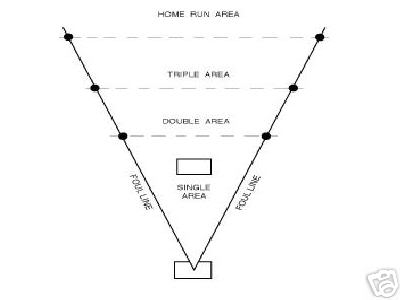
Some versions of the game eliminate base running entirely and turn the field into a V shape, where hits are scored as singles, doubles, triples, or home runs based on where they land. That format strips away chases around the bases and puts all of the value into contact quality and placement. A clean line drive into the right lane can be worth more than a loud swing that lands in the wrong part of the field.
A shorter fence rewards low missiles. A wider alley opens more extra-base hits. A backstop-based target at the plate replaces catcher positioning with precision throwing.
Organized Wiffle Ball has grown around those design choices
Wiffle Ball’s field logic has roots in a 1953 backyard in Fairfield, Connecticut, where David N. Mullany and his 12-year-old son David A. Mullany first experimented with a perforated plastic golf ball and broomstick handle before refining the Wiffle Ball design. The perforations were meant to create movement while reducing the strain of throwing curveballs. The sport was built to work in limited space.
The Wiffle Ball, Inc. has been in Shelton since around 1960, and the factory manufactures more than a million balls each year.
Championship play shows how far the game has moved from its origins
The World Wiffle Ball Championship, founded in 1980, uses five-person teams on miniature fields and has grown into a centerpiece of the sport’s competitive culture. Its history includes a 2020 move back to Rose Park in Mishawaka because of the coronavirus pandemic. AWA Wiffle says it has eight professional franchises.