IFAF rules reveal how flag football adapts across formats
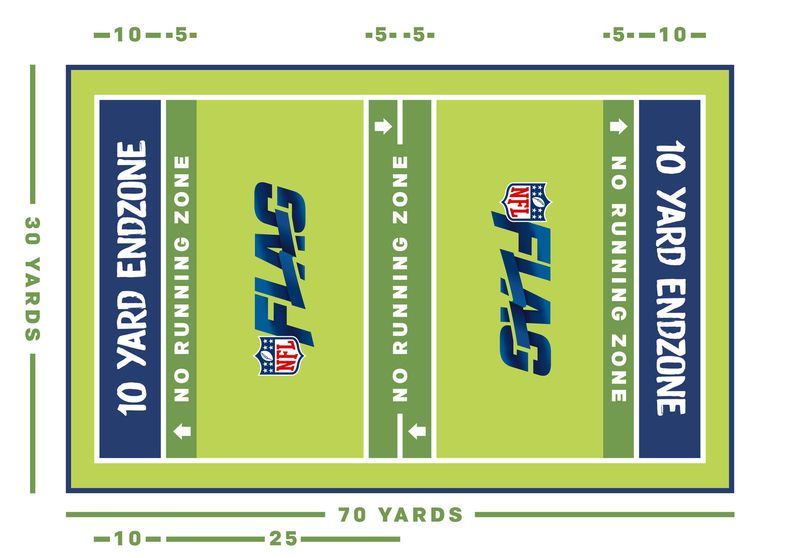
Flag football keeps getting described as one game with one identity, but the IFAF’s 2023 rules make a different point. The rulebook covers 5-on-5 non-contact flag, 7-on-7 flag, beach flag 4-on-4 and indoor flag, and those formats do not produce the same sport once the ball is snapped. The differences in space, contact and surface shape everything from route spacing to how a defender closes a lane.
One game, four different structures
The cleanest way to read the sport is as a family of versions rather than a single code. IFAF’s 2023 release keeps the same core idea across every format, advance the ball without tackles and protect the flags, but it adapts that idea to different roster sizes and competition settings. That flexibility is why the sport can fit youth leagues, elite national events and international play without each organizer inventing its own version from scratch.
The 5-on-5 game compresses the field and forces decisions to happen faster. In 7-on-7, the extra bodies and added space create a more open chess match, where timing, spacing and coverage recognition matter more than brute acceleration through traffic. Beach flag 4-on-4 and indoor flag shift the calculation again because the surface changes footing, plants and cuts, so the same route can look entirely different once sand or an indoor floor replaces a conventional field.
The rule details that actually change football
The 2023 IFAF update shows that the sport treats its details seriously, not cosmetically. The release added field-surface requirements, revised the definition of non-breakable glasses, updated pants and flag specifications, clarified the diving definition and made jersey number 0 legal. Even that last change signals how the sport is trying to balance standardization with practicality.
Those adjustments matter because flag football is built around a standardized framework that still leaves room for distinct formats. The surface requirements help define where each version can be played. The equipment tweaks and the clarified diving rule help officials apply the game consistently. In a sport where contact is removed, those small details become the guardrails that keep the game recognizable across ages, genders and venues.
Why field size changes the tactics
Field dimensions are not a background detail in flag football. IFAF’s 2023 document specifically notes the addition of 7-on-7 on a big field measuring 50 by 30 yards, and that extra width changes the entire geometry of the game. More width means more room to isolate defenders, stretch coverage and build route combinations that punish hesitation.
On the smaller 5-on-5 field, space is premium. The offense cannot rely on the same kinds of deep, sprawling concepts that work when there is more room to operate, so every yard matters more and substitutions have to fit tighter windows. The result is a faster, more condensed game in which a single missed flag pull or a half-step of separation can decide the drive.
Contact standards define the sport as much as the ball does
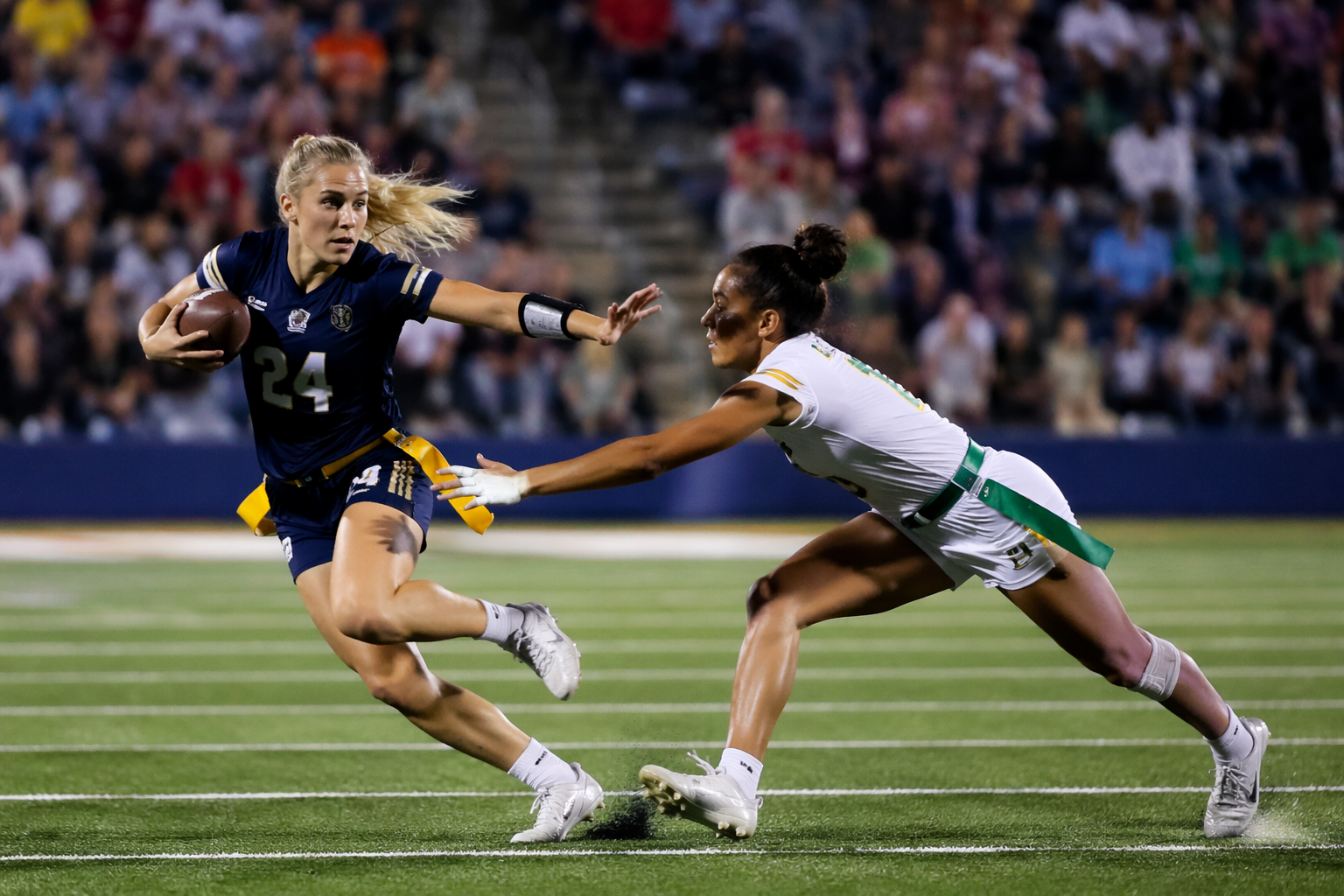
The most important dividing line in flag football is simple: no tackles. LA28 describes the Olympic version as a non-contact format of American football, played in two 20-minute halves, and that contact standard changes how the game is taught and watched. Tackling is removed, so defenders are chasing flags rather than finishing hits, and the offense is built around preserving movement without crossing into full-contact football.
That difference also changes the audience’s experience. In tackle football, collisions often create the emotional peak of a play. In flag football, the tension comes from pursuit angles, clean releases, quick decisions and whether a ball carrier can stay just out of reach. The sport is still physical, but the physicality is expressed through speed, leverage and positioning instead of tackling.
Rushing, running and the shape of possession
The rules around rushing and running restrictions matter because they determine how quickly a defense can attack the quarterback and how freely an offense can move the ball. In flag football, those choices are not uniform across every format, which is another reason arguments about the sport often talk past each other. Some versions are built to emphasize the pass and timing, while others leave more room for designed movement and different pressure rules.
That is why a discussion about flag football has to start with which version is being played. A coach preparing for 5-on-5 is solving a different problem than one working in 7-on-7 or indoors. The same applies to the viewer: what looks like a simple handoff, quick throw or scramble in one format can be a strategic centerpiece in another.
The Olympic stage pushes the rules question further
The sport’s profile rose sharply when the International Olympic Committee approved flag football for the 2028 Summer Games in Los Angeles. The IOC said flag football and squash will make their Olympic debut at LA28, and ESPN reported on Oct. 16, 2023, that five sports were added to the 2028 program: baseball-softball, cricket, lacrosse, squash and flag football. LA28 frames flag football as a non-contact version of American football, and the NFL later said clubs approved participation of NFL players in the 2028 Olympic Games in Los Angeles.
That gives the rulebook broader stakes. A format designed for youth leagues and local tournaments now has to fit an Olympic showcase, where the presentation, pace and competitive balance all matter. The two 20-minute halves described by LA28 underline that this is not just American football with the pads taken off. It is a separate competition structure built for speed and clarity.
The growth story runs through youth football
The rules matter most because they are enabling scale. NFL FLAG says it has more than 2,000 leagues and 830,000 youth athletes across all 50 states, which shows how deeply the format has spread through the American development pipeline. Project Play, using Aspen Institute State of Play 2023 data, said that in 2022 there were 277,000 more children ages 6-12 playing flag football than tackle football, compared with a decade earlier when the comparable gap favored tackle by 251,000.
That shift explains why flag football is now a serious discussion at the developmental level, not a novelty. The National Federation of State High School Associations said in January 2025 that girls’ flag football is one of the fastest-growing sports in the United States, and that growth reinforces the sport’s flexibility. Different formats serve different age groups, different facilities and different safety expectations, but they are all part of the same expanding ecosystem.
A sport that scales because it adapts
Flag football’s spread is tied to the fact that the rules do not pretend every setting should look the same. Beach, indoor, 5-on-5 and 7-on-7 each shape a different tactical language, and the IFAF rulebook gives those versions a common backbone without flattening their differences. That is why the sport can move from youth fields to Olympic stage lighting without losing its identity.
Sources
- [1]americanfootball.sport
- [2]olympics.com
- [3]espn.com
- [4]la28.org
- [5]nfl.com
- [6]nflflag.com
- [7]projectplay.org
- [8]nfhs.org