IQA policy sets rules for national teams and multiple entries
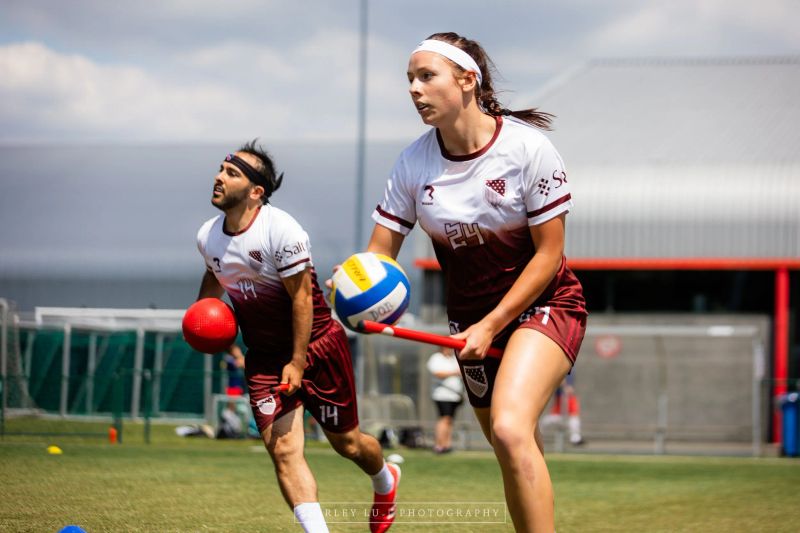
At the 2025 World Cup, 31 nations competed for the title of World Champion over three days in Belgium. In quadball, the biggest decisions happen above the club level. The International Quadball Association’s National Team Policy 2025 puts national governing bodies, not local teams, at the center of who can represent a country, who can enter multiple sides, and who gets access to elite international competition.
National teams start with the governing body
The clearest line in the policy is also the most important: a national team must represent a National Governing Body, country, or nation, and it may not represent a club or region. That means the path to international play does not run through the hottest local roster or the most successful weekend league. It runs through the national structure that the IQA recognizes.
Quadball is built as a global sport, not a collection of isolated domestic leagues. The game grew from the inaugural match in 2005 to thousands of players in over 40 countries, and the IQA has operated as an international governing body since 2010. Once a sport gets that wide, club-level improvisation stops working. Eligibility, representation, and tournament access have to be standardized somewhere, and the IQA has put that authority in national bodies.
Multiple entries are allowed, but only with guardrails
The policy on multiple national teams is where the governance gets practical. An NGB that wants to field more than one national team must be a full member NGB or an Area of Interest, be in good standing with the IQA, and have at least one coach and one team manager for every team requested. It also has to show either a geopolitical reason for multiple teams or precedent in other nationally recognized sports.
The rule forces every extra entry to come with staffing, legitimacy, and a real-world rationale. If a national body cannot supply coaches and managers, or cannot explain why multiple teams make sense in its political or sporting context, the answer is no.
Multiple teams are possible, but only through a process that binds them to the national system. That leaves room for places with genuine geopolitical complexity while stopping clubs and regions from freelancing their way into international play.
The calendar is built around nations, not franchises
The IQA’s event structure makes the same point in another language. Its Continental Games take place every other year, on the opposite year to the IQA World Cup, and continental regions are defined by team density and reasonable travel distances for members. The Continental Games bring in national and regional teams from across each region, while the World Cup is open to elite international competition teams selected by eligible NGBs and is billed as the premier international quadball event.

In the 2024 European Games, 15 nations competed for the title of European Champion. Those fields are the product of a governance model that starts with national bodies, then uses IQA rules to decide who can enter, where they enter, and what kind of event they enter.
Quadball Europe’s European Games are a biennial event that alternates with the IQA World Cup, and the games are contests between national teams selected by each NGB. Regional competition stays aligned with the broader international calendar instead of letting every market invent its own version of the sport.
The membership map shows how broad the sport already is
The IQA’s member assembly already spans multiple countries, including Australia, Austria, Belgium and Brazil. Quadball is functioning as a multi-national sport with a real governance base, not as a one-country export with a global label slapped on it.
In July 2022, the IQA joined US Quadball and Major League Quadball in changing the name of the sport worldwide from quidditch to quadball. The international system coordinated that shift across different organizations and markets.
The United Kingdom is the cleanest example of how the policy works
QuadballUK makes the structure easy to see. Its national teams represent England, Scotland and Wales on the international stage, and Team UK was founded in 2012. The teams are led by volunteer coaches and managers, matching the IQA’s requirement that an NGB seeking multiple national teams must have staffing in place for each one.
Even in a mature quadball scene, local clubs do not control international pathways. The club may develop the player, but the NGB defines the national lane, assembles the team, and puts the squad into the competition system the IQA recognizes.
Sources
- [1]iqasport.org
- [2]quidditcheurope.org
- [3]quadballuk.org
- [4]youtube.com