IRF court specs reveal racquetball's hidden design for visibility and broadcast
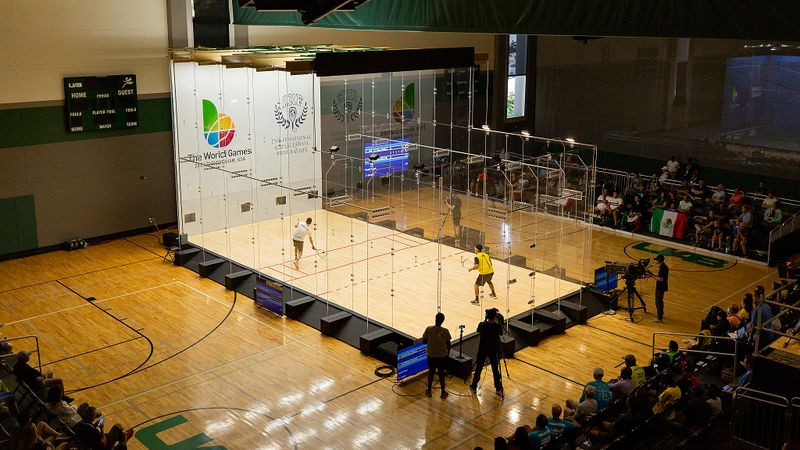
A racquetball court is a 20-by-40-by-20 enclosure built to make a small black ball readable at full speed for players, officials and spectators, and the International Racquetball Federation’s court-specification document treats it as a visual standard as much as a room. The performance standard keeps courts comparable from country to country and supports certification in international competition.
A court designed for the eye first
Joseph Sobek created the sport’s first form in Greenwich, Connecticut, in 1949 and 1950, calling it “paddle rackets,” with rules built from squash and handball. Robert W. Kendler formalized the sport’s future in 1969 by founding the International Racquetball Association, and the modern court followed the same basic idea: give the ball a clean visual path and give every venue the same competitive geometry.
The familiar 20-by-40-by-20 enclosure gives the ball a consistent visual path from venue to venue. A racquetball court is supposed to feel consistent whether it sits in a health club, a national training center or a broadcast set. The IRF document, revised in 1988, 1997, 2013 and 2014, treats the court as a standardized viewing environment, not just a room with walls.
Why the floor cannot fight the ball
The floor is one of the simplest details and one of the most important. The IRF guidance recommends a light, relatively consistent floor color so it does not absorb the ball into the background. A court is trying to stay visually quiet while the ball moves at high speed.
Television sharpened that requirement. The specification explicitly allows bleaching hardwood white when a court is being used under television broadcast conditions, because the point is to make the ball easier to track on camera. When an older or nonstandard court uses a darker, busier or patchier floor, the ball can disappear for a beat at exactly the wrong moment.
Lighting is a competitive advantage, not an afterthought
The lighting standard is even more precise. For television, the recommended illumination level is at least 150 foot-candles measured 36 inches above the finished floor.
In racquetball, the ball can change direction suddenly off a wall or corner. Weak lighting creates shadow pockets, and shadow pockets create guesswork. In a fast rally, guesswork costs points, slows the pace for officials, and makes a broadcast harder to follow because the viewer is always half a step behind the flight path.
Glass walls only work if the background works
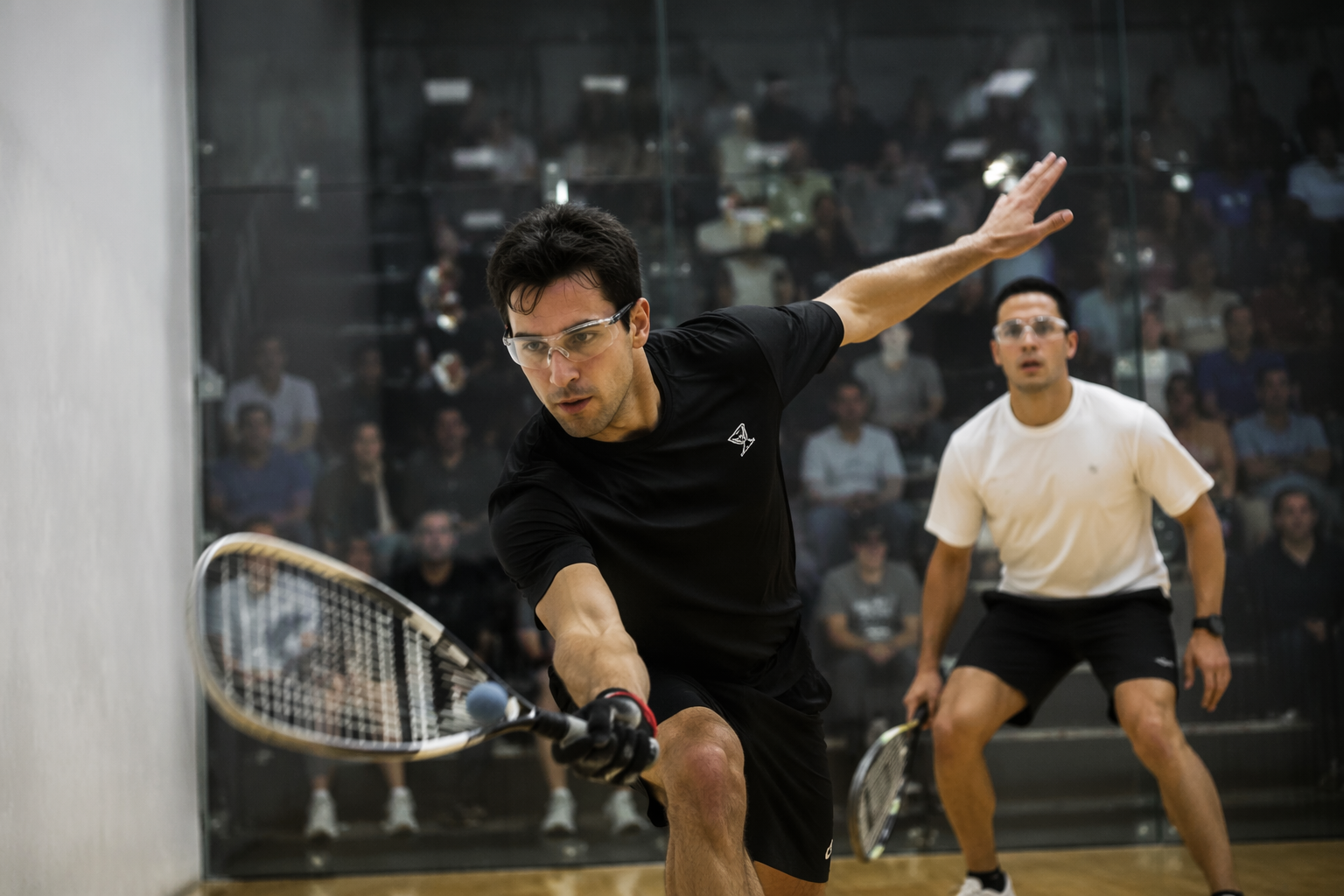
The glass wall is supposed to be a window, not a visual trap. The IRF’s visibility rule is unusually specific: surfaces behind a glass wall that a player sees when looking downward at a 55-degree angle from an eye height of 60 inches and from a point 12 inches inside the court are not supposed to be darker than the floor.
In practical terms, the rule keeps the background from swallowing the ball when a player glances down and across the court. Darker backdrops can make the ball vanish against the far wall, especially in facilities that were not designed with racquetball’s optics in mind. A court built with the wrong contrast can still be playable, but it will be slower to read, more fatiguing to officiate and less clean on camera.
The rest of the venue is part of the design
The IRF specification does not stop at the four walls. It also maps the larger matchday environment, including space for referees and line judges, spectators, camera facilities, camera panels and convertible courts.
By 1974, U.S. participation had reached an estimated 3 million players, and USA Racquetball later put the sport at about 10 million U.S. players and 14 million players in more than 90 countries during the late 1970s through the early 1990s. The first racquetball magazine appeared in November 1972, the first NRC pro stop was held in Houston, Texas, from September 27-30, 1973, and grandstand-style showcase courts became part of the sport’s presentation.
Broadcasting made the court philosophy impossible to ignore
By the time the U.S. Open Racquetball Championships debuted in Memphis, Tennessee, in 1996, the sport had already embraced the idea of a court built for television. That event was played on a specially constructed “made for TV” glass court.
At Franklin Racquet Club in Southfield, Michigan, a court used colored squares and giant red, blue and green alphabet blocks as design elements. The design elements helped orientation and defined space.