Johnny Appleseeds kept ultimate alive after its New Jersey birth

Ultimate’s real origin story is not just that it was invented in Maplewood. It is that a small group of early believers kept carrying it out of Maplewood before it could fade into a one-school curiosity. USA Ultimate’s Hall of Fame frames those carriers as the “Johnny Appleseeds,” the evangelists who made sure the game kept moving from parking lot experiment to repeatable sport.
How a New Jersey school game avoided disappearing
Ultimate was created at Columbia High School in Maplewood, New Jersey, in 1968, and the first game was played there in 1969. By the time Columbia met Millburn High School on November 7, 1970, the game had already crossed from idea to competition, and Columbia won that first interscholastic matchup 43-10. WFDF’s history also records the next steps in that chain of survival: the first conference of ultimate teams came in 1971 and included five New Jersey high schools, then the first college game followed on November 6, 1972, when Rutgers beat Princeton 29-27.
That sequence matters because it shows how quickly ultimate had to become portable. A game that stayed trapped in one school would have been a novelty; a game that moved into other high schools, then into a college rivalry, had a future. WFDF notes that graduates from the New Jersey league formed teams at their colleges, which is the clearest sign that the sport was already building its own pipeline.
The people who carried it beyond Maplewood
The Hall of Fame’s special merit group makes the diffusion story concrete. The named early ambassadors were Joe Barbanel, Walter Belding, Dan Buckley, Jon “JC” Cohn, Ed Davis, Jim Diehl, Dave Dinerman, Jeff “Yogi” Durra, Bob Evans, Steve Frieman, Kevin “Igor” Harper, Jon Hines, Bill “BJ” Johnson, Bruce “Frisbee” Johnson, Al Jolley, Irv Kalb, Ron Kaufman, Rick Labasky, Dave Leiwant, Jim Lovell, Andy Magruer, Dave “Buddha” Meyer, Mike Miller, Jim Pistrang, Jim Powers, Dan “Stork” Roddick, Larry Schindel, Ed “Zoop” Summers and Geoff West. Their value was not limited to what they did with a disc in hand. They were the people who translated a homegrown campus game into something other schools could adopt, adapt and repeat.

The Hall of Fame’s description is blunt about the stakes: ultimate likely would have disappeared without the efforts of this cadre of early players. Joel Silver later dubbed them the “Johnny Appleseeds,” a name that fits the job they actually did. They did not just play the game once; they replanted it.
What they built, step by step
The most important survival tools were practical. Silver, Bernard “Buzzy” Hellring and Jonathan “Jonny” Hines got other students to play, refined the rules and produced a written first edition of those rules in early 1970 under the Columbia High School Varsity Frisbee Squad name. That codification made the sport teachable. If a game cannot be explained, it cannot spread; if its norms cannot be repeated, it cannot survive beyond the original group that knows the unwritten version.
The early network then turned those rules into local scenes. The first interscholastic game at Millburn gave nearby schools a model. The 1971 conference of five New Jersey high schools gave the game a league structure. The Rutgers-Princeton game in 1972 showed that college campuses could absorb it too. By 1974, the Hall of Fame says the Johnny Appleseeds had pushed the game beyond central New Jersey, which is the point where a regional pastime starts looking like a sport with national legs.
Why 1968 still matters, and why it is not the whole story
NJ Spotlight News places the origin in the broader turbulence of 1968, a year marked by antiwar protest and distrust of authority. That context helps explain why self-officiation became so central to ultimate’s identity. The game was born in a moment when a lot of young people were questioning institutions, and ultimate’s culture answered that mood with player responsibility instead of referees.
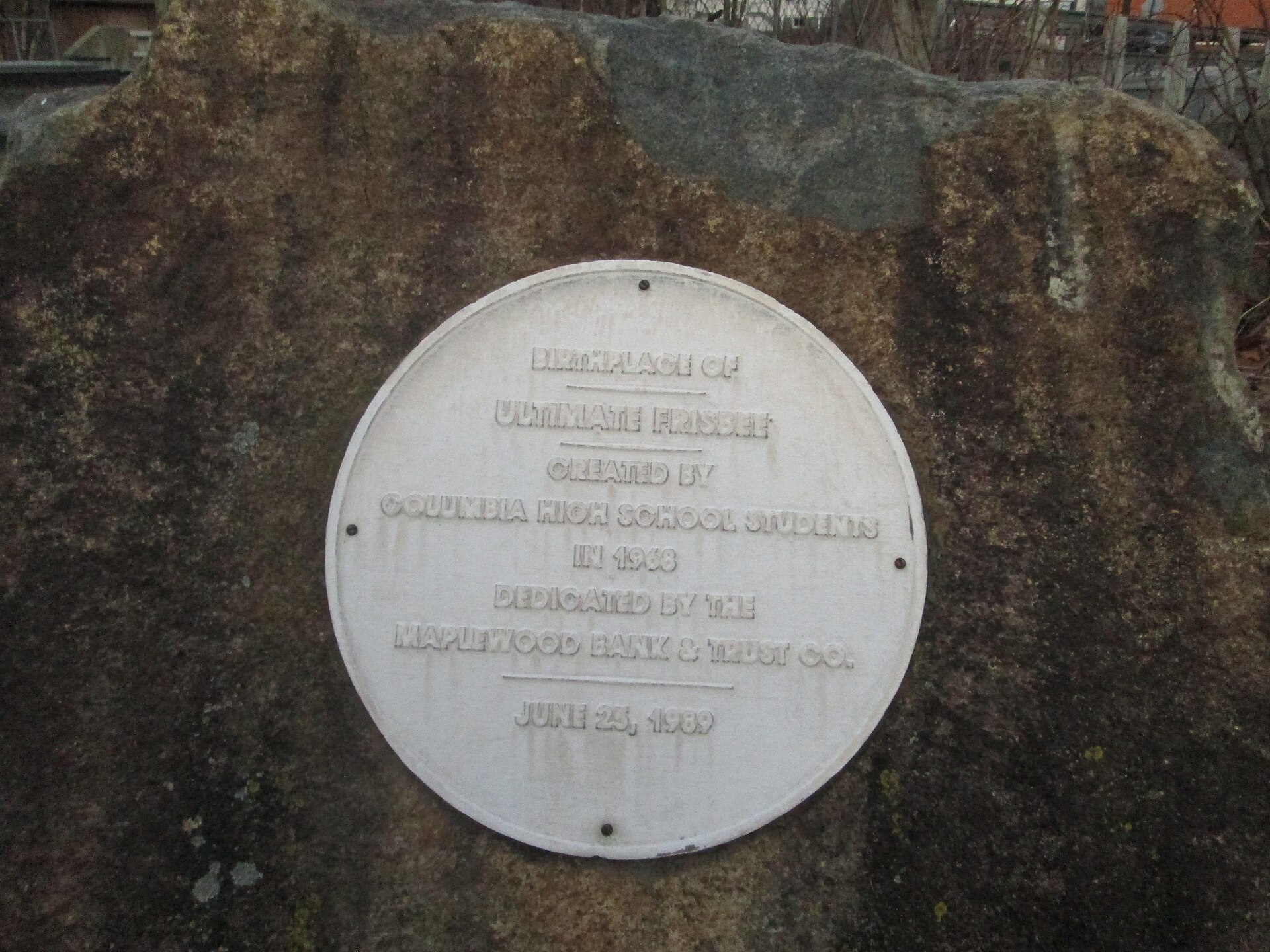
A historical marker in Maplewood now identifies Bernard “Buzzy” Hellring, Jr., Jonny Hines and Joel Silver as the creators of Ultimate Frisbee. USA Ultimate still describes the sport as created in 1968 by Columbia High School students in Maplewood and now played worldwide across grass, beach and indoor disciplines. Those details matter, but they are only half the story. Creation gave ultimate a beginning; the Johnny Appleseeds gave it a future.
The survival lesson in ultimate’s early years
The sport’s early history is unusually well documented because invention, codification and dissemination happened in quick succession. The first written rules, the first interscholastic game, the first conference of teams and the first college game all arrived within a few years of the game’s birth. That speed is the real reason ultimate escaped the trap that catches most local inventions.
Maplewood made the game. The Johnny Appleseeds made it travel. And because they taught it, organized it and repeated it in new places, ultimate became the rare sports story where the most important figure is not the inventor alone, but the network that refused to let the invention stay put.
Sources
- [1]archive.usaultimate.org
- [2]usaultimate.org
- [3]wfdf.sport
- [4]ultimatehall.org
- [5]njspotlightnews.org
- [6]hmdb.org