Major League Quadball explains the sport’s chaos, culture, and rules
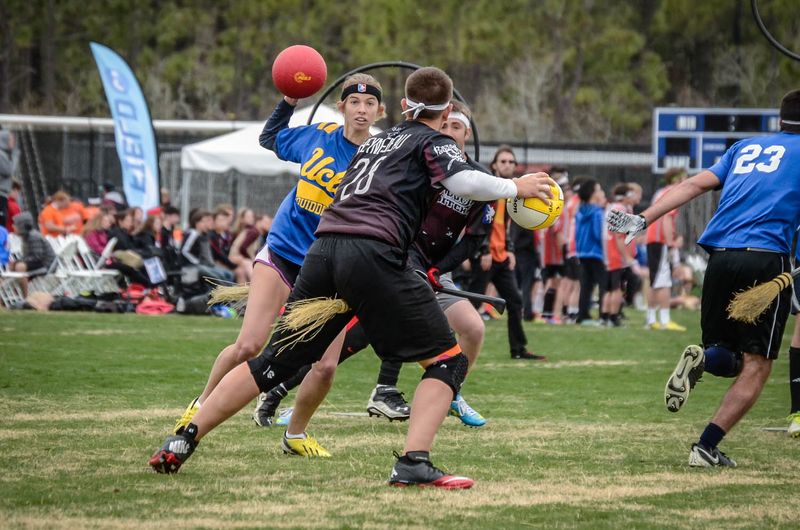
Seven players on each side are trying to control space, control the ball, and survive the next collision at the same time. Major League Quadball puts it plainly: “Quadball is a sport for all. Chaos is part of its charm.” The line fits a mixed-gender, full-contact sport built on collisions and constant change.
How a quadball game moves
The International Quadball Association calls quadball a “mixed gender, full contact sport played across the world,” and the sport was adapted by fans in 2005 from the fictional game in Harry Potter. Since that inaugural match, the IQA counts thousands of players in more than 40 countries. Quadball’s pace is not built around one star taking over a possession or one set play ending the shift; it is built around constant motion, frequent turnover, and the ability to reset fast.
The action is split between offense, defense, and a live-ball pressure game that never fully stops. That is why the sport feels faster than it looks from the outside. The best teams do not just run hard, they manage substitutions, spacing, ball control, defensive pressure, and scoring chances while the game keeps mutating in front of them.
The positions and the possession battle

Quadball is easier to understand when you stop thinking about one ball and start thinking about roles. The name “quadball” nods to both the balls on the field and the positions in the game. That is the right lens for watching it: chasers drive most of the possession work, beaters create disruption, the keeper anchors the defense, and the seeker waits for the late-game chase that can swing everything.
The point is not just that there are jobs, but that the jobs overlap under pressure. Chasers are constantly trying to turn field position into scoring opportunities, while beaters make every clean outlet pass and every lane to the hoops feel earned. The seeker’s role means the game never settles into a simple race to an arbitrary clock, which is part of why quadball’s finish can feel volatile even when one team has controlled play for long stretches.
Why the contact is the point, not a side effect
A lot of outsider confusion comes from treating quadball like a novelty built off a fictional template. Quadball is physical, but it is also tactical, and the contact only matters because it changes possession, spacing, and the next scoring sequence.
That is where the sport separates itself from a simple chaos reel. The hits are real, but they are not random. Players are reading lanes, managing substitutions, and trying to create pressure without breaking structure, which is why a clean sequence in quadball can look more satisfying than a highlight collision. The best possessions are not the loudest ones; they are the ones that survive the chaos long enough to produce a score or a turnover on the right terms.

The culture around the rules
Major League Quadball does not present the league only as a rulebook. The navigation on its explainer page includes tryouts, a practice squad, grants, volunteer opportunities, franchise eligibility, and diversity, equity and inclusion resources, alongside “What is Quadball” and “Who is MLQ.” It signals a sport that wants newcomers, club players, prospective owners, and community builders in the same ecosystem.
That emphasis on access fits the page’s opening line about quadball being “a sport for all.” In practical terms, it means the sport is built to pull people in at different entry points, from recruitment and practice squads to higher-level competition and leadership.
From Middlebury to a worldwide rebrand

The sport was founded in 2005 at Middlebury College by Xander Manshel and Alex Benepe, and it was adapted by fans that same year from the fictional game in Harry Potter. From there, the sport grew into a global game with a real governing body, real competition, and a growing need to define itself on its own terms.
That became impossible to ignore on July 19, 2022, when the International Quadball Association joined US Quidditch and Major League Quidditch in changing the sport’s name worldwide to quadball. The move distanced the sport from J.K. Rowling and avoided trademark issues with Warner Bros.; the new name also reflects the structure of the game itself, a reference to the balls on the field and the positions in the game.
Where MLQ sits now
The league context has changed just as much as the name. In 2022, Major League Quidditch was a semi-professional league with 16 teams. Later MLQ materials call the organization the premier professional league for quadball in the United States and Canada, and a 2024 MLQ press release announced that its season-ending championship would feature the 12 best teams from across the U.S. and Canada in Howard County, Maryland.
Sources
- [1]mlquadball.com
- [2]iqasport.org
- [3]usquadball.org
- [4]npr.org
- [5]thehill.com
- [6]assets.simpleviewinc.com