Major League Wiffle Ball turns a backyard game into a growing hit
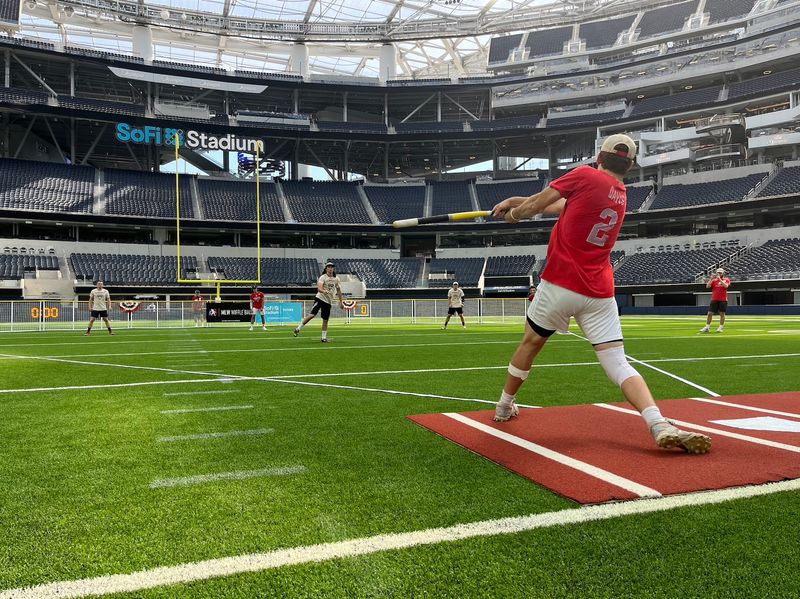
Major League Wiffle Ball has outgrown the backyard, but it has not lost the backyard logic that made it clickable. The league staged its 2022 World Series at SoFi Stadium in Los Angeles, and its official YouTube channel now shows 596,000 subscribers and 784 videos, proof that a handmade sport can become a repeatable digital property.
From Brighton to a league brand
Kyle Schultz started playing in Brighton, Michigan in 2009 with neighborhood friends. The next summer, that loose setup became a formal league with rules, teams, a fence, and video documentation of every season. That shift is the key to MLW’s rise: it gave the game the structure of a real sports property, with continuity from one season to the next instead of one-off summer games.
The first field setup still feels like a visual shorthand for the whole project. The first strike zone was an art easel, while the outfield and backstop came from a garden fence and a golf swing net. Those details matter because they made the league legible on camera from the start, and they gave the videos a distinct look that fans could recognize immediately.
Why the videos work
Wiffle Ball itself is built for visual drama. The perforated plastic ball was designed to be lighter than a regulation baseball and to make batters miss more often, which means the action naturally turns on movement, deception, and swings that look better in close-up than they do in a box score. That makes the sport ideal for a platform where every pitch can be replayed, clipped, and discussed.
MLW has borrowed the logic of mainstream sports broadcasts and adapted it to a creator-era format. Full games, highlights, and instructional uploads such as pitching tutorials give viewers different ways in, while the league structure turns casual backyard matchups into recurring contests with rivalry stakes. The result is a format that feels like a scheduled sport, not just a stream of clips.
The presentation also rewards the same production choices that make televised sports watchable. Clean camera angles help track the ball’s break, a brisk editing pace keeps the action moving, and league branding makes each video feel like part of a larger competitive universe. Add recognizable personalities and team identities, and the channel starts to function less like a hobby page and more like a fan base around an established show.
The audience numbers tell the story

MLB’s 2022 snapshot showed how quickly MLW had scaled. At that point, Major League Wiffle Ball had more than 350,000 YouTube subscribers, 54 million views, 148,000 Instagram followers, and 492,000 TikTok fans. The league was already big enough to stage its 2022 World Series at SoFi Stadium, a venue choice that made a backyard game look like it belonged in the same conversation as major sporting events.
By June 2026, the official YouTube channel showed 596,000 subscribers and 784 videos. The league’s about page placed the broader footprint at more than 500,000 YouTube subscribers, 86 million views, 225,000 Instagram followers, and 635,000 TikTok followers. Those numbers show a property that is not simply collecting one-off viral attention, but sustaining an audience across platforms with enough depth to keep seasons, clips, and tutorials in circulation.
How this fits Wiffle Ball’s longer history
The modern MLW story makes the most sense against Wiffle Ball’s original invention. The game began in Fairfield, Connecticut in 1953, when the founder’s father watched two boys play in a backyard with a perforated plastic golf ball and a broomstick handle. The Wiffle Ball, Inc. says the brand name came from the neighborhood word “wiff” for a strikeout, with the missing H becoming the WIFFLE trademark, and the ball was patented in 1957.
The Baseball Hall of Fame describes the deeper design logic: the ball was meant to be lighter than a regulation baseball and to make batters miss more often. Smithsonian adds the patent date, which locks the invention into a specific mid-century moment. That design still drives the online appeal today, because a ball built to dart and deceive gives every pitch a built-in visual payoff.
Where the creator era now sits
Major League WIFFLE® Ball, founded in Cohoes, New York in 2000, shows that organized wiffle-ball leagues existed before MLW became a digital brand. MLW’s difference is the packaging. It took neighborhood-friends energy, formalized it into rules and teams, then wrapped it in video documentation, social media, and a presentation style that borrows from the grammar of mainstream sports broadcasts.
That is why the league works as more than a novelty. It uses simple rules, memorable personalities, and a league identity that feels bigger than the field itself, then sells the action through the same visual cues that make sports television addictive. The backyard never disappeared, but MLW turned it into something fans can follow like a season.
Sources
- [1]mlb.com
- [2]youtube.com
- [3]mlwmerch.com
- [4]wiffle.co
- [5]baseballhall.org
- [6]smithsonianmag.com
- [7]majorleaguewiffleball.com