Michelle Gould’s racquetball legacy defined by record-breaking titles

Michelle Gould did not build her legacy on a single breakthrough season. She built it by winning at every level the sport offered, from a first national title at age 12 to a run of pro and international crowns that made consistency look routine. In an era before streaming and social media could inflate a star overnight, Gould’s greatness was measured in the oldest possible currency: titles, repetition, and the expectation that she would win again.
The standard before modern media
Gould started playing racquetball at 10 and reached the adult national team at 13, a jump that signaled more than precocious talent. It announced a player whose fitness, shot selection, and competitive discipline were already ahead of her age group, and those traits carried through the rest of her career. By the time Sports Illustrated’s Vault profiled her in 1993, she was 22, had won her fifth consecutive women’s national singles title, and had become the current world titlist after beating Malia Bailey, 15-6, 15-9.
That score line matters because it captures the way Gould separated herself from the field. She was not surviving tight matches by accident; she was controlling pace, forcing errors, and turning elite opponents into spectators. In women’s racquetball before the modern media era, domination was not measured by highlights or follower counts. It was measured by whether the best player could keep winning in different arenas, against different styles, and under different championship labels. Gould did that with uncommon regularity.
Titles across every circuit that mattered
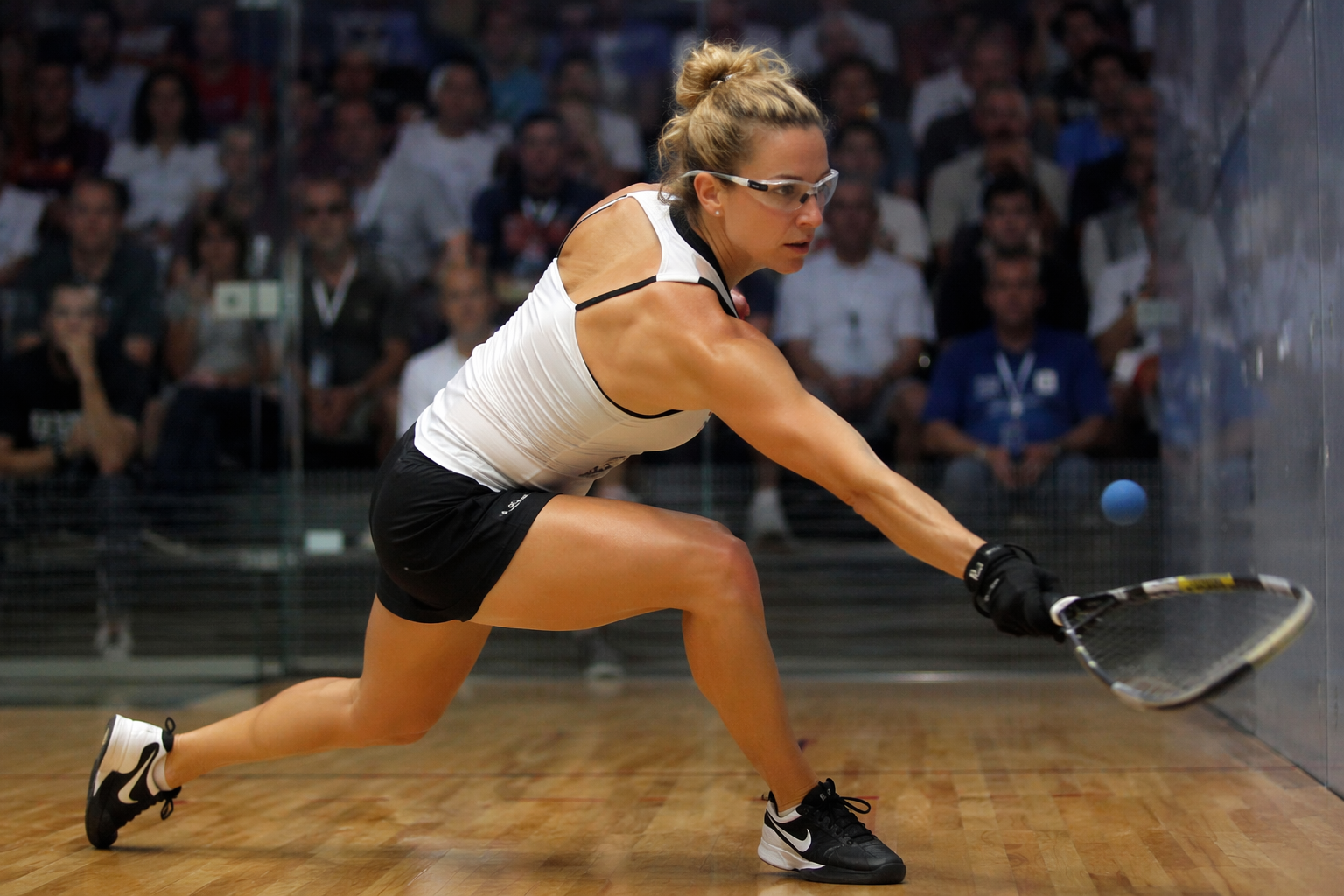
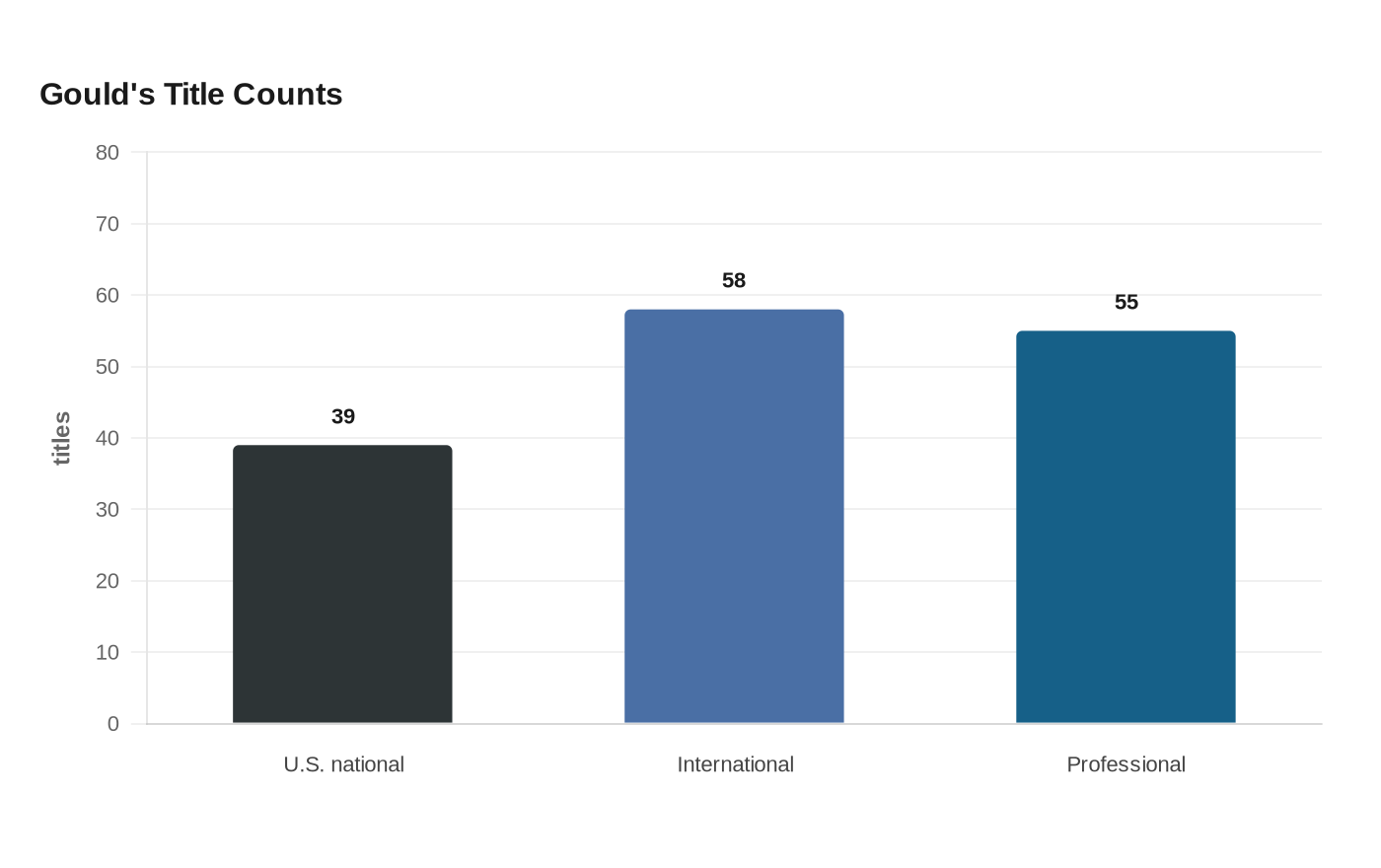
USA Racquetball’s Hall of Fame lists Gould with 39 U.S. national titles, 58 international titles, and 55 professional titles, numbers that place her in a category few athletes in any sport ever reach. The same record shows she won the WPRA and WIRT National Pro Singles Championships seven times in eight years from 1990 to 1997. That kind of run turns a player into a template, because it leaves later stars with a standard they must match before they can be compared to her.
Her year-end pro title streak tells the same story in cleaner form. USA Racquetball’s pro champions record shows Gould finished as the women’s year-end pro title winner from 1994 through 1998, five straight seasons at the top of the standings. In the sport’s lineage, that run sits alongside the names that defined earlier and later generations, including Lynn Adams, Heather McKay, Jackie Paraiso, and Paola Longoria. Gould’s block of dominance is what makes the comparison useful: she was not a flashpoint, she was the reference point.
Championship expectation as a skill
What separated Gould from other great players was not only that she won, but that she made victory feel mandatory. That expectation mattered in racquetball, where pro tours, national championships, and international events all carried their own prestige. Gould met that pressure by staying sharp across multiple formats, which is why her résumé includes both domestic and global success rather than a single specialty.
Her international record is especially strong. The International Racquetball Federation Hall of Fame lists women’s singles gold medals at the 1992 World Championships in Montreal, the 1993 World Games in The Hague, the 1994 and 1996 World Championships, the 1995 Pan American Games in Mar del Plata, and the 1994, 1996, and 1998 Pan American Championships. That is a championship map of the sport’s major stages, and Gould’s name appears at nearly every destination. When the Pan American Games first included racquetball as a full medal sport in 1995, Gould claimed the women’s singles gold in the inaugural edition, giving the event an immediate benchmark.
Visibility, recognition, and the sport’s public face
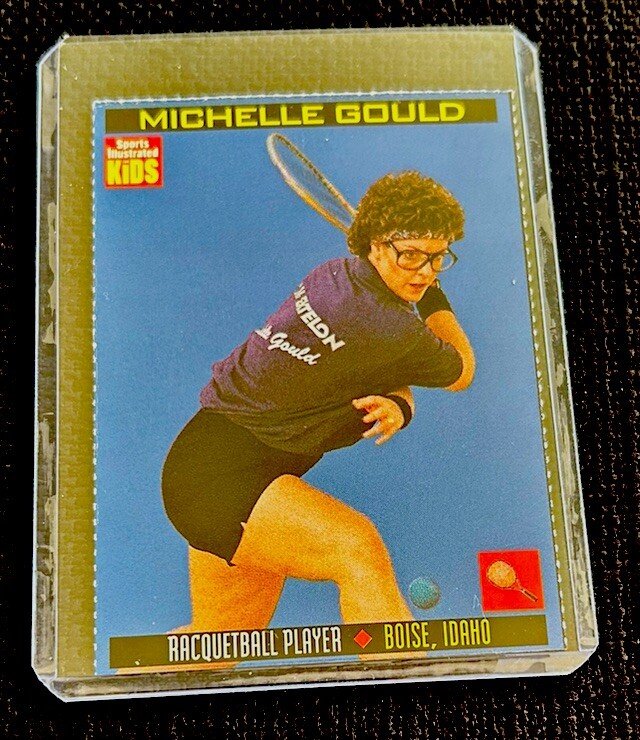
Gould’s dominance was not confined to scorebooks. The International Racquetball Federation profile says Boise proclaimed April 14, 1995, as Michelle Gould Day, a civic marker that shows how far her reputation reached beyond tournament brackets. The same profile says she was a four-time finalist for the Women’s Sports Foundation Sportswoman of the Year award and made multiple appearances in Sports Illustrated, Fit Magazine, USA Today, ESPN, ESPN2, TBS, and Prime Sports Northwest.
That visibility mattered for racquetball itself. Before broad digital coverage, a player like Gould helped define whether the sport could break into mainstream conversation at all. Each feature, television appearance, and award nomination widened the audience for a sport that often lived outside the national spotlight. Gould’s profile also helps explain why women’s racquetball in the 1990s could produce stars whose legacies were built on repeated excellence rather than one-off fame.
The traits that made her the template
Gould’s career shows exactly what later stars were measured against. Competitive consistency came first, because she won too often for too long to be dismissed as a peak-period specialist. Fitness came next, because a player who began as a junior champion and still owned the professional ranks needed the movement and endurance to control long seasons. Shot selection was the quiet separator, visible in results like the 15-6, 15-9 win over Malia Bailey and in the repeated ability to turn big finals into controlled finishes.
The final trait was championship expectation. Gould was not just a favorite; she was the player others had to solve. That is why her résumé reads like a blueprint for women’s racquetball excellence. From the first national title at 12 to adult national team status at 13, from a five-year pro title run to world and Pan American gold, she established the standard by which dominance in the sport was, and still is, understood.
Life after the run
Gould’s post-competition life adds another layer to the story. The International Racquetball Federation says she worked 15 years as a Level 22 Station Manager for the United States Postal Service and served as Corporate Director of Programming for 24 Hour Fitness from 1998 to 2000. It also lists two children, Ryan Gould and Courtney Gould. Those details matter because they show a champion whose impact did not stop at the court door; she carried the discipline of elite sport into public service, fitness leadership, and family life.
That larger arc is part of why her place in racquetball remains so secure. Gould’s record-breaking titles are the headline, but the deeper legacy is the standard she created: win nationally as a teenager, win globally in your 20s, win across tours and championships, and make every era after you measure itself against that kind of completeness.