Milwaukee girls flag football league gives athletes a place to belong
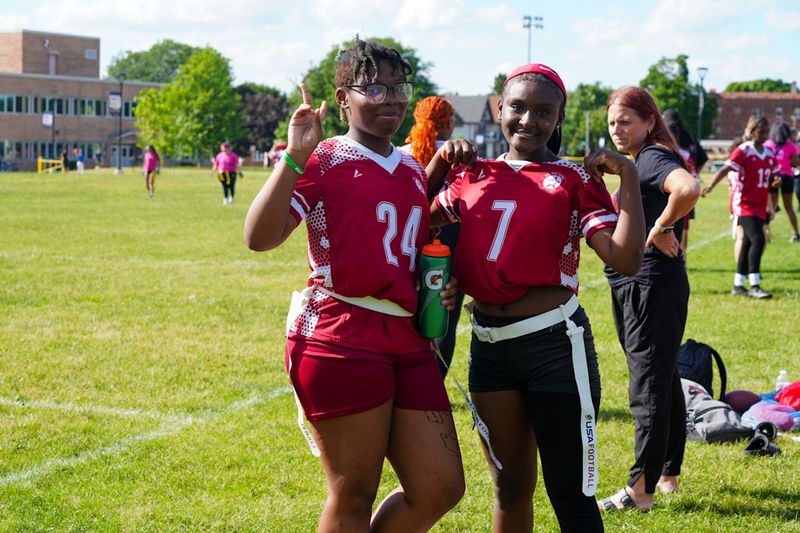
Alonna Davis has found a new kind of home on the flag football field at Milwaukee High School of the Arts. In Milwaukee Public Schools’ first girls flag football league, the freshman is part of a program built as much around confidence and connection as it is around competition, with eight teams spread across seven MPS high schools turning four Friday afternoons into something bigger than a schedule.
A league built around access
This is not a narrow, tryout-only varsity setup. The league was created so girls of any skill level could join, with no tryouts required and participation free. Because it operates as an alternative club sport rather than a WIAA-sanctioned varsity program, students are not held to the physical-exam and GPA requirements that can block access in other school sports.
That structure matters in a district where the point is to pull more students into athletics, not sort them out of it. Milwaukee Recreation’s girls flag football program is open only to MPS high school teams, which keeps it rooted in the school system while lowering the barrier to entry for athletes who may never have seen themselves as football players before. It also fits within Milwaukee Recreation’s broader school-based sports offerings, where the sport sits beside other programs designed to meet kids where they are.
The league’s game calendar was compact and deliberate. Teams played on May 22, May 29, June 5, and June 12 at Wick Playfield, 4929 W. Vliet St., with games starting at 4:30 p.m., 5:30 p.m., and 6:30 p.m. Practices were held twice a week after classes through May and June, a rhythm that gave the season a school-day feel instead of a travel-sport grind.
What the first season looked like on the ground

The central figure in this inaugural season is Davis, whose experience captures why the sport is landing. She describes the field as the place where she feels most at home, and that kind of language says as much about the league as any final score. For her and teammates across the district, the season offered a space to compete while still learning the game.
That learning curve was part of the point. Coaches in the league said some athletes had never played organized sports before, and the format gave those students a first real entry point into team athletics. Others joined because they wanted another place to belong, and the league responded with something school sports often promise but do not always deliver: a place where beginners could show up, stay in the mix, and keep coming back.
Players described a team culture built on laughter, trust, and learning. Davis said the sport gives her room to be herself, which is exactly why first-year participation matters in a program like this. A season that feels welcoming on day one is more likely to keep students around for day 10, and that retention is what turns an experiment into a durable school sport.
Why belonging is the real measure
The practical effects reach beyond the field. One coach said the program has helped with attendance, behavior, and leadership inside school, turning team membership into a daily incentive to stay engaged. That is a significant marker for an inaugural league, because the best proof of concept is not just whether girls can play football, but whether the sport changes how they move through school.
In that sense, Milwaukee’s league is functioning like a retention tool. It brings in students who might otherwise sit out athletics entirely, then gives them a reason to keep showing up, keep learning, and keep building relationships with teammates from other schools. The sisterhood stretches across campuses, but it is still anchored in MPS, which gives the league a community identity that travel teams cannot replicate.

The Packers have helped deepen that foundation. Several schools in the Milwaukee league received $5,000 grants from the Packers to buy equipment and supplies, a direct investment from the NFL side of the sport that helps the program feel less improvised and more permanent. The support also connects Milwaukee’s school-level experiment to a much wider football ecosystem in Wisconsin.
Part of a statewide push
The Milwaukee league is moving inside a state that is formalizing girls flag football at the same time. The Wisconsin Interscholastic Athletic Association has published a 2025-26 girls flag football rules manual in partnership with Referee Magazine, and its tournament-format resources show that the postseason structure is still being built out. That places Milwaukee’s season inside an official-inaugural-era framework, where the sport is shifting from club-level possibility to statewide competition.
The Packers have added another layer to that growth. On May 5, 2026, the team announced $100,000 in Girls Flag Grants for 20 Wisconsin high schools. Each school was eligible for a $3,000 cash grant, a $2,000 GameBreaker equipment credit, 20 customizable GameBreaker AURA flag football headbands, and a USA Football flag equipment starter kit.
That combination of district access, Packers backing, and WIAA structure gives girls flag football a path that is wider than the score sheet. Milwaukee’s first season shows what happens when the sport is built for inclusion from the start: more athletes get in, more stay involved, and more schools gain a program that can shape culture long after the final Friday in June.