NFL Play Football explains flag football positions and spacing rules

A flag football rusher must start at least seven feet off the line of scrimmage before the snap, and that small gap shapes everything that follows. The real battle happens in space and time: a quarterback who cannot run after the snap, a rusher who has to close from distance, and receivers who have only a narrow window to create separation before the defense closes the lane.
The positions are built for movement, not collision
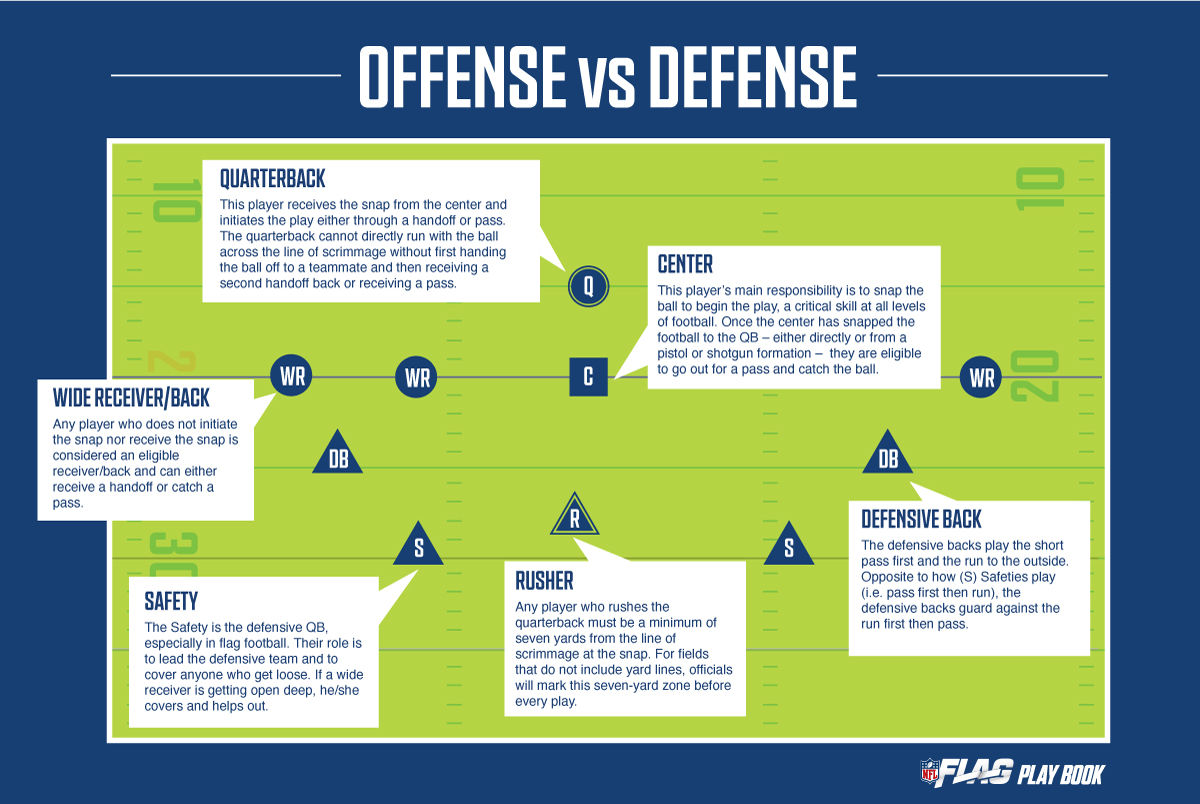
NFL Play Football’s glossary lists the core jobs, but they are easy to miss if you are still thinking in tackle-football terms. The center snaps the ball and can become a receiver, the quarterback receives the snap and distributes it, the running back can take a handoff or catch a pass, and the wide receivers are the route runners who stretch the defense. On the other side, defensive backs and safeties are not hunting hits, they are defending grass, closing windows, and preventing the deep gain.
In NFL FLAG rules, the quarterback is not allowed to run with the ball after the snap, so the offense cannot rely on scramble magic to save a broken play. Depending on the play, five-on-five teams can field three receivers or two receivers and a running back, which means the pre-snap shape often tells you more than the ball does about where the play is headed.
The rusher is the sport’s timing clock
The most important tactical lever in flag football is the rusher rule. That seven-foot gap creates the brief but decisive window that defines the sport. If the offense is slow to release the ball, late to identify leverage, or sloppy in its route timing, the rush can collapse the play before the first route even fully opens.
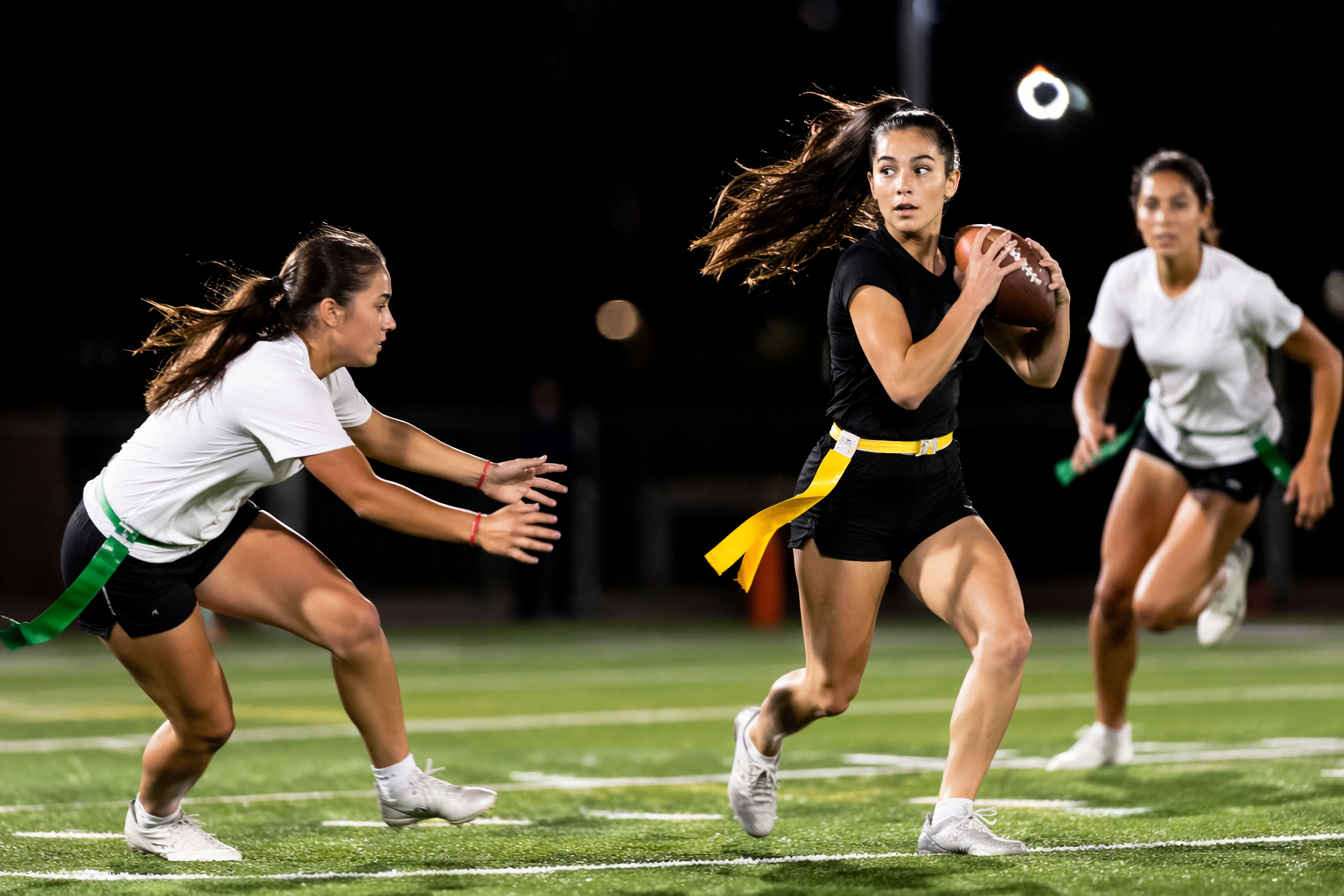
That is why flag football rewards precision over power. The best offenses do not merely throw quickly, they sequence the throw, using route combinations that force defenders to choose between underneath coverage and depth. The best defenses do not merely chase, they rush with discipline, because a rushed throw is often better than a missed flag pull.
What to watch on a live snap: • Does the quarterback catch, set, and throw on rhythm? • Does the center release into a route after the snap? • Do the receivers create layers, or do they crowd the same piece of grass? • Does the rusher force an early decision without overcommitting?
Field size changes the chessboard
The field is not just a backdrop in flag football, it changes the entire tactical language. NFL FLAG ages 5 to 17 are played on a 30-yard-wide, 70-yard-long field with a midfield line-to-gain, while many high school and college versions use a 100-by-40-yard field with first downs every 20 yards. That means the same play can feel completely different depending on age group and level, because route depth, horizontal spacing, and how fast a defense can recover all change with the surface.
On the shorter field, the offense has to move the ball horizontally and vertically with much less room for error. On the longer high school and college version, defenders have more depth to defend, but they also have to cover more ground laterally, which makes leverage, angle play, and route combinations even more valuable.
The drills tell you what the sport really values
NFL Play Football’s drill collection includes quarterback accuracy drill, quarterback evasion drill, route-running distraction drill, ball-security drill, catch-and-tuck drill, pass-rushing Y-cone drill, flag-pulling fundamentals, angle flag-pulling, make-’em-miss drill, gauntlet drill, and backpedal drill. The list shows the sport’s priorities: speed of decision, clean handling, disciplined pursuit, and controlled flag pulling matter more than brute force.
Those drills also reveal the open-field logic that separates good teams from great ones. A receiver who can sell one break and explode into another changes the geometry of the defense, while a defender who backpedals well and takes a proper angle can erase space without a collision.
The sport’s growth is changing who gets to play football
Flag football is now a major growth sport, not a backyard novelty. It is a fast-paced, non-contact game played five-a-side, and the NFL says it is played in more than 100 countries with over 20 million participants.
While youth participation in sports overall has declined 13 percent over the last decade, the NFL says youth flag participation among ages 6 to 17 has grown 40 percent since 2019, with girls’ participation up 89 percent in the same span. The NFL also says about 35 percent of surveyed kids who quit flag football start tackle football.
LA28 and the international stage raise the stakes
Flag football’s Olympic debut at Los Angeles 2028 changes how the sport is viewed at every level. The International Olympic Committee approved its place in the Games, and the NFL later made its players eligible to compete in Olympic flag football after a league decision that also authorized cooperation with the NFL Players Association, the International Federation of American Football, and Olympic authorities on participation rules.
The international footprint is already real. NFL FLAG now has a presence in 15 markets outside the United States, and the NFL called the 2025 Pro Bowl Games flag football event the largest international flag football tournament to date, with countries across five continents represented, including Australia, Brazil, Canada, China, France, Germany, Great Britain, Ireland, Japan, Mexico, New Zealand, Panama, and Spain.
The rulebook is still catching up to the game
Flag football is still standardizing as it grows. The NFHS announced eight key revisions to its high school flag football rules for the 2026-27 season.
Sources
- [1]playfootball.nfl.com
- [2]nfl.com
- [3]olympics.com
- [4]media.nfl.com