NJCAA Division I basketball championship uses 24-team seeded bracket
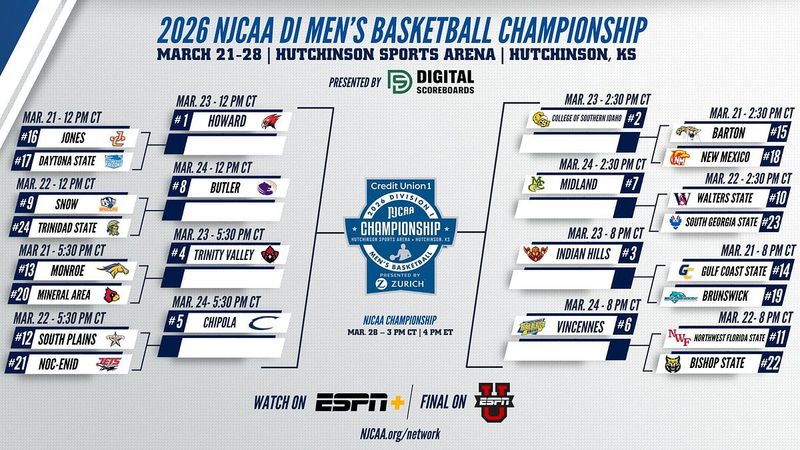
The path to an NJCAA Division I men’s basketball title is brutally efficient: 24 teams, single elimination, and no room for a bad night. Sixteen district champions get in automatically, eight at-large teams fill the rest, and the top eight seeds earn a first-round bye before the bracket starts chewing people up.
How the 24-team bracket really works
This is not a sprawling postseason with multiple lifelines. Once the field is set, every game is an elimination game, and the only cushion is the bye line that goes to the top eight seeds. That matters because it separates the teams that have to survive from the opening round from the ones that can watch, rest, and study matchups while the first wave of pressure hits somebody else.
The selection formula is clean enough to read in one glance: district champions get automatic access, and the at-large spots go to the teams that built the strongest résumés outside their district title. In championship seeding materials, at-large teams are marked with double asterisks, which makes the bracket easier to decode than a lot of college postseason trees. If a fan wants the practical answer to “how do you get in?”, it is simple: win your district or convince the committee your body of work deserves one of the eight at-large places.
Why seeding changes the entire road
The seed line is not decoration in this tournament. The top eight seeds avoid the opening round, which means they have one less game to survive and one less chance to get clipped by a hot lower seed before the bracket settles in. That is a major edge in a one-and-done setting, especially when the tournament is built to punish any team that arrives flat.

The recent title games show how dangerous the bracket can still be below the top line. In 2024, No. 1 Barton met No. 7 Triton in the championship game, and Barton won 88-73. In 2025, No. 2 Trinity Valley played No. 17 Connors State for the title, and Trinity Valley won 69-61. Those matchups prove the same point from two different directions: the top seeds are protected early, but a lower seed that catches form at the right time can still push all the way to the final weekend.
The 2025 seed reveal also gives you the tournament’s rhythm. National tournament seedings were announced on March 16, 2025 at 8:00 PM ET through the NJCAA Network, which means district results feed directly into a near-final bracket less than a week before the tournament opens. That short runway leaves very little mystery once the field is locked, but it also leaves plenty of room for debate about whether the at-large teams were rewarded for strength of schedule, quality wins, or simply surviving a brutal season.
Why Hutchinson is part of the championship identity
The venue is not just a backdrop here. The championship is anchored at Hutchinson Sports Arena in Hutchinson, Kansas, and the event’s history runs back to 1948, when the first NJCAA Men’s Basketball Championship was held in Springfield, Missouri. A year later, it moved to Hutchinson, and it has been tied to that city ever since.
That continuity gives the tournament a feel that most postseason events never find. The 2025 championship ran March 22-29, 2025 at Hutchinson Sports Arena, and the 2026 championship was scheduled for March 21-28, 2026 at the same building. By the 2025 event, the tournament had been played there for 77 consecutive years, which is the kind of detail that turns a bracket into a tradition. The same floor, the same title chase, and the same narrow margin for error have made Hutchinson synonymous with NJCAA men’s basketball.

How fans follow the event and get in the building
The 2026 championship came with a straightforward viewing plan. All games were set to stream on ESPN+, and the national championship game was scheduled to air on ESPNU on Saturday, March 28, at 3:00 pm CT. That matters because the title game is not buried on a platform nobody can find; it gets a national TV window, which gives the winner a bigger stage than most junior college titles ever receive.
Tickets were priced to keep the event accessible. Single-session tickets were set at $16, and all-session tickets were $80, before taxes and fees. For a tournament that compresses its entire championship chase into one arena and one week, that price structure fits the format: buy a seat for one session if you want a slice of the action, or lock in the full run if you want to track the bracket from the first elimination game to the final horn.
The real answer to the title question
If you want the shortest possible answer to how a team actually wins the NJCAA title, it is this: win your district, land as high a seed as possible, avoid the opening round if you can, and survive a bracket that gives no second chances. The byes help, the at-large spots widen the field, and Hutchinson keeps the championship stage familiar, but the math never changes. One bad night ends the run, and one strong week can carry a team seeded outside the top tier all the way to the trophy.
Sources
- [1]njcaa.org