NJCAA men’s basketball records highlight Schumann’s 159-point championship feat
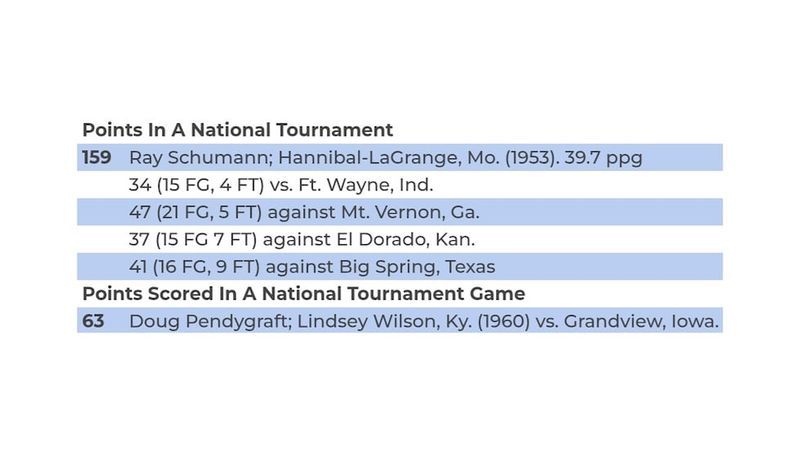
Ray Schumann’s 159 points for Hannibal-LaGrange in the 1953 national tournament still reads like a scoreboard malfunction, but it is the kind of number that tells the real story of NJCAA men’s basketball. The confirmed championship records are a tour through the sport’s most violent scoring surges, its cleanest shooting nights, and the kind of coaching longevity that only a handful of programs ever match.
A championship built in the tournament’s roughest years
The records matter because the championship itself was forged in uncertainty. The NJCAA says it was formally organized in 1938 after 13 two-year colleges regrouped in Fresno following the NCAA’s rejection, then staged its first national championship event in May 1939. Men’s basketball came later: the first NJCAA Men’s Basketball Championship was held in 1948 at the Southwest Missouri State Fieldhouse in Springfield, Missouri, before moving to Hutchinson, Kansas in 1949.
That move makes sense in light of how difficult the early event was to stage. The association says the tournament was hampered by high travel costs, logistical issues, poor attendance and severe financial losses. That history gives the modern record archive real weight, because the numbers preserved on the championship pages are the remnants of a tournament that had to survive long enough to build a legacy at all. The NJCAA says its Division I men’s basketball championship has recognized record-setting performances since 1948, and it is still researching and compiling a broader list, which makes the confirmed marks especially valuable.
Schumann set the ceiling for championship scoring
Schumann’s 159-point total remains the cleanest measure of how far an individual could carry a tournament run. The confirmed individual records page also gives the shape of that run: a 39.7 points-per-game average, plus single-game outputs of 34 points against Ft. Wayne, Indiana and 47 points against Mt. Vernon, Georgia. That is not just volume. It is a player producing elite scoring night after night while the bracket tightened around him.
Doug Pendygraft supplied the other great single-game scoring burst in the archive, pouring in 63 points for Lindsey Wilson in 1960 and making 28 field goals in that tournament game. Chris McMullin’s 29-for-29 performance at the free-throw line for Dixie State in 1982 is a different kind of domination, one built on precision rather than pace. Together, those records show three separate paths to offensive takeover: relentless workload, shot-making at scale, and perfect execution when the game slowed down.
Free throws and threes show how the tournament changed shape
The championship record book is not only about pure scoring totals. It also captures the different ways players bent games to their will, from the foul line to the arc. Pierre Jackson made 46 free throws in a single tournament, a number that signals both contact and control over multiple games. McMullin’s perfect night at the stripe belongs in the same conversation, because the two records show how a player can turn free points into tournament separation.
Chris Weakley’s 13 made three-pointers in a game and 25 in a tournament for Southern Union State in 1998 push the archive into a more modern offensive space. That record says the championship was no longer only about post play and interior volume. By the late 1990s, one hot perimeter shooter could alter the geometry of the bracket just as surely as a bruising low-post scorer could in earlier eras.
Rebounding and playmaking complete the box score
The confirmed records also reveal how often the championship has been decided by the hidden possessions. Larry Dassie grabbed 28 rebounds in a tournament game for Dodge City in 1974, a total that speaks to control of the glass and the ability to erase second-chance opportunities. Jemerrio Jones went even further in 2015, collecting 72 rebounds in a national tournament for Hill. That is the kind of figure that turns every missed shot into a rebounding story and every matchup into a test of physical endurance.
The assist records round out the picture. Sammy West and Dan McCarthy each had 16 assists in a tournament game, while Detrick White reached 40 assists in a tournament. Those numbers matter because they show that championship basketball at this level has never been only about individual scoring explosions. At its best, the NJCAA tournament also rewards pace control, spacing, and the ability to generate advantage for others possession after possession.
Gene Bess turned consistency into a separate kind of record
The coaching records give the archive its long view. Gene Bess holds the confirmed record for most tournament appearances by a coach with 17, and the NJCAA says only six programs have made more national tournament appearances than Bess himself. That is a remarkable measure of staying power in a championship that has changed venues, styles and eras since 1948. Floyd Wagstaff joins Bess as one of the standard-bearers in wins, underscoring how rare sustained success is at this level.
Bess’s deeper resume explains why his place in the record book is so secure. The NJCAA says his teams had an 83-game home-court winning streak from 1978 to 1984, he recorded 16 30-plus-win seasons, and he won two national titles with two runner-up finishes at Three Rivers. The association inducted him into its Hall of Fame in 2024, a fitting marker for a career that tied championships to repetition as much as to peak performance. In a record book filled with single-game shocks, Bess shows that the most durable form of dominance is often the one that repeats across seasons.
The NJCAA men’s basketball archive works because the numbers are extreme without feeling random. Schumann’s 159 points, Pendygraft’s 63, Jones’s 72 rebounds and Bess’s 17 appearances all point to the same truth: this championship has always measured excellence in its most exaggerated form.
Sources
- [1]njcaa.org