NJCAA regions shape basketball path to national championship tournaments
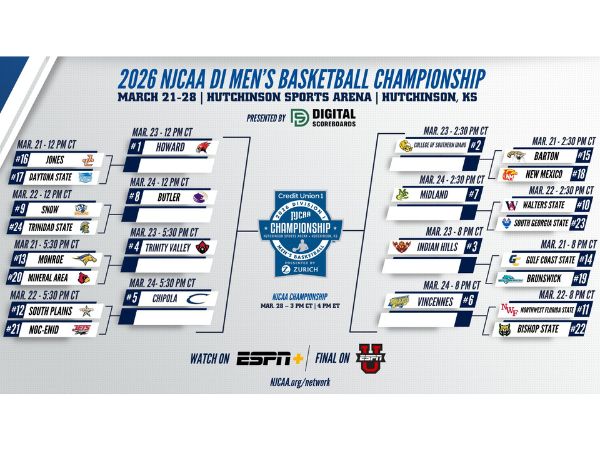
In NJCAA basketball, the conference label is not the thing that steers a season. The region map does that work, shaping who a team plays, how far it travels, and how it reaches the national tournament.
The region map is the real operating system
Every NJCAA member college is assigned to a region when it joins the association, usually because of geography, and NJCAA says that regional membership is guaranteed inside its structure. That makes the sport look very different from college models built around conference branding, because the region assignment comes first and everything else follows.
There are 24 regions across the country, and each one is represented by one women’s region director, one men’s region director, one women’s assistant region director, and one men’s assistant region director. Those regional representatives are elected by members of each region for a term defined by the region, which gives the map real political weight inside the association, not just administrative convenience.
Regions also reach beyond scheduling and into governance. NJCAA committees are made up of region directors who oversee rankings, All-America selections, postseason seeding, at-large selections, and national championship obligations. In other words, the same regional structure that sorts opponents also helps shape how postseason decisions are made.
Districts turn geography into the postseason path
The region system is the primary method NJCAA uses across all sponsored sports to determine qualification for national championship tournaments. In some sports, two or more regions are paired to create a district, and those district structures vary by sport and are recalibrated every two years by the NJCAA Board of Directors.
That matters because basketball does not wait until a bracket is filled to reveal its road to nationals. The path is already defined by region placement and district alignment. A school in Kansas, Florida, New York, or Arizona can all be part of the same national association, yet operate in very different competitive environments because of the region and district structure around them.

For fans, that explains why junior-college basketball has such strong local identities. A region can create natural rivalries, repeated matchups, and shorter road trips, while another region can stretch teams across far more ground. For recruits, it affects travel demands, how familiar opponents are, and how realistic a national run feels before the first tipoff of district play.
How basketball qualification works at nationals
Basketball gives the clearest view of how the system works in practice. In NJCAA Division I men’s basketball, each district champion earns an automatic bid to the national tournament, and there are eight at-large selections available. That means district success is still the front door, but the committee can also widen the field for teams that did enough over the season to merit a place.
Division III men’s basketball works a little differently. Each district champion earns an automatic bid there too, regions with multiple districts receive multiple bids, and there are four at-large selections available. That structure keeps district competition central while giving larger or more complex regional setups a direct line into the national event.
The result is that region placement can shape a season more than a conference name ever could. A team’s day-to-day reality is built around the opponents clustered in its region, the district it lands in, and the number of national spots available from that part of the map. Before a bracket is printed, the geography has already sorted much of the field.
The basketball championship was built on regions from the start
That regional logic is not a recent overlay. NJCAA traces its origin to May 14, 1938, when its first constitution was accepted by 13 charter member colleges after an earlier NCAA rejection. The association staged its first national championship event in May 1939, signaling that postseason competition was part of the organization’s identity almost immediately.
NJCAA says the success of the Western States Basketball Tournament helped lay the groundwork for the regional and national basketball championship structure that followed. The first NJCAA men’s basketball championship was held in 1948 at Southwest Missouri State Fieldhouse in Springfield, Missouri, and the tournament featured 16 schools from eight newly formed regions. That detail is telling: the region system was not bolted on later, it was already central to how the first national tournament was assembled.
The men’s championship moved to Hutchinson, Kansas in 1949, giving the event a permanent Midwest anchor after its Springfield debut. That shift reflected the association’s effort to build a stable championship model around the regional framework that had already defined access to the tournament.
Why the region map still decides so much
The modern importance of NJCAA regions shows up in the small stuff that shapes a season and the big stuff that decides championships. A team’s region can influence travel distance, game frequency against familiar rivals, and how quickly a program can build a path to a district title. In a structure with 24 regions, those differences are not minor. They are the mechanics of the sport.
The map also explains why two programs with similar talent can face very different postseason roads. One may live in a district where the automatic bid is the main prize and at-large breathing room is limited. Another may sit in a multi-district region where additional bids exist, changing how many teams can realistically reach nationals.
That is why NJCAA basketball is best understood through geography first. The region system determines governance, district formation, and championship access, and it has done so since the association’s earliest championship years. In a sport where the bracket starts long before selection day, the region map is the hidden architecture behind every trip to the national stage.
Sources
- [1]njcaa.org