Padel rules explained, court size, serving, walls and scoring basics
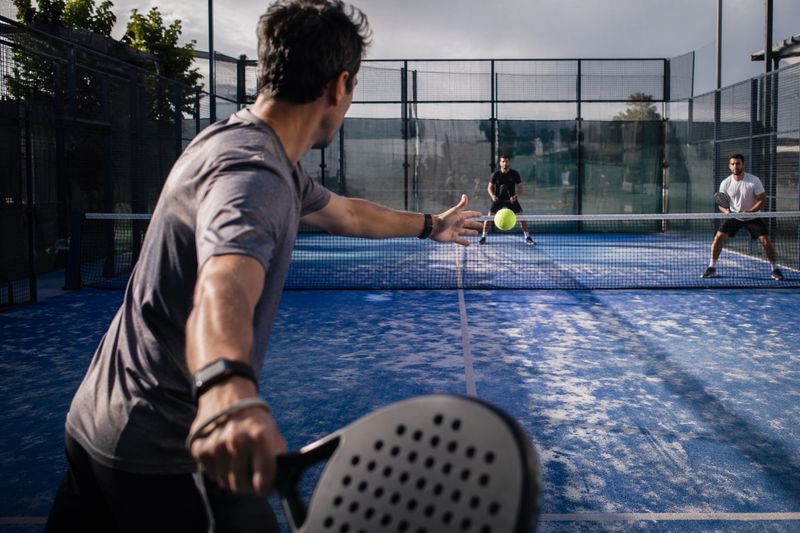
Padel feels familiar for about five seconds, then the court, the serve and the walls rearrange the whole sport. It is played as doubles on a compact, enclosed court, so the first thing to learn is not how to hit harder but how to read rebounds, recover to the net and keep points alive. Once you understand those three differences, the rest of the rulebook starts to make sense fast.
The court is the sport’s biggest tell
The International Padel Federation sets the court at 10 metres wide and 20 metres long, with service lines 6.95 metres from the net, lines 5 centimetres wide, and a net that stands 0.88 metres high at the centre and 0.92 metres at the ends. New facilities are also recommended to have at least 8 metres of free height above the court, because lobs are not a decorative extra in padel, they are central to the geometry of the game.
The enclosure changes everything. Official rules and the Lawn Tennis Association both describe padel as being played inside glass walls, a metal cage and doors, which means the ball can stay live after a rebound instead of disappearing out of the court. That is why the sport feels like a hybrid of tennis and squash, but with its own rhythm: the court is small enough to compress time, yet the walls create extra angles that force players to think a shot ahead.
That compact footprint is not an accident. The International Padel Federation traces the sport back to 1969 in Acapulco, Mexico, when Enrique Corcuera built a smaller 20 by 10 metre court at Las Brisas because he did not have enough space for a full tennis court. The first court had 3-metre walls, and that original design still explains the modern sport’s obsession with positioning, patience and counterpunching.
Serving is where padel instantly diverges from tennis
The serve is underarm, struck below waist height after a bounce, and sent cross-court into the opposite service box. That single rule is the quickest way to tell newcomers they are not watching tennis with a different fence. Power matters much less than placement, because the serve is designed to start a rally, not to erase one.
There is a second twist that catches people out immediately: if a serve lands and then hits the cage first, it is out. If it lands and then reaches the back wall, it stays live, which means the returner has to keep reading the ball even after what would look like a bad bounce in another racket sport. Once that logic clicks, the game opens up, because every serve becomes a positioning battle rather than a race to the fastest delivery.
Scoring still follows the tennis system, and best-of-three-set matches are common. That familiar scoring structure makes padel easy to follow on paper, but the feel of a point is different because the serve rarely produces the kind of free winners tennis fans expect. In practice, the first clean advantage usually comes from winning the net or forcing a weak reply off the back glass.
Walls are in play, which changes the tactics
After one legal bounce, the ball may rebound off the glass walls, and players can even run outside the court through the doors to keep a point alive. That single feature transforms padel into a sport of anticipation rather than pure striking power. A player who waits well, reads the rebound and keeps the ball deep can neutralize a bigger hitter far more easily than in tennis.
That is why padel strategy leans so heavily toward lobs, net control and patience. The court is too compact for endless baseline grinding, but the walls give defenders time to extend rallies and regain shape. For a first match, the practical lesson is simple: hit with margin, recover quickly, and expect the point to continue after shots that would be terminal elsewhere.
Because the walls remain part of the court, doubles positioning matters from the first ball. One partner can press at the net while the other covers the back glass, and the pair that communicates better usually controls the tempo. The sport rewards teamwork so much that the doubles format does not feel like an option, it feels like the point of the design.

The equipment is built for that style of play
FIP-approved balls are rubber spheres with a uniform outer surface, a diameter of 6.35 to 6.77 centimetres and a weight of 56.0 to 59.4 grams. The federation also recognises standard and high-altitude balls, which matters because padel is played in a wide range of climates and elevations. If you are borrowing gear for your first match, the simplest check is whether the balls match those FIP specifications.
The racket is just as distinctive. It is not strung like a tennis racquet, and FIP rules describe a perforated hitting surface with a handle that must have a non-elastic wrist cord no longer than 35 centimetres. That shape helps explain the sport’s feel off the face of the racket: contact is firmer and more controlled, but the equipment is built for touch, blocks and angled placement rather than long, string-assisted drives.
• Bring or borrow a padel-specific racket, not a strung tennis racquet. • Use balls that meet FIP size and weight standards. • Expect the walls to be part of the rally, not a boundary to avoid. • Think doubles first, because the sport is always built around two-player coordination.
Why padel has spread so quickly
The scale is now impossible to miss. FIP’s 2024 World Padel Report said the sport was being played in 130 countries, with almost 20,000 clubs and more than 63,000 courts worldwide. FIP later said padel had grown to more than 30 million players, and its 2025 General Assembly announcement put participation at over 35 million players after 14 new national federations lifted FIP membership to 100.
That growth has pushed the sport toward a more unified professional structure. Starting in 2024, FIP established a single official international ranking for men and women with Premier Padel and the CUPRA FIP Tour, in agreement with the Professional Padel Association and the International Padel Players Association. For a young global sport, that kind of standardization matters because it gives tournaments, players and fans one ladder to follow.
The expansion is also changing how regional bodies think about access. The Lawn Tennis Association says padel is one of the fastest-growing sports in Britain, and its 2024 to 2029 strategy says 25 tennis federations identified padel as a key way to attract new audiences and grow participation. In Asia, FIP said the Olympic Council of Asia recognized padel in 2025 and would include it in future Asian Games editions, building on the sport’s earlier appearances in the European Games and South American Games.
The physical demand is real, even if the learning curve feels friendly
Padel’s public image is often that of an easy entry point, but the body still works hard. A 2023 systematic review in BMJ Open Sport & Exercise Medicine examined the incidence, prevalence and nature of padel injuries, a sign that the sport is now large enough to demand proper sports-medicine attention. The enclosure and quick transitions create repeated lateral movement, sudden stops and awkward wall reads, all of which make timing and balance more important than brute force.
That is the real beginner takeaway. Padel was born from a 20 by 10 metre court in Acapulco, and the rules still reflect that compact origin: underarm service, live walls, doubles only, and a scoring system borrowed from tennis but played in a very different space. Learn the geometry first, and the sport opens up immediately.
Sources
- [1]padelfip.com
- [2]lta.org.uk
- [3]bmjopensem.bmj.com