Porter Wilson's Sonic Boom belts shaped modern flag football
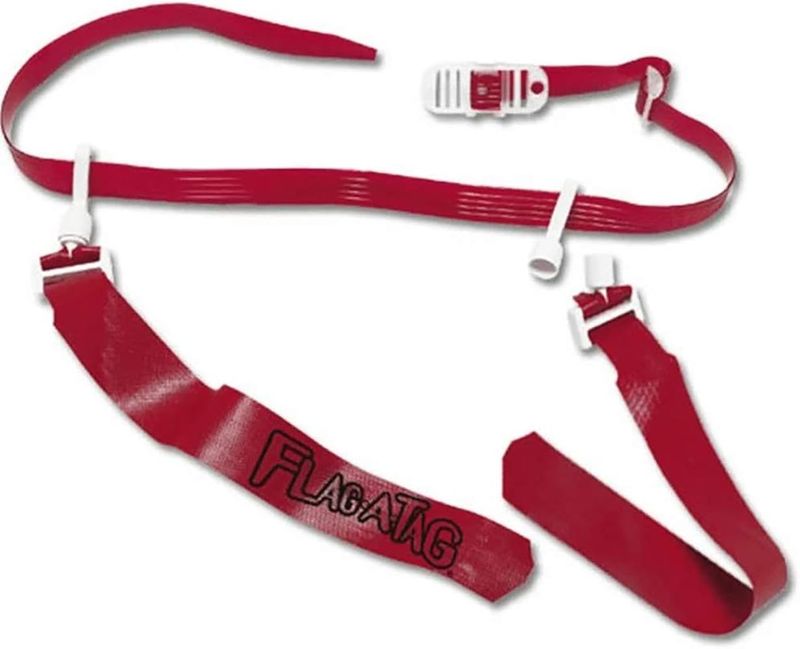
Porter Wilson’s biggest impact on football was not a play call or a championship run. It was the belt: the Sonic Boom release system that gave flag football a clean, visible way to stop the action without tackle contact. That one design choice helped make the sport easier to referee, easier to teach, and easier to spread through schools and clubs.
The equipment that made the stop obvious
Flag football works because everyone on the field can see when a play is over. Wilson’s Sonic Boom belts and flags added that clarity, with a release that produced an audible “pop” when the flag was pulled, turning the dead-ball signal into something both players and officials could register instantly. That mattered in a game built around speed and repetition, where disputes over whether a runner was down can slow everything to a crawl.
The belt-and-flag system also gave the sport a practical identity separate from tackle football and touch football. It created a way to end a play safely without collisions, while keeping the pace quick and the field crowded with younger players, beginners, and athletes who wanted a lower-contact entry point. In a sport where the equipment has to communicate the rule, Wilson’s design did that work every snap.
Why standardization changed the game
Flag football grew because it needed something more than local improvisation. Diane Beruldsen, founder and president of the International Women’s Flag Football Association, says that until 1995 there had never been a central organization for women’s flag football, which made a dependable equipment standard even more valuable. The IWFFA describes itself as a union of women’s and girls’ flag football teams, leagues, and individual players from around the world, run by women, and it traces its roots to a regional organization based in New York with fewer than 1,000 women.
That kind of expansion depends on tools that travel well. A belt system is cheaper than tackle gear, fits a wide range of body types, and gives coaches and officials a common language for when a play ends. Wilson’s Sonic Boom concept helped supply that language, which is why the invention matters not just as a product, but as part of the sport’s operating system.

Porter Wilson, Flag-A-Tag, and the award that bears his name
The IWFFA identifies Wilson as the inventor of the Sonic Boom belts and flags and the founder of Flag-A-Tag. The organization says he died in September 2000, and it created the Porter Wilson Award to honor his contributions and support of girls’ and women’s flag football. That award is a reminder that the sport’s growth has never depended only on players and coaches; it also depends on the people who solved the equipment problems that let leagues function.
Wilson’s company name still carries weight in schools, clubs, and recreational leagues because the equipment solved a basic problem in a way that was easy to repeat. Modern Flag-A-Tag belt descriptions still center on a patented release system that produces an audible “pop” when the flag is pulled. That continuity shows how his original idea became part of the sport’s standard visual identity, not a one-off product that disappeared when a trend passed.
Sahuarita gave the inventor a local home
Wilson’s story is also rooted in Sahuarita, Arizona. A May 27, 2025 Sahuarita Town Council staff report says he taught for 35 years in the Sahuarita Unified School District, standardized the game of flag football, invented the sonic belt, founded Flag-A-Tag, and established flag football in Sahuarita. In 2025, Sahuarita recognized that legacy with a permanent marker outside Sahuarita High School honoring the man widely linked to the modern form of the sport.
That local recognition matters because it ties a global youth and school game to one community and one classroom career. Wilson was not just a product inventor; he was a teacher whose work moved from the schoolyard into the broader structure of the sport. His name now sits where flag football’s modern identity began: at the intersection of equipment, education, and a simple rule that had to be obvious to everyone on the field.
Sources
- [1]iwffa.com
- [2]pub-sahuarita.escribemeetings.com
- [3]kgun9.com
- [4]facebook.com
- [5]usgames.com
- [6]bsnsports.com