President Trump’s College Sports Summit: Fact-Checking the Controversial Claims
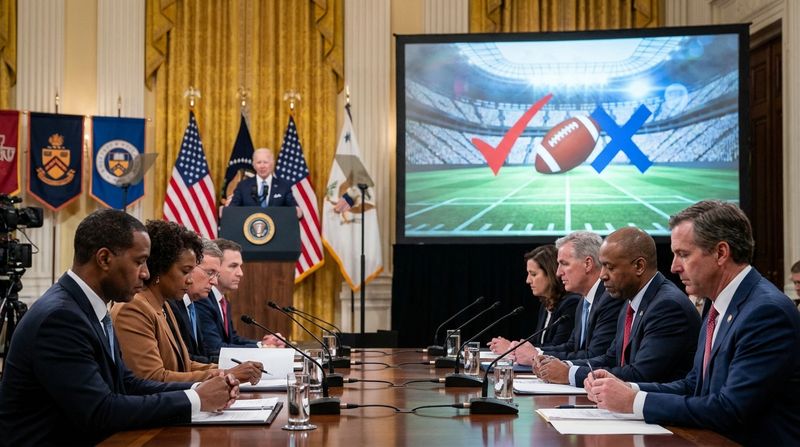
President Trump recently hosted a college sports summit, drawing widespread attention thanks to a series of statements that prompted fact-checking and debate across the athletic and political landscape. According to reporting from USA Today, the event saw the president make 17 claims about college sports, many of which were found to be inaccurate or misleading.
The summit was designed to address key issues in college athletics, including athlete compensation, academic standards, and NCAA regulations. However, the conversation quickly shifted as several assertions made by Trump were called into question.
- The president misstated the current rules regarding student-athlete compensation, suggesting that athletes are not allowed to receive any financial benefits—a claim refuted by recent NCAA changes permitting Name, Image, and Likeness (NIL) earnings.
- Trump erroneously described the number of scholarships available to college athletes, overstating figures for prominent sports like football and basketball.
- He claimed that NCAA eligibility rules are “the same as they’ve always been,” despite multiple revisions in recent years to accommodate transfer flexibility and COVID-19 disruptions.
- The president cited outdated graduation rates for student-athletes, not reflecting the latest NCAA data showing recent improvements across several sports.
USA Today’s analysis highlights that Trump’s statements overlooked crucial reforms that have reshaped college sports in the past five years. For example, the NCAA now allows athletes to profit from NIL deals, a major departure from the previous model. Additionally, transfer rules have become more flexible, with student-athletes able to switch schools and play immediately in many cases.
The summit also touched on academic standards, with Trump asserting that "most athletes struggle academically and barely graduate." However, statistics from the NCAA contradict this, showing graduation rates for Division I athletes have reached record highs in recent years.
- Division I student-athlete graduation rates now exceed 90% in several sports, compared to much lower figures cited by the president.
- Recent reforms have enhanced support for academic success, including mandatory tutoring and progress tracking.
Some of Trump’s claims about college football revenues and expenditures did not align with publicly available data. He suggested that "all college sports programs are extremely profitable," failing to note that only a small percentage of major programs generate significant surpluses, while most athletic departments operate at a loss or rely heavily on institutional support.
In addition, the president’s statements about conference realignment and its effects on student-athletes were criticized for ignoring the logistical challenges faced by athletes, such as increased travel and reduced rest periods.
USA Today’s fact check underscores the importance of accuracy when discussing complex issues like college athletics. The summit’s missteps highlight ongoing confusion about NCAA policies and the realities facing student-athletes. While the event brought attention to major collegiate sports topics, experts and stakeholders emphasize the need for informed dialogue backed by current data and policy.
Sources
- [1]USA Today