Quadball equipment guide reveals the sport’s precise field and gear setup
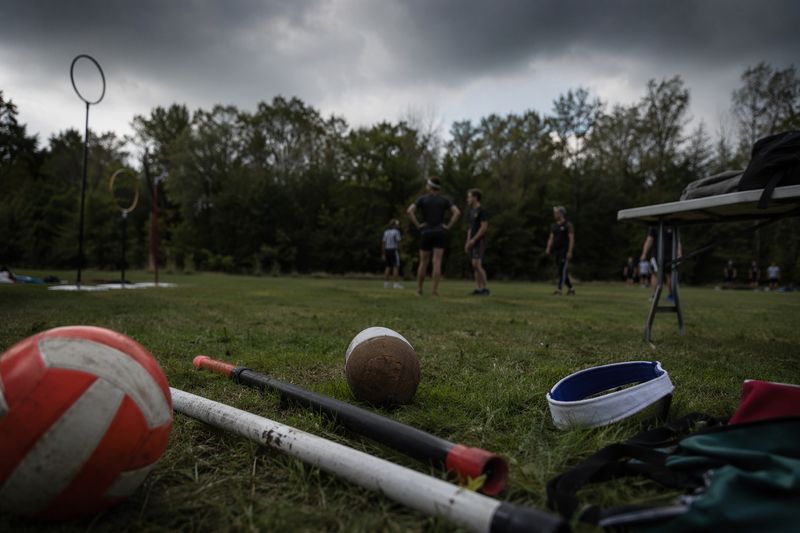
Quadball only looks like organized chaos from the stands. The sport’s geometry is doing far more work than it gets credit for: a 33m x 60m rectangle, six hoops split into two goals of three, and field markings that carve the pitch into lanes, zones, and pressure points. Once you know the numbers, the game stops looking random and starts reading like a map.
The field is built for movement, not just boundaries
The first thing that matters is the scale. A 33m x 60m playing surface is compact enough to keep contact and transitions constant, but large enough to create real spacing for chasing attacks and defensive recovery. The six hoops are not one uniform target line either. They are divided into two goals of three hoops each, and the hoops rise at different heights, which forces offenses to choose angles rather than simply flooding one spot.
That vertical variation matters because it changes sightlines around the hoops. A pass that looks open at one height can be blocked by traffic at another, and defenders can use bodies and sticks to contest space without just camping a single lane. The field is not flat in a tactical sense, even if the turf is.
The markings sharpen that structure further. Keeper zone lines sit 11m from midfield, while goal lines are 16.5m from midfield. Those distances create the sport’s reset points and define where pressure is legal, where protection matters, and where a team can step into an attack with real purpose. For a fan watching closely, those lines tell you when a possession is about to become dangerous.
Every piece of gear has a job
Quadball’s visual identity comes as much from equipment as from tactics. Players wear a rigid stick mounted between the legs, a mouthguard, a numbered jersey, and a color-coded headband that identifies position. That last detail is easy to miss, but it is crucial: the headband makes the game readable at speed, because positions are identified instantly even in the middle of a scramble.
The core scoring and defensive tools are just as specific. The game uses a standard volleyball for scoring and three dodgeballs for defensive disruption. That combination is what creates quadball’s layered rhythm: one ball to advance, three balls to harass, interrupt, and force a bad decision. It is not just a passing game with extra props. The ball mix is what makes every possession feel like a small crisis.
The measurements are the part that makes the sport feel genuinely standardized. The volleyball sits at a circumference of 65 to 67 cm, while the dodgeballs measure 68 to 70 cm. The flag ball, carried in a fabric sleeve attached to the flag runner’s shorts, is smaller and tighter in design, with a 65 to 69 mm diameter ball and a visible length of 25 to 30 cm. Those numbers are not trivia. They tell you why the sport can be replicated cleanly across venues without losing its shape.
The hoops set the terms of the attack
Quadball’s hoops are standardized too, and the height bands matter more than casual viewers might think. The shortest hoop sits roughly 89 to 93 cm high, while the tallest reaches 181 to 185 cm. That spread creates different layers of difficulty, so a team cannot rely on one preferred target or one favorite angle all match long.
Because the hoops are arranged in sets of three, the offense has to read the entire goal structure, not just one opening. A chaser driving one line can drag defenders away from another, and the staggered heights reward teams that can switch angles quickly. If the field is the map, the hoops are the landmarks that decide which route is actually open.
That is why the sport can feel messy to a first-time viewer but controlled to anyone who knows what to watch. The best attacks are not just fast. They are disciplined enough to pull defenders out of shape, then precise enough to exploit the gap before it closes.
Safety rules are also access rules
The equipment guide does more than define the sport. It defines what players must wear and what the game can tolerate. Mouthguards are mandatory, cleats are regulated, and any non-standard equipment or medical or religious modification needs approval before play. That is not bureaucracy for its own sake. It is how a contact sport keeps its boundaries clear while still allowing legitimate exceptions.
The broom is part of that same logic. The IQA play guide says brooms are typically just under a meter long and capped for safety. That keeps the visual identity of the sport intact without turning the stick into a hazard. It also signals how quadball balances contact and control: the game wants physicality, but not at the expense of the players wearing it.
The accessibility piece is unusually practical. Simple brooms and hoops can be built cheaply from common hardware-store plumbing supplies. That detail matters because it means the sport does not depend on elite facilities to exist in real life. Quadball can be standardized and still remain buildable, which is rare in a contact sport with this much structure.
What to watch for in a match
Once the measurements sink in, the game gets easier to follow. Watch the 11m keeper zone line to see when pressure becomes meaningful. Watch the 16.5m goal line to understand when a defense is collapsing into protection. Watch the different hoop heights to see which lanes are open and which are being baited shut.
The gear tells the same story. The headbands show position, the numbered jerseys keep players identifiable in traffic, the mouthguards and regulated cleats keep the collision legal, and the ball sizes keep the action consistent from one venue to the next. That is why quadball does not need to be simplified to make sense. Its rules already provide the structure.