Quadball marks 20 years since Middlebury origins, founders and growth

The cleanest way to understand quadball is to start where it actually started: a campus experiment at Middlebury College that turned into a sport with rules, leagues, championships, and a worldwide identity. The game’s 20-year marker is not just a birthday. It is a case study in how a niche sport earns legitimacy, one governing body, one standardized season, and one public event at a time.
From Battell Beach to a real sport
Middlebury College gives quadball a rare kind of origin story because the founders are still part of the record and the birthplace is still named. US Quadball says the sport was founded in 2005 by Xander Manshel and Alex Benepe, and its history page pins the start to October 9, 2005, when a small group at Middlebury began what would become quadball. Middlebury’s own 2017 history piece places that invention on Battell Beach, the campus field where the game was first played.
That location matters because it grounds quadball in a concrete place rather than a hazy pop-culture imitation. The sport began as a student-made activity at Middlebury in Middlebury, Vermont, but it did not stay a campus novelty. The fact that the invention site, founders, and first date are still identifiable gives quadball something many young sports never get: a traceable line from improvisation to institution.
The founders and the 20-year milestone
US Quadball used the sport’s 20th anniversary to frame that evolution directly in a retrospective titled “Quadball Turns 20: Honoring the Past, Building the Future.” That framing fits the sport’s history because the early era is no longer just an origin story, it is a foundation that later structures built on top of. A 20-year mark is enough time for a game to move from memory to system.
That system now includes the basic tools of a mature sport. US Quadball describes itself as the national governing body for quadball in the United States, and that title carries more weight than a simple brand label. It signals that the sport has moved beyond self-organized club play and into a framework with season calendars, season play requirements, national qualifiers, a USQ Cup history page, a strategic plan, event pages, a watch page, and national team structure.
Those details are not cosmetic. A sport that wants durability needs more than enthusiasm, and quadball’s infrastructure shows the difference between being played and being governed. Season requirements create standards, qualifiers create pathways, and a public watch page turns games into events with audiences, not just participants.
Why the name change mattered
The biggest public turning point came on July 19, 2022, when the International Quadball Association said it would join US Quidditch and Major League Quidditch in changing the sport’s name from quidditch to quadball worldwide. That was more than a cosmetic rebrand. It gave the sport a cleaner identity that could travel beyond its literary origin and stand on its own competitive terms.
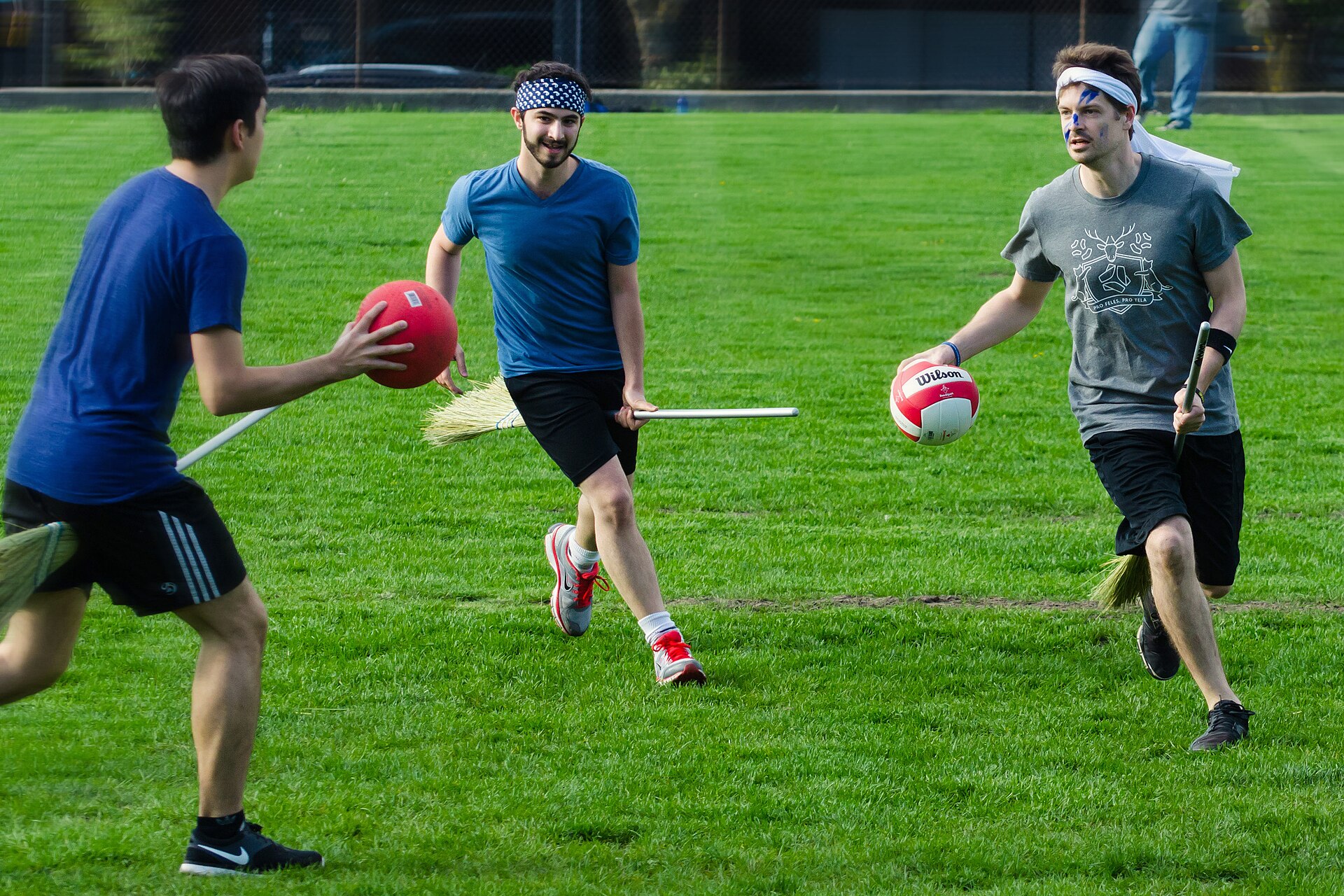
NPR noted that the change was meant to distance the sport from J.K. Rowling and help it grow, and it also explained why the new name fit the game itself: “quadball” refers both to the number of balls on the field and the number of positions in the game. That matters because the best sports names usually carry function, not just branding, and this one does both. The old name tied the game too tightly to a pop-culture source; the new one gives it room to be treated like a sport first.
US Quadball’s own announcement captured that shift with the headline “Quidditch Changes Name to Quadball.” The wording is blunt because the decision was structural, not symbolic. Once the sport had a name that was not borrowed from fiction, it could present itself as an organized competition with its own rules, its own calendar, and its own future.
A mixed-gender, full-contact game with a wider footprint
Quadball’s legitimacy also comes from how broadly it is played and who it is designed to include. The International Quadball Association says the sport has grown from the inaugural match in 2005 to thousands of players in more than 40 countries. That scale is enough to make the game an international network rather than a college-born curiosity.
QuadballUK describes quadball as the only full-contact, mixed-gender sport in the world and says it welcomes trans and non-binary players. That combination explains a large part of the sport’s appeal: it is not just unusual because of its fantasy roots, but because of the way it organizes competition. Mixed-gender full-contact play is still rare in mainstream sport, and quadball has built an identity around that rarity instead of treating it as a side note.
The result is a sport whose growth has been social as well as administrative. Players are not just signing up for a game with unusual equipment and a fast tempo; they are joining a format that makes inclusion part of the design. That helps explain why quadball has remained distinctive even as it has tried to shed the baggage of its original name.
How quadball earned credibility
Quadball’s first 20 years show a pattern that matters in sports development. The game started with a small group at Middlebury on October 9, 2005, but it kept adding the elements that make competition serious: shared rules, national oversight, regular seasons, qualifiers, championship history, and a public-facing event structure. Each step made the next one easier to recognize as legitimate.
That is why the anniversary is more than nostalgia. A sport can grow in participants without ever becoming stable, but quadball has done both. It moved from Battell Beach to a national governing body, from “quidditch” to a global name with its own logic, and from campus memory to an international sport played by thousands in more than 40 countries.
Sources
- [1]usquadball.org
- [2]iqasport.org
- [3]npr.org
- [4]quadballuk.org
- [5]middlebury.edu