Quadball’s officiating system shapes safety, fairness and gameplay

The most revealing moment in quadball often comes before anyone scores. A match’s pace, safety and clarity depend on six to seven referees working around one flag runner, a setup built to keep a multi-ball, high-contact game legible when everything speeds up.
The opening sequence locks the match in place
Before brooms up, the head referee sets the terms of the field with ground rules specific to that pitch and confirms the identity of the flag runner. A coin toss can decide which team attacks which set of hoops, and both sides must line up with three chasers, one keeper and two beaters while the quadball and dodgeballs sit in their exact resting positions.
That opening procedure matters because quadball does not forgive drift. If any ball moves, the setup has to be reset, and a false brooms up or any pre-start foul sends the whole sequence back to the beginning. The first whistle is not ceremonial here, it is the moment when position, legality and timing all get locked together.
The sport’s roots make that structure feel even more significant. Quadball began in 2005 at Middlebury College in Middlebury, Vermont, when Xander Manshel and Alex Benepe adapted the fictional game into a real one. US Quadball marked October 9, 2025 as the sport’s 20th anniversary, a reminder that what started as a campus experiment now operates with the kind of formal officiating most college sports never need.
Who does what once the balls are live
Once play starts, the officiating system becomes the game’s backbone. US Quadball describes a match as being overseen by six to seven referees, plus one flag runner per game, and its broader match description includes a head referee, a lead assistant referee, a seeker referee, up to two assistant referees and two goal judges. US Quadball’s 2025-26 officials update tightens that into a required club crew of one head referee, two lead assistant referees, one seeker referee, two assistant referees and one flag runner.
The hierarchy is built for pressure. The head referee can stop play at any time for safety or fairness, and that official is also the only one who may directly issue penalty cards. Assistant referees watch for knockouts, out-of-bounds plays and other action away from the quadball, while the scorekeeper and the rest of the crew help the game stay intelligible when possession changes fast and bodies are moving in different directions.
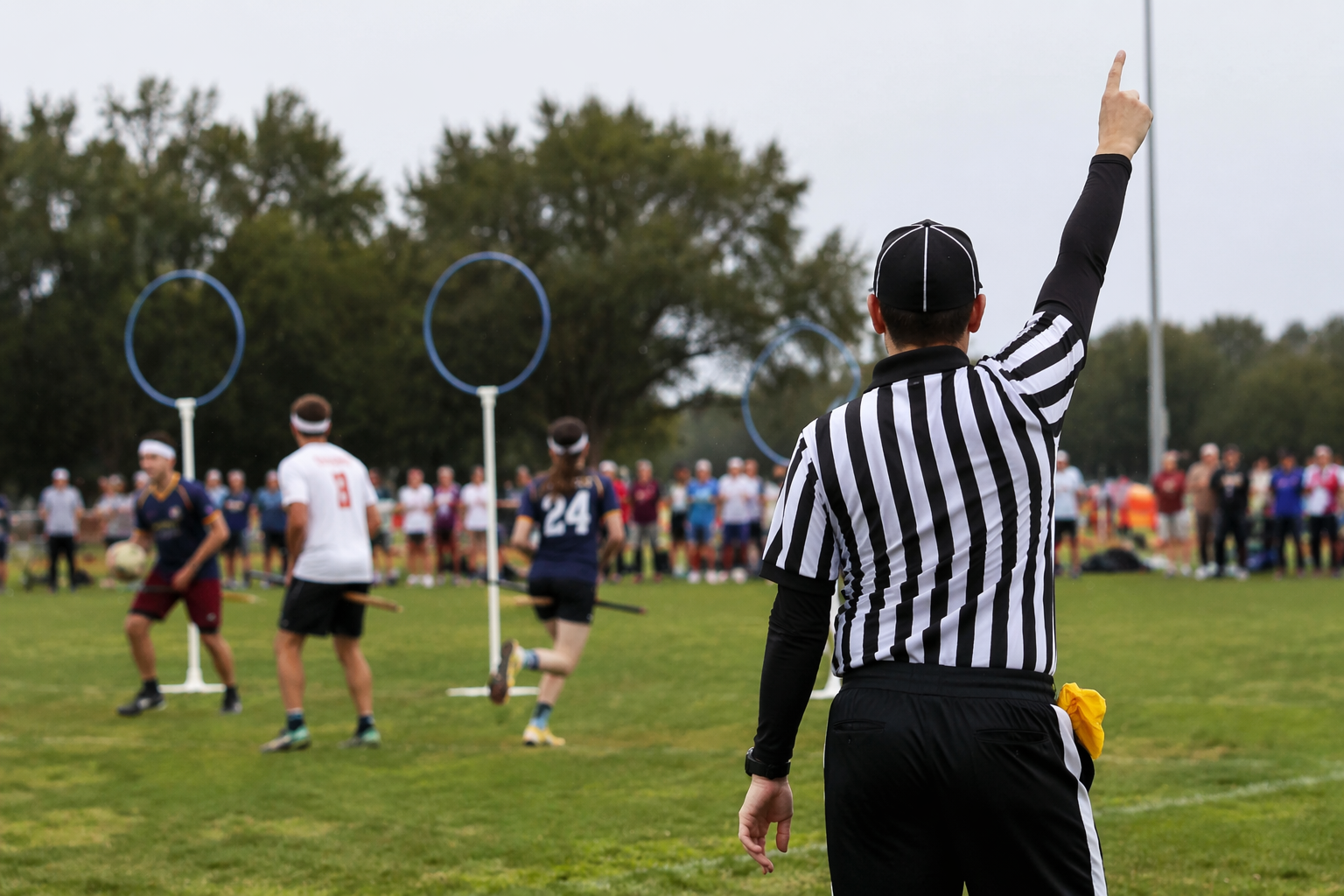
That level of specialization is not cosmetic. Quadball’s structure is designed around contact, multiple balls and a separate flag-running phase, so the officiating has to split the chaos into manageable pieces. The 2025-26 update also makes a certified head referee requirement apply only to club teams, another sign that the sport’s governing body is building a more formal pipeline for higher-level competition.
The live sequence that shows how the system works
The easiest way to understand quadball under pressure is to follow one live sequence. A chaser drives toward the hoops, an assistant referee tracks contact away from the ball, and the head referee watches for anything that affects safety or fairness. If the play breaks down, the head referee can kill it immediately, while the runner referee keeps focus on the flag side of the field and counts the three-second head start that governs the flag runner’s release.
That flag runner is not a prop or a passive obstacle. In Major League Quadball’s rules, the runner referee may stop play only if a catch may have been successful, which is why the flag phase has its own rhythm and its own official. The flag runner must remain fair and impartial while trying to avoid being caught, turning the final race into a controlled contest rather than a free-for-all.
This is where quadball’s officiating becomes more than rule enforcement. The system lets the sport run on two tracks at once: one for the ordinary possession game and one for the endgame chase. Without the referee split, the match would be too chaotic to read in real time, especially when contact, dodging and the flag sequence all overlap.
What happens after the score
Scoring has its own clean break. In Major League Quadball, a goal is worth 10 points, and the head referee confirms it with a long whistle and raised arms. At that point the quadball becomes dead until play restarts, which is why the restart is part of the drama rather than an afterthought.
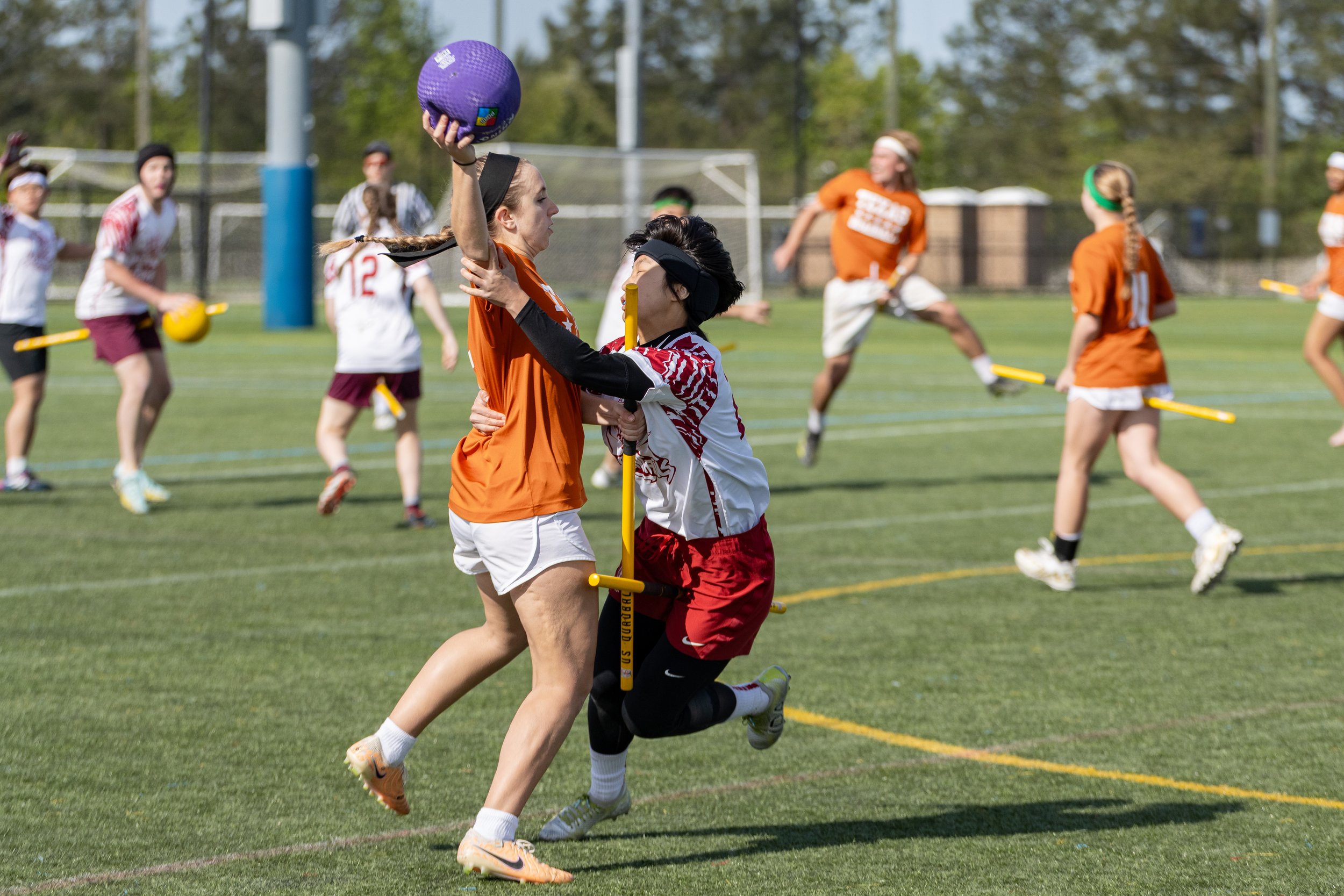
The rules also spell out when a score does not count. Goaltending and fouls can invalidate a goal, and an unplayable hoop changes the scoring picture as well. That matters because quadball’s offense is not just about getting the ball through a hoop, it is about doing it in a way that survives scrutiny from officials who are tracking multiple layers of action at once.
The signature endgame adds another layer of arithmetic. US Quadball says the flag is worth 35 points, attached to a neutral flag runner, and released at the 20-minute mark. The point cap can also end the game once a team reaches plus 60 over the leading score, which keeps the final minutes from turning into a purely open-ended sprint.
Why the officiating model has become part of the sport’s identity
The sport’s governance has turned that referee structure into a selling point. US Quadball describes quadball as one of the country’s most gender-inclusive sports leagues and says the game is built around mixed-gender participation, which helps explain why safety, neutrality and procedural clarity are treated as core features rather than background details. The more inclusive the field, the more important it becomes to make every stoppage, reset and restart unmistakable.
The international picture has also forced the officiating model to mature. US Quadball says quadball is now played in over 40 countries, and the 2023 IQA World Cup drew teams from 15 nations and was the first tournament in the sport’s history to include every inhabited continent. A global sport with that kind of reach needs rules that travel cleanly, and quadball’s layered officiating system is what keeps the game recognizable from one country to the next.
Major League Quadball shows how that scale looks in practice today. The league says it currently fields 12 teams from the United States and Canada and runs its season from June 1 to August 30, a compact schedule that puts a premium on officiating consistency and game management. The July 19, 2022 rename from quidditch to quadball, announced by USQ, MLQ and the International Quadball Association, gave the sport a new identity; the referee system is what gives that identity structure every time play stops, resets and starts again.
Sources
- [1]mlquadball.com
- [2]usquadball.org
- [3]iqasport.org