Racquetball ball colors evolved as players battled visibility and bounce
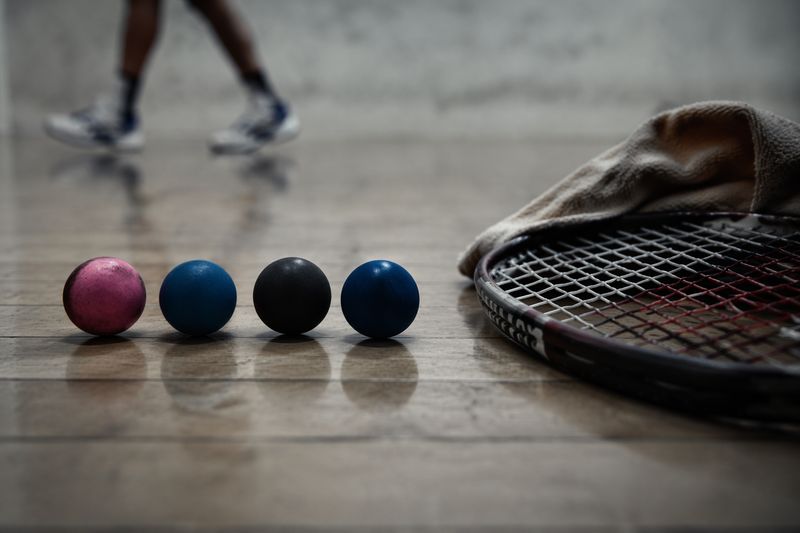
The smallest piece of racquetball equipment has done the most to shape how the sport feels. The game’s ball moved from the bright pinkie of the late 1960s to standardized blue and black models, and every shift answered the same two questions: can players see it, and can it play the right speed? That tension explains why racquetball’s identity has always been built around one rubber sphere, not just a court and a racquet.
From the pinkie to a sport still hunting for a color
The US Racquetball Museum describes the earliest widely discussed ball as the pinkie, an inner core of a tennis ball with the fuzz removed. Its bright pink color made it memorable, but it was only the first stop in a long equipment evolution. After pink came black, then green, then blue, and the museum’s history says racquetball balls have appeared in a wide assortment of colors, including yellow, brown, red, purple, black, green, blue, pink, and orange.
That variety was not cosmetic. The museum also says at least 25 different manufacturers have made racquetball balls, which is a reminder that early equipment was not yet locked into one standard. One of the most useful lessons from that era is also the most surprising: studies found blue was the hardest color to see on court. In a sport built around speed off white walls and a tight reaction window, visibility mattered as much as rebound.
When players had to warm the ball to make the game work
The early 1970s were a transition period, and Steve Keeley’s account of the 1971 tournament era shows just how rough the ball could be. Match balls could be slow, mushy, and inconsistent enough that organizers literally heated them on sauna benches or, when necessary, injected air into them. That is not a polished pro-tour detail; it is a picture of a sport still trying to make the ball behave like the game demanded.
What players wanted was simple and specific: a ball that would carry a well-hit ceiling shot to the back wall instead of dying short. Keeley places the real pivot in 1973, when manufacturers finally began producing a ball that met that practical standard. USA Racquetball’s history fits that same arc of improvisation, noting that Joseph Sobek, a tennis and handball player from Greenwich, Connecticut, first sketched the rules in 1949, developed a short-strung racket in 1950, and founded the National Paddle Rackets Association in 1952. Its Hall of Fame material adds that the first racquetball racquet had a test run of 25 in 1950, which shows how much of the sport was being built by trial and error.
The modern ball is a spec sheet, not a guess
Today’s racquetball ball is defined by measurements that leave very little room for improvisation. USA Racquetball’s rules say the standard ball must be close to 2 1/4 inches in diameter, weigh about 1.4 ounces, have a hardness of 55 to 60 durometer, and rebound 68 to 72 inches when dropped from 100 inches at 70 to 74 degrees Fahrenheit. Only USA Racquetball-approved balls can be used in sanctioned play, and the referee can replace a ball if it becomes erratic or misshapen.
Those numbers explain why the modern game feels so different from the pinkie era. Bounce is no longer a happy accident, and visibility is no longer an afterthought. The ball has to be fast enough to reward ceiling shots, predictable enough to keep rallies fair, and durable enough to survive the pace that racquetball asks of it every night in every gym.
The ball changed alongside the rest of the gear
Racquetball’s equipment story never stopped at the ball. USA Racquetball says aluminum alloy racquet frames arrived in 1971, fiberglass in 1972, graphite in 1979, and oversize frames in 1984. The federation also says its first Racquetball magazine appeared in November 1972, followed by its first National Racquetball magazine in September 1973, a sign that the sport’s media and equipment worlds were evolving together.
That broader timeline matters because the ball’s development was tied to the rest of the game’s rise. Better frames let players swing harder and control more shots, which made ball consistency even more important. As the sport professionalized, the ball had to keep pace with the racquets, the walls, and the players who were learning how to drive rallies instead of merely survive them.
Blue and black, old problems in new packaging
The newest chapter in the ball story is not a clean break from the past. In February 2025, USA Racquetball announced Gearbox Sports as its official brand partner, with Gearbox Blue and Black balls set to be used at national events beginning with the National Indoor Championships in Pleasanton in May 2025. A 2025 participant survey at that event drew 48 responses, and 72.9 percent preferred the Gearbox Electric Blue ball.
That preference sits right next to the old museum warning that blue is the hardest color to see on court. The sport is still balancing the same tradeoffs it faced with the pinkie: visibility, bounce, and feel. Racquetball’s ball history is really the story of a game learning how to be seen, how to stay alive off the wall, and how to turn one small piece of rubber into the sport’s defining feature.