Racquetball growth hinges on easy first sessions, clear adult pathways
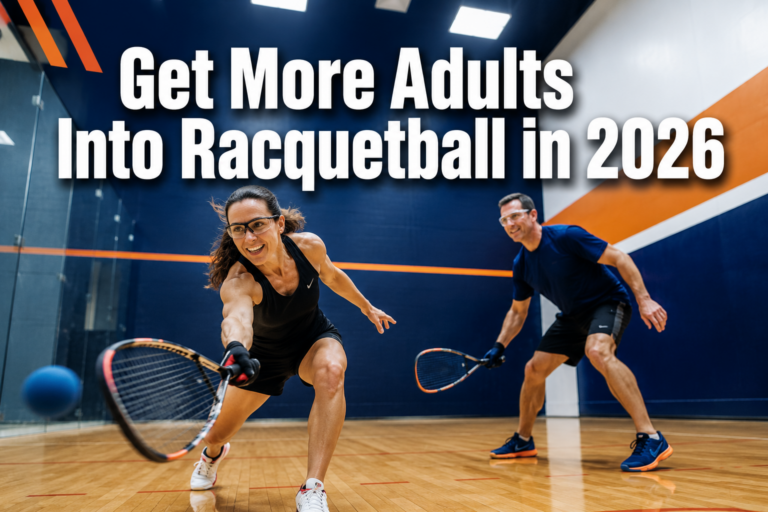
On a 40-foot-by-20-foot-by-20-foot court, a racquetball can travel faster than 150 mph. The sport’s next growth push depends on making that first session feel manageable enough for a beginner to come back for a second visit. The sport already has a clear workout case, a fast-learning curve, and a built-in social format; the missing piece is often the path that removes intimidation before it starts.
Make the first touch feel simple
The most effective adult entry point is the one that feels low-pressure from the start. Beginner clinics, short introductory lessons, and social open play nights work because they answer the questions adults are asking before they ever step on court: How long does this take, what do I need, and will I look lost? The game can look far more intimidating from the hallway than it feels after a few rallies.
Racquetball was built for quick conversion. It was developed in the early 1960s as an alternate winter workout for tennis players, so the sport has always had crossover DNA. That makes ex-players and tennis players natural return candidates, but only if the first session is framed as an easy re-entry rather than a test of conditioning or old-school club know-how.
Turn curiosity into a clear next step
A first session only matters if the club has a second one ready. The strongest adult pathways are the ones that leave no ambiguity: a beginner ladder, a weekly social league, or a mixed-level event that keeps newcomers from being thrown straight into high-pressure competition. USA Racquetball’s Find a Club, Find a League, Challenge Ladders, Facility Partnership, and coach resources are built to move a player from interest to regular play.
Adults do not usually need to be sold on the sport’s value. They need to be shown how to fit it into a week already packed with work, family, and fitness goals. A clear ladder or league gives them a reason to return, while a mixed-level format keeps the first few visits social and competitive.
Message the sport as efficient, social, and flexible
The language around racquetball has to change with the audience. Juniors and elite tournament players may respond to rankings, medals, and speed, but adult newcomers usually respond to convenience, community, and a workout that respects a busy schedule. The pitch works best when it explains how long a session lasts, what equipment is needed, and what the court experience actually feels like, instead of treating the first visit like a full commitment.
The sport can be intense in a small space, but it also lends itself to short sessions, quick learning, and social repetition. A club that advertises open play as a low-commitment trial, then follows with a regular weekly slot, gives adults a low-pressure first visit and a set time to come back.

Use history as proof, not as nostalgia
The boom years ran from the late 1970s through the early 1990s, when the sport reached about 10 million U.S. players and 14 million players in more than 90 countries, according to the US Racquetball Museum. The first world championship was held in the United States in 1981, the U.S. Olympic Committee recognized racquetball as a developing Olympic sport in 1982, and the sport reached full medal status in the Pan-American Games in 1995.
Racquetball once had the kind of club visibility that made discovery almost automatic. As more facilities converted courts to other uses, that easy exposure faded, which is why today’s growth model has to be more intentional about discovery, booking, and return visits. World championships were staged in San Antonio, Texas, in 2024 and in San Luis Potosí, Mexico, in 2022.
Keep the adult pipeline visible
USA Racquetball continues to push membership as a signal to facilities, manufacturers, and sponsors that long-term demand still exists, and its 2024 membership campaign explicitly urged current players to invite lapsed or never-been members back into the fold. It is a retention strategy as much as a recruitment one, because the easiest new member is often a former player who already knows how good the sport can be.
USA Racquetball honored Rhonda Rajsich and Scott Winters at the 2026 National Indoor Championships in Tempe, Arizona, on February 14, 2026, and it scheduled the 2026 National Junior Championships for June 24-28 in Des Moines, Iowa.
Measure participation the right way
The National Sporting Goods Association’s Sports Participation in the US - 2026 Edition tracks participation during calendar year 2025 and was conducted in 2026 using a sample of about 25,000 people ages 7 and older. The study has been run for 42 years, which gives the sport a credible benchmark for tracking whether adult entry points are actually working.
A June 2026 business directory listed 453 racquetball clubs in the United States.