Racquetball physics explained, why impact and rebound decide points
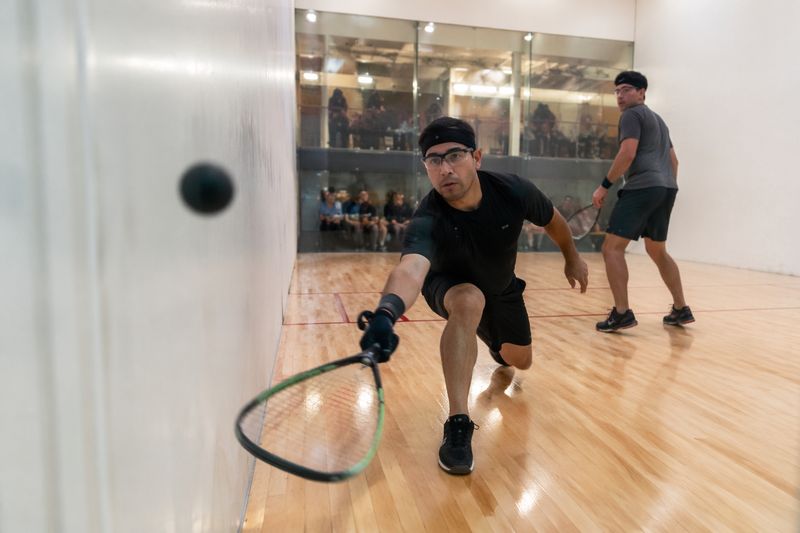
The International Racquetball Federation puts top racquetball shots above 150 mph before anyone even reaches the T, and the speed comes down to what happens when the ball slams into a wall, compresses, and gives back only part of its energy.
The court is a speed chamber
The standard four-wall racquetball court is 20 feet wide, 40 feet long, and 20 feet high, with a ceiling that keeps the ball trapped in a compact space where every bounce matters. That geometry is why a serve, a pinch, or a flat drive can turn into a race measured in fractions of a second. The game was developed in the early 1960s as an alternate workout for tennis players during winter, and that indoor, cold-weather origin still explains the sport’s hard edges: quick walls, short reaction windows, and almost no dead air.
Joe Sobek sits at the center of that story. USA Racquetball calls him the Father of Racquetball. He began with an idea for paddle rackets with strings, a concept that led to the first racquet of its kind. His earliest development work dates to 1949, and he was associated with the National Paddle Rackets Association in 1952.
Why impact never gives back all the speed
The cleanest way to understand racquetball physics is to stop thinking of the ball as a tiny pinball. Purdue’s impact model describes what happens when the ball hits a rigid floor: vibrations are imparted into the ball, energy is lost from the gross motion, and the rebound comes back lower because part of the collision has been diverted into vibration. That is the heart of the coefficient of restitution in plain English.
Under USA Racquetball’s rulebook, the standard racquetball is 2 1/4 inches in diameter, weighs about 1.4 ounces, must rebound 68 to 72 inches when dropped from 100 inches at 70 to 74 degrees Fahrenheit, and has a hardness of 55 to 60 durometer. The temperature clause matters because ball behavior changes when the material is cold or warm.
What the ball is telling you on every shot
Once you understand impact, the shots stop looking random. A kill shot works because the hitter aims low and hard, usually to a front-wall target that forces the ball to die quickly after the rebound. The collision with the wall and floor takes enough energy out of the ball that it comes back with a low hop, often too low for a clean counter.
A ceiling ball is the opposite trade. Instead of trying to overpower the rally, the hitter sends the ball high so it takes a longer route, burns time, and arrives with less usable pace. The ball may still be fast in the air, but by the time it comes off the front wall and drops, the energy has been spread across distance, impact, and vibration. The result is a shot that looks soft to the casual eye and ugly to the defender, because it forces a late read and a difficult, defensive contact point.
Side-wall recoveries live in the same physics lane. A ball that hits a side wall changes angle, loses some energy, and then carries a new path that can keep a rally alive when the point should already be over. Experienced players do not just watch where the ball is going; they watch where the last collision changed its life cycle. The walls are repeatable surfaces, and once the ball’s speed and angle are known, the next rebound becomes a calculation.
You can read rallies like this:
• A hard drive that stays low is trying to use compression and energy loss to finish the point fast.
• A ceiling ball is trying to stretch the rally and force a weaker return.
• A side-wall recovery is using angle change to survive pressure and reset the court.
• A rebound off the front wall after a sharp angle is usually a test of timing, not power.
Why the standards keep the sport honest
The International Racquetball Federation governs internationally sanctioned racquetball events, and USA Racquetball publishes the official rules and rulebook used for sanctioned and non-sanctioned play in the United States. Those standards keep the court and the ball from drifting into local custom. The court is 20 feet high, and the ball must rebound 68 to 72 inches when dropped from 100 inches at 70 to 74 degrees Fahrenheit.