Racquetball's official ball specs shape pace, rebound and strategy
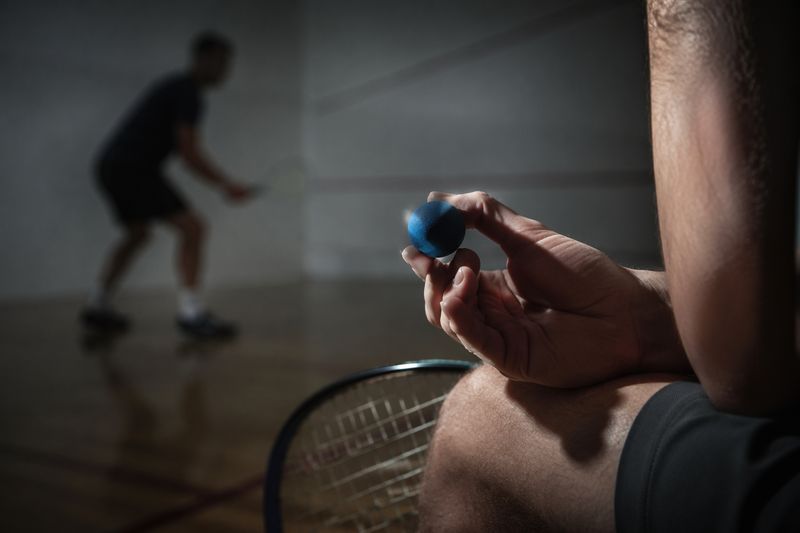
An official racquetball is 2-1/4 inches in diameter, weighs about 1.4 ounces, has a hardness of 55-60 durometers, and must bounce 68-72 inches from a 100-inch drop at 70-74 degrees Fahrenheit under International Racquetball Federation standards.
The spec sheet is the sport’s speed limit
Racquetball’s official ball is built to work with a 40-foot by 20-foot by 20-foot court, where the IRF puts top shots above 150 mph. That kind of velocity is not just about elite racquet skills, because the ball’s size and mass control how easily it can be accelerated off the strings and how much pace it carries after contact.
Diameter and weight matter because they shape how quickly the ball gets moving and how much effort it takes to change direction under pressure. A ball built to the official standard can be driven hard, but it still gives defenders a chance to read the next bounce if the court and temperature are consistent.
Hardness and bounce decide how the ball behaves after contact
The official hardness range and rebound requirement are the real tells for how “live” a ball feels once it leaves the wall or floor. Harder balls usually rebound more briskly, while softer balls tend to absorb more of the strike and play heavier. In racquetball, that changes how aggressively a player can pinch a corner and how much time a defender has to recover from a drive serve.
The bounce test turns feel into a measurable standard. If the rebound lands inside the official range from a 100-inch drop, the ball is close enough to the sport’s preferred playing characteristics to be considered official.
Temperature is part of the rulebook, not a side note
Racquetball is an indoor sport, but indoor does not mean uniform. The IRF ties the bounce standard to that temperature window because the ball reacts differently as the room changes around it. Colder air can make the ball play dead, while warmer conditions make it rebound more aggressively, and that changes rally speed, shot selection, and how much control players have off the back wall.
That is why warm-up routines matter so much at clubs and tournaments. Players are not just hitting balls to loosen up; they are trying to bring the ball and the court into a playable range where the rebound is predictable. Tournament organizers care for the same reason, because a court that is too cold or a ball that is not properly warmed can tilt a match before the first rally settles into rhythm.
Legal balls are about endorsement, not just branding
Any ball carrying the IRF endorsement stamp of approval is an official ball. A familiar brand name does not automatically make a ball legal for sanctioned play.
Penn Racquet Sports fits into that larger market as one of the major equipment names tied to racquetball products. But the spec sheet and the endorsement stamp, not the logo on the package, determine whether a ball is legal. In practice, players and coaches use those standards to choose balls that meet the official rebound profile, while tournament staff use them to reduce the kind of match-day argument that starts with, “this ball feels off.”
Why the numbers shape tactics, not just compliance
Ball specs shape pace, defense, and shot choice by determining how much life the ball has after it hits the strings, the front wall, or the floor. When the ball rebounds cleanly and consistently, aggressive drives and quick counterattacks become more viable; when it plays flat, rallies slow and the margin for precision shrinks.
That is why “ball feel” is such a real phrase in racquetball circles. Experienced players can sense when a ball is in the sweet spot of speed and rebound, and they adjust their pace of play accordingly.
A sport built around the ball and the court together
Joseph Sobek invented modern racquetball in 1949 and 1950 by adapting paddleball with a stringed racquet. He built a game where ball-and-court interaction sat at the center of the action. The sport developed in the early 1960s as an alternate winter workout for tennis players.
The governing structure later gave that design an international framework. The International Racquetball Federation was formed in 1979 with 13 national federations across four continents, was recognized by the International Olympic Committee in 1985, and was one of the charter members of The World Games in 1981, when the event was held in Santa Clara, California.